

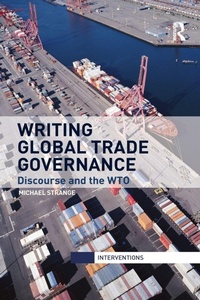
Writing Global Trade Governance
Discourse and the WTO
1st Edition
Published on 27. February 2017
Book
Paperback/Softback
224 pages
978-1-138-89670-3 (ISBN)
Description
Writing Global Trade Governance operationalises a key post-structuralist methodology in order to expand understanding on the institution at the heart of the global political economy. Despite the WTO's centrality and the growing popularity of methods utilizing discourse theory, no other text has yet demonstrated how these two fields of learning can be productively combined. The book seeks to move beyond existing literatures that assume the WTO to be a structure, institution or normative framework, in order to enquire into the discursive processes of identity formation that make the WTO both possible and contested.
The book criticises conventional approaches that treat critical civil society as distinct to the WTO, arguing instead that it is only through including such social practices within the field of relations making the WTO that we can properly understand what makes the WTO work. The book presents an empirical analysis of the discursive character of the present-day WTO (including its formation and operation) and then moves on to evaluate how it is subject to change within a broader social context. The final stage of the book seeks to discuss the impact of the findings on future research, both on the WTO and other institutions.
This work is a significant intervention in the literature on the World Trade Organization and the politics of global trade and social movements, and will be of great interest to students and scholars of global governance, discourse theory and international organizations
The book criticises conventional approaches that treat critical civil society as distinct to the WTO, arguing instead that it is only through including such social practices within the field of relations making the WTO that we can properly understand what makes the WTO work. The book presents an empirical analysis of the discursive character of the present-day WTO (including its formation and operation) and then moves on to evaluate how it is subject to change within a broader social context. The final stage of the book seeks to discuss the impact of the findings on future research, both on the WTO and other institutions.
This work is a significant intervention in the literature on the World Trade Organization and the politics of global trade and social movements, and will be of great interest to students and scholars of global governance, discourse theory and international organizations
Reviews / Votes
More details
Series
Language
English
Place of publication
London
United Kingdom
Publishing group
Taylor & Francis Ltd
Target group
College/higher education
Product notice
Paperback (trade)
Dimensions
Height: 234 mm
Width: 156 mm
Thickness: 12 mm
Weight
322 gr
ISBN-13
978-1-138-89670-3 (9781138896703)
Copyright in bibliographic data and cover images is held by Nielsen Book Services Limited or by the publishers or by their respective licensors: all rights reserved.
Schweitzer Classification
Other editions
Additional editions
E-Book
08/2013
1st Edition
Routledge
€61.99
Available for download
E-Book
08/2013
1st Edition
Routledge
€61.99
Available for download
Book
08/2013
1st Edition
Routledge
€231.60
Shipment within 15-20 days
Person
Michael Strange is a Reader (Docent) in International Relations, Dept. of Global Political Studies, Malmoe University, Sweden.
Content
Introduction: Embedding the World Trade Organization 2. Contesting Global Trade Governance - A Genealogy 3. The WTO as an Uncertain Political Project 4. The Emergence of New Actors in the WTO - the 'NGO' Identity 5. The Formation of New Actors Contesting the WTO - 6. Conclusion: The Discursivity of Global Trade Governance