

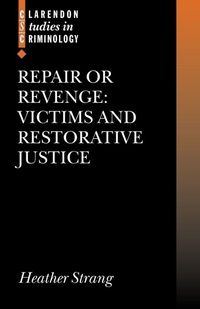
Repair or Revenge
Victims and Restorative Justice
Published on 30. September 2004
Book
Paperback/Softback
320 pages
978-0-19-927429-1 (ISBN)
Description
This book addresses the role of victims in our criminal justice system and the shortcomings they perceive in the way they are treated. It examines whether restorative justice can offer them more justice than they receive from the formal court-based system.
Research into the shortcomings of the court-based system has identified a number of issues that victims want to address. In brief, they want a less formal process where their views count, more information about both the processing and the outcome of their case, a greater opportunity for participation in the way their case is dealt with, fairer and more respectful treatment, and emotional as well as material restoration as an outcome. Over the past three decades, the victim movement worldwide has agitated for an enhanced role for victims in criminal justice. Despite some successes, it appears that structural as well as political factors may mean that victims have won as much as they are likely to gain from formal justice.
A series of randomized controlled trials in Canberra, known as the Reintegrative Shaming Experiments (RISE), has provided an opportunity to compare rigorously the impact on victims of court-based justice with a restorative justice program known as conferencing. In these experiments, middle-range property and violent offences committed by young offenders were assigned either to court (as they would normally have been treated) or to a conference.
Empirical evidence from RISE examined in this book suggests that the restorative alternative of conferencing more often than court has the capacity to give victims what they say they want in achieving meaningful victim participation and restoration, especially emotional restoration.
Research into the shortcomings of the court-based system has identified a number of issues that victims want to address. In brief, they want a less formal process where their views count, more information about both the processing and the outcome of their case, a greater opportunity for participation in the way their case is dealt with, fairer and more respectful treatment, and emotional as well as material restoration as an outcome. Over the past three decades, the victim movement worldwide has agitated for an enhanced role for victims in criminal justice. Despite some successes, it appears that structural as well as political factors may mean that victims have won as much as they are likely to gain from formal justice.
A series of randomized controlled trials in Canberra, known as the Reintegrative Shaming Experiments (RISE), has provided an opportunity to compare rigorously the impact on victims of court-based justice with a restorative justice program known as conferencing. In these experiments, middle-range property and violent offences committed by young offenders were assigned either to court (as they would normally have been treated) or to a conference.
Empirical evidence from RISE examined in this book suggests that the restorative alternative of conferencing more often than court has the capacity to give victims what they say they want in achieving meaningful victim participation and restoration, especially emotional restoration.
Reviews / Votes
...undoubtedly the most scientifically balanced study to focus entirely on victim-oriented expectations and outcomes as a result of restorative justice interventions...an important addition to the empirical and theoretical literature on restorative justice. * Russ Immarigeon, Victim Offender Mediation Association (USA) * ...Strang goes beyond the simple assessment of 'satisfaction' to the value of the informal proceedings as well as the outcome... this research shows that while we should not claim too much or raise expectations too far, good quality restorative justice apparently gives victims more of what they want than the conventional process. * Martin Wright, University of Sussex, British Journal of Criminology *More details
Series
Language
English
Place of publication
Oxford
United Kingdom
Target group
Professional and scholarly
Illustrations
numerous graphs, tables and 3 line drawings
Dimensions
Height: 216 mm
Width: 140 mm
Thickness: 19 mm
Weight
453 gr
ISBN-13
978-0-19-927429-1 (9780199274291)
Copyright in bibliographic data and cover images is held by Nielsen Book Services Limited or by the publishers or by their respective licensors: all rights reserved.
Schweitzer Classification
Other editions
Additional editions
Book
11/2002
Oxford University Press
€149.90
Shipment within 15-20 days
Person
Dr Heather Strang is Director of the Centre for Restorative Justice and a Fellow at the Research School of Social Sciences, Australian National University.
Content
1. The Victim in Criminal Justice ; 2. Victims of Crime and the Victim Movement ; 3. The Theory and Practice of Restorative Justice ; 4. The Reintegrative Shaming Experiments: Research Design and Methodology ; 5. The Lived Experience of Victims: How Restorative Justice Worked in Canberra ; 6. Victim Satisfaction with the Restorative Alternative ; 7. Victims and Offenders: A Relational Analysis ; 8. Conclusion