

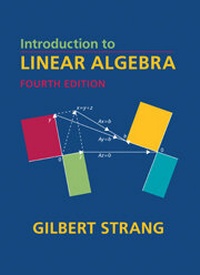
Introduction to Linear Algebra
4th Edition
Published on 10. February 2009
Book
Hardback
585 pages
978-0-9802327-1-4 (ISBN)
Description
This leading textbook for first courses in linear algebra comes from the hugely experienced MIT lecturer and author Gilbert Strang. The book's tried and tested approach is direct, offering practical explanations and examples, while showing the beauty and variety of the subject. Unlike most other linear algebra textbooks, the approach is not a repetitive drill. Instead it inspires an understanding of real mathematics. The book moves gradually and naturally from numbers to vectors to the four fundamental subspaces. This new edition includes challenge problems at the end of each section. Preview five complete sections at math.mit.edu/linearalgebra. Readers can also view freely available online videos of Gilbert Strang's 18.06 linear algebra course at MIT, via OpenCourseWare (ocw.mit.edu), that have been watched by over a million viewers. Also on the web (http://web.mit.edu/18.06/www/), readers will find years of MIT exam questions, MATLAB help files and problem sets to practise what they have learned.
More details
Edition
4th Revised edition
Language
English
Place of publication
Wellesley
United States
Target group
College/higher education
Edition type
Revised edition
Dimensions
Height: 238 mm
Width: 198 mm
Thickness: 30 mm
Weight
1160 gr
ISBN-13
978-0-9802327-1-4 (9780980232714)
Copyright in bibliographic data and cover images is held by Nielsen Book Services Limited or by the publishers or by their respective licensors: all rights reserved.
Schweitzer Classification
Other editions
New editions
Gilbert Strang
Introduction to Linear Algebra
Book
01/2023
6th Edition
Wellesley-Cambridge Press,U.S.
€93.00
Article is exhausted; no reprint
Gilbert Strang
Introduction to Linear Algebra
Book
06/2021
5th Edition
Wellesley-Cambridge Press,U.S.
€112.84
Article exhausted; check for reprint
Gilbert Strang
Introduction to Linear Algebra
Book
08/2016
5th Edition
Wellesley-Cambridge Press,U.S.
€116.55
Article exhausted; check for reprint
Person
Content
1. Introduction to Vectors: 1.1 Vectors and linear combinations; 1.2 Lengths and dot products; 1.3 Matrices; 2. Solving Linear Equations: 2.1 Vectors and linear equations; 2.2 The idea of elimination; 2.3 Elimination using matrices; 2.4 Rules for matrix operations; 2.5 Inverse matrices; 2.6 Elimination = factorization: A = LU; 2.7 Transposes and permutations; 3. Vector Spaces and Subspaces: 3.1 Spaces of vectors; 3.2 The nullspace of A: solving Ax = 0; 3.3 The rank and the row reduced form; 3.4 The complete solution to Ax = b; 3.5 Independence, basis and dimension; 3.6 Dimensions of the four subspaces; 4. Orthogonality: 4.1 Orthogonality of the four subspaces; 4.2 Projections; 4.3 Least squares approximations; 4.4 Orthogonal bases and Gram-Schmidt; 5. Determinants: 5.1 The properties of determinants; 5.2 Permutations and cofactors; 5.3 Cramer's rule, inverses, and volumes; 6. Eigenvalues and Eigenvectors: 6.1 Introduction to eigenvalues; 6.2 Diagonalizing a matrix; 6.3 Applications to differential equations; 6.4 Symmetric matrices; 6.5 Positive definite matrices; 6.6 Similar matrices; 6.7 Singular value decomposition (SVD); 7. Linear Transformations: 7.1 The idea of a linear transformation; 7.2 The matrix of a linear transformation; 7.3 Diagonalization and the pseudoinverse; 8. Applications: 8.1 Matrices in engineering; 8.2 Graphs and networks; 8.3 Markov matrices, population, and economics; 8.4 Linear programming; 8.5 Fourier series: linear algebra for functions; 8.6 Linear algebra for statistics and probability; 8.7 Computer graphics; 9. Numerical Linear Algebra: 9.1 Gaussian elimination in practice; 9.2 Norms and condition numbers; 9.3 Iterative methods for linear algebra; 10. Complex Vectors and Matrices: 10.1 Complex numbers; 10.2 Hermitian and unitary matrices; 10.3 The fast Fourier transform; Solutions to selected exercises; Matrix factorizations; Conceptual questions for review; Glossary: a dictionary for linear algebra; Index; Teaching codes.