

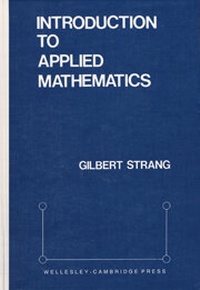
Introduction to Applied Mathematics
Will be published approx. on 1. January 1986
Book
Hardback
760 pages
978-0-9614088-0-0 (ISBN)
Description
Renowned applied mathematician Gilbert Strang teaches applied mathematics with the clear explanations, examples and insights of an experienced teacher. This book progresses steadily through a range of topics from symmetric linear systems to differential equations to least squares and Kalman filtering and optimization. It clearly demonstrates the power of matrix algebra in engineering problem solving. This is an ideal book (beloved by many readers) for a first course on applied mathematics and a reference for more advanced applied mathematicians. The only prerequisite is a basic course in linear algebra.
More details
Language
English
Place of publication
Wellesley
United States
Target group
Professional and scholarly
Dimensions
Height: 243 mm
Width: 169 mm
Thickness: 40 mm
Weight
1230 gr
ISBN-13
978-0-9614088-0-0 (9780961408800)
Copyright in bibliographic data and cover images is held by Nielsen Book Services Limited or by the publishers or by their respective licensors: all rights reserved.
Schweitzer Classification
Person
Content
1. Symmetric Linear Systems: 1.1 Introduction; 1.2 Gaussian elimination; 1.3 Positive definite matrices; 1.4 Minimum principles; 1.5 Eigenvalues and dynamical systems; 1.6 A review of matrix theory; 2. Equilibrium Equations: 2.1 A framework for the applications; 2.2 Constraints and Lagrange multipliers; 2.3 Electrical networks; 2.4 Structures in equilibrium; 2.5 Least squares estimation and the Kalman filter; 3. Equilibrium in the Continuous Case: 3.1 One-dimensional problems; 3.2 Differential equations of equilibrium; 3.3 Laplace's equation and potential flow; 3.4 Vector calculus in three dimensions; 3.5 Equilibrium of fluids and solids; 3.6 Calculus of variations; 4. Analytical Methods: 4.1 Fourier series and orthogonal expansions; 4.2 Discrete Fourier series and convolution; 4.3 Fourier integrals; 4.4 Complex variables and conformal mapping; 4.5 Complex integration; 5. Numerical Methods: 5.1 Linear and nonlinear equations; 5.2 Orthogonalization and eigenvalue problems; 5.3 Semi-direct and iterative methods; 5.4 The finite element method; 5.5 The fast Fourier transform; 6. Initial-Value Problems: 6.1 Ordinary differential equations; 6.2 Stability and the phase plane and chaos; 6.3 The Laplace transform and the z-transform; 6.4 The heat equation vs. the wave equation; 6.5 Difference methods for initial-value problems; 6.6 Nonlinear conservation laws; 7. Network Flows and Combinatorics: 7.1 Spanning trees and shortest paths; 7.2 The marriage problem; 7.3 Matching algorithms; 7.4 Maximal flow in a network; 8. Optimization: 8.1 Introduction to linear programming; 8.2 The simplex method and Karmarkar's method; 8.3 Duality in linear programming; 8.4 Saddle points (minimax) and game theory; 8.5 Nonlinear optimization; Software for scientific computing; References and acknowledgements; Solutions to selected exercises; Index.