

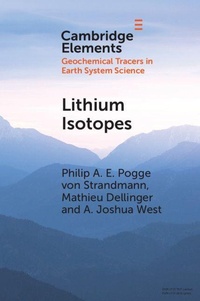
Lithium Isotopes
A Tracer of Past and Present Silicate Weathering
Published on 26. August 2021
Book
Paperback/Softback
34 pages
978-1-108-96496-8 (ISBN)
Description
Lithium isotopes are a relatively novel tracer of present and past silicate weathering processes. Given that silicate weathering is the primary long-term method by which CO2 is removed from the atmosphere, Li isotope research is going through an exciting phase. We show the weathering processes that fractionate dissolved and sedimentary Li isotope ratios, focusing on weathering intensity and clay formation. We then discuss the carbonate and silicate archive potential of past seawater ?7Li. These archives have been used to examine Li isotope changes across both short and long timescales. The former can demonstrate the rates at which the climate is stabilised from perturbations via weathering, a fundamental piece of the puzzle of the long-term carbon cycle.
More details
Series
Language
English
Place of publication
Cambridge
United Kingdom
Target group
Professional and scholarly
Product notice
Paperback (trade)
Illustrations
Worked examples or Exercises
Dimensions
Height: 229 mm
Width: 152 mm
Thickness: 2 mm
Weight
67 gr
ISBN-13
978-1-108-96496-8 (9781108964968)
Copyright in bibliographic data and cover images is held by Nielsen Book Services Limited or by the publishers or by their respective licensors: all rights reserved.
Schweitzer Classification
Other editions
Additional editions
E-Book
08/2021
Cambridge University Press
€15.49
Available for download
Philip A. E. Pogge von Strandmann | Mathieu Dellinger | A. Joshua West
Lithium Isotopes
A Tracer of Past and Present Silicate Weathering
E-Book
08/2021
Cambridge University Press
€15.49
Available for download
Persons
Content
Introduction; 1. Lithium isotopes as a tracer of silicate weathering intensity; 2. Methods and archive materials; 3. Li isotopes in pre-Cenozoic archives; 4. Developing a mechanistic understanding of Li isotope fractionation; 5. Future prospects.