

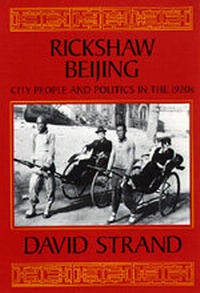
Rickshaw Beijing
City People and Politics in the 1920s
1st Edition
Published on 27. April 1993
Book
Paperback/Softback
388 pages
978-0-520-08286-1 (ISBN)
Description
In the 1920s, revolution, war, and imperialist aggression brought chaos to China. Many of the dramatic events associated with this upheaval took place in or near China's cities. Bound together by rail, telegraph, and a shared urban mentality, cities like Guangzhou, Shanghai, and Beijing formed an arena in which the great issues of the day--the quest for social and civil peace, the defense of popular and national sovereignty, and the search for a distinctively modern Chinese society--were debated and fought over. People were drawn into this conflicts because they knew that the passage of armies, the marching of protesters, the pontificating of intellectual, and the opening and closing of factories could change their lives. David Strand offers a penetrating view of the old walled capital of Beijing during these years by examining how the residents coped with the changes wrought by itinerant soldiers and politicians and by the accelerating movement of ideas, capital, and technology.
By looking at the political experiences of ordinary citizens, including rickshaw pullers, policemen, trade unionists, and Buddhist monks, Strand provides fascinating insights into how deeply these forces were felt. The resulting portrait of early twentieth-century Chinese urban society stresses the growing political sophistication of ordinary people educated by mass movements, group politics, and participation in a shared, urban culture that mixed opera and demonstrations, newspaper reading and teahouse socializing. Surprisingly, in the course of absorbing new ways of living, working, and doing politics, much of the old society was preserved--everything seemed to change and yet little of value was discarded. Through tumultuous times, Beijing rose from a base of local and popular politics to form a bridge linking a traditional world of guilds and gentry elites with the contemporary world of corporatism and cadres.
By looking at the political experiences of ordinary citizens, including rickshaw pullers, policemen, trade unionists, and Buddhist monks, Strand provides fascinating insights into how deeply these forces were felt. The resulting portrait of early twentieth-century Chinese urban society stresses the growing political sophistication of ordinary people educated by mass movements, group politics, and participation in a shared, urban culture that mixed opera and demonstrations, newspaper reading and teahouse socializing. Surprisingly, in the course of absorbing new ways of living, working, and doing politics, much of the old society was preserved--everything seemed to change and yet little of value was discarded. Through tumultuous times, Beijing rose from a base of local and popular politics to form a bridge linking a traditional world of guilds and gentry elites with the contemporary world of corporatism and cadres.
More details
Edition
First Edition
Language
English
Place of publication
Berkerley
United States
Target group
College/higher education
Professional and scholarly
Product notice
Paperback (trade)
Illustrations
1 frontisp., 25 illustrations
Dimensions
Height: 229 mm
Width: 152 mm
Thickness: 23 mm
Weight
544 gr
ISBN-13
978-0-520-08286-1 (9780520082861)
Copyright in bibliographic data and cover images is held by Nielsen Book Services Limited or by the publishers or by their respective licensors: all rights reserved.
Schweitzer Classification
Other editions
Additional editions
E-Book
04/2023
1st Edition
Naval Institute Press
€32.99
Available for download
Person
David Strand is Associate Professor of Political Science at Dickinson College.
Content
List of Illustrations
Preface
Acknowledgments
A Note on Romanization and Currency
I. A Twentieth-Century Walled City
2. The Rickshaw: Machine for a Mixed-up Age
3. Rickshaw Men: Careers of the Laboring Poor
4? Policemen as Mediators and Street-Level ~ureaucrats
5? Jeweler, Banker, and Restaurateur:
Power Struggles in the Beijing Chamber of Commerce
6. Profits and People's Livelihood:
The Politics of Streetcar Development
7? Bosses, Guilds, and Work Gangs:
Labor Politics and the Sprouts of Unionism
8. Citizens in a New Public Sphere:
Widening Circles of Political Participation
9? City People Under Siege:
The Impact of Warlordism
IO. Union and Faction:
Organized Labor in the Wake of the Northern Expedition
11. Machine-Breakers:
The Streetcar Riot of October 22, I929
I2. Order and Movement in City Politics
Notes
Bibliography
Index
Preface
Acknowledgments
A Note on Romanization and Currency
I. A Twentieth-Century Walled City
2. The Rickshaw: Machine for a Mixed-up Age
3. Rickshaw Men: Careers of the Laboring Poor
4? Policemen as Mediators and Street-Level ~ureaucrats
5? Jeweler, Banker, and Restaurateur:
Power Struggles in the Beijing Chamber of Commerce
6. Profits and People's Livelihood:
The Politics of Streetcar Development
7? Bosses, Guilds, and Work Gangs:
Labor Politics and the Sprouts of Unionism
8. Citizens in a New Public Sphere:
Widening Circles of Political Participation
9? City People Under Siege:
The Impact of Warlordism
IO. Union and Faction:
Organized Labor in the Wake of the Northern Expedition
11. Machine-Breakers:
The Streetcar Riot of October 22, I929
I2. Order and Movement in City Politics
Notes
Bibliography
Index