

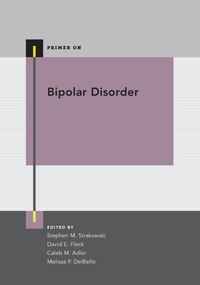
Bipolar Disorder
Published on 9. April 2020
Book
Paperback/Softback
336 pages
978-0-19-090809-6 (ISBN)
Description
Bipolar disorder is among the most common conditions affecting humankind and one of the leading causes of disability worldwide. It is a complex and dynamic psychiatric condition that makes it difficult to both understand and manage. However, with good management, people affected by bipolar disorder can lead very successful lives. This book was written specifically with new psychiatrists and mental health practitioners in mind to facilitate their ability to care for this condition. Chapters review clinical presentation and epidemiology, etiology and neurobiology, and treatment of bipolar disorder.
Reviews / Votes
This book is an easy-to-read overview of bipolar disorder, appropriate for the population for which it is intended. It provides a good review of current literature in this area ... [and is] a good read for residents and young psychiatrists just starting clinical practice. * Michael Easton, Doodys Book Reviews *More details
Series
Language
English
Place of publication
New York
United States
Target group
Professional and scholarly
Dimensions
Height: 254 mm
Width: 178 mm
Thickness: 18 mm
Weight
626 gr
ISBN-13
978-0-19-090809-6 (9780190908096)
Copyright in bibliographic data and cover images is held by Nielsen Book Services Limited or by the publishers or by their respective licensors: all rights reserved.
Schweitzer Classification
Other editions
Additional editions
Stephen M. Strakowski | Melissa P. DelBello | Caleb M. Adler
Bipolar Disorder
E-Book
01/2020
1st Edition
OUP eBook
€69.99
Available for download
Stephen M. Strakowski | Melissa P. DelBello | Caleb M. Adler
Bipolar Disorder
E-Book
01/2020
1st Edition
OUP eBook
€69.99
Available for download
Persons
Stephen M. Strakowski, MD, is Acting Senior Associate Dean for Research, and Associate Vice President, Regional Mental Health and Founding Chair and Professor of Psychiatry at Dell Medical School, University of Texas. Previously, he spent 24 years at the University of Cincinnati, serving most recently as Senior Vice President of Strategy in the health system. He is an internationally recognized expert in the management of bipolar disorders, as a Best Doctor (R) and by US News and World Report (R) as a Top 1% Psychiatrist. His research focuses on the brain changes that occur at the onset of bipolar disorder.
David E. Fleck, PhD, is Associate Professor of Psychiatry and Behavioral Neuroscience at the University of Cincinnati (UC) where he serves as Director of the Neuropsychology Section of the Division of Bipolar Disorders Research and as a member of the Neuroscience Graduate Program faculty. He also serves as Program Evaluator for the Trauma Recovery Center at the Cincinnati Veterans
Administration Medical Center. Dr. Fleck is a respected clinical and translational mood disorders researcher in neuropsychology, MRI, and outcomes research.
Caleb Alder, MD, is a board certified psychiatrist with clinical privileges at the University of Cincinnati Medical Center. A professor in the Department of Psychiatry and Behavioral Neuroscience, Dr. Adler is the vice-chair for clinical research and co-directs the Division of Bipolar Disorders Research. Dr. Alder's research focuses on the treatment for, and the neuropathophysiology of, bipolar and related disorders.
Melissa DelBello, MD, MS, is a nationally recognized expert on child and adolescent mood disorders. She has lectured and published extensively on bipolar disorder and served as principal or co-investigator of several NIH grants. She has served as professor and chair of the Department of Psychiatry and Behavioral Neuroscience at the University of Cincinnati since 2014.
David E. Fleck, PhD, is Associate Professor of Psychiatry and Behavioral Neuroscience at the University of Cincinnati (UC) where he serves as Director of the Neuropsychology Section of the Division of Bipolar Disorders Research and as a member of the Neuroscience Graduate Program faculty. He also serves as Program Evaluator for the Trauma Recovery Center at the Cincinnati Veterans
Administration Medical Center. Dr. Fleck is a respected clinical and translational mood disorders researcher in neuropsychology, MRI, and outcomes research.
Caleb Alder, MD, is a board certified psychiatrist with clinical privileges at the University of Cincinnati Medical Center. A professor in the Department of Psychiatry and Behavioral Neuroscience, Dr. Adler is the vice-chair for clinical research and co-directs the Division of Bipolar Disorders Research. Dr. Alder's research focuses on the treatment for, and the neuropathophysiology of, bipolar and related disorders.
Melissa DelBello, MD, MS, is a nationally recognized expert on child and adolescent mood disorders. She has lectured and published extensively on bipolar disorder and served as principal or co-investigator of several NIH grants. She has served as professor and chair of the Department of Psychiatry and Behavioral Neuroscience at the University of Cincinnati since 2014.
Editor
Founding Chair, Department of PsychiatryFounding Chair, Department of Psychiatry, Dell Medical School, University of Texas, Ausitin
Professor of Psychiatry and Pediatrics, Dr. Stanley and Mickey Kaplan Professor and Chair of the Department of Psychiatry and Behavioral Neuroscience, and Co-Director of the Division of Bipolar Disorders ResearchProfessor of Psychiatry and Pediatrics, Dr. Stanley and Mickey Kaplan Professor and Chair of the Department of Psychiatry and Behavioral Neuroscience, and Co-Director of the Division of Bipolar Disorders Research, University of Cincinnati College of Medicine
Professor and Vice Chair of Research, Co-Director of Bipolar Disorders Research, Department of PsychiatryProfessor and Vice Chair of Research, Co-Director of Bipolar Disorders Research, Department of Psychiatry, University of Cincinnati College of Medicine
Research Associate Professor of Psychiatry and Behavioral Neurosicence,Research Associate Professor of Psychiatry and Behavioral Neurosicence,, University of Cincinnati College of Medicine
Series Editor
Content
Introduction and Overview
Section 1: Clinical Presentation & Epidemiology of Bipolar Disorder
1. Clinical presentation: Bipolar disorder in DSM5, ICD10 and beyond
2. Course of bipolar illness
3. Epidemiology
4. Making a diagnosis: Differentiating bipolar disorder from other similar conditions
5. Comorbidity of bipolar and substance use disorders
6. Comorbidity of bipolar and other psychiatric disorders
7. Comorbidity of bipolar and medical disorders
Section 2: The Etiology and Neurobiology of Bipolar Disorder
8. The neurobiology of bipolar disorder: Clues from neuroimaging
9. The neurobiology of bipolar disorder: Neurotransmitter and other models
10. Cognitive models of bipolar disorder
11. Genetics of bipolar disorder
Section 3: Treating Bipolar Disorder
12. Psychopharmacologic treatments for bipolar disorder
13. Behavioral and psychotherapeutic treatments for bipolar disorder
14. Integrative medicine and lifestyle management in the treatment of bipolar disorder
15. Assessment tools
16. A programmatic approach to treatment
17. Psychopharmacologic treatments for bipolar disorder
18. Behavioral and psychotherapeutic treatments for bipolar disorder
19. Integrative medicine and lifestyle management in the treatment of bipolar disorder
20. Assessment tools
21. A programmatic approach to treatment
Section 1: Clinical Presentation & Epidemiology of Bipolar Disorder
1. Clinical presentation: Bipolar disorder in DSM5, ICD10 and beyond
2. Course of bipolar illness
3. Epidemiology
4. Making a diagnosis: Differentiating bipolar disorder from other similar conditions
5. Comorbidity of bipolar and substance use disorders
6. Comorbidity of bipolar and other psychiatric disorders
7. Comorbidity of bipolar and medical disorders
Section 2: The Etiology and Neurobiology of Bipolar Disorder
8. The neurobiology of bipolar disorder: Clues from neuroimaging
9. The neurobiology of bipolar disorder: Neurotransmitter and other models
10. Cognitive models of bipolar disorder
11. Genetics of bipolar disorder
Section 3: Treating Bipolar Disorder
12. Psychopharmacologic treatments for bipolar disorder
13. Behavioral and psychotherapeutic treatments for bipolar disorder
14. Integrative medicine and lifestyle management in the treatment of bipolar disorder
15. Assessment tools
16. A programmatic approach to treatment
17. Psychopharmacologic treatments for bipolar disorder
18. Behavioral and psychotherapeutic treatments for bipolar disorder
19. Integrative medicine and lifestyle management in the treatment of bipolar disorder
20. Assessment tools
21. A programmatic approach to treatment