

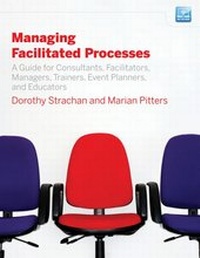
Managing Facilitated Processes
A Guide for Facilitators, Managers, Consultants, Event Planners, Trainers and Educators
1st Edition
Published on 27. March 2009
Book
Paperback/Softback
208 pages
978-0-470-18267-3 (ISBN)
Description
Managing Facilitated Processes
Managing Facilitated Processes helps people make thoughtful decisions about managing successful gatherings. The book's ten chapters are divided into three parts:
From Contact to Contract-building customized agreements; eighteentypes of facilitated processes, their deliverables and unique features
Approach and Style-ensuring integrated, customized, and systematic elements; a forget-me-not prompter; effective management styles
Management x 5: Participants, Speakers, Logistics, Documents,Feedback-practice guidelines, examples, and time-saving tools
Managing Facilitated Processes also includes a companion Web site with handy e-versions of the book's tools and templates.
Praise for Managing Facilitated Processes
"This book honors the importance of the details and care that every gathering deserves.It should be a standard reference?for people who come together to produce results."
-Peter Block, author of Community: The Structure of Belonging, and consultant and partner, Designed Learning, Ohio, USA
"The authors' combined experience of nearly 60 years in process facilitation is generously shared in this clearly written guide."
-Sharon Almerigi, certified professional facilitator (CPF), Barbados International Association of Facilitators, Latin America and the Caribbean
"In a world of 'expert-centered' workplaces, Managing Facilitated Processes offers a much-needed focus on the process of creating effective, customized environments for learning and work."
-Marilyn Laiken, professor and chair, Department of Adult Education and Counseling Psychology, The Ontario Institute for Studies in Education, University of Toronto, Canada
"A comprehensive and practical guide to making group sessions effective and outcome driven-great insights from cover to cover and a terrific 'go to' reference guide."
-Gabriella Zillmer, senior vice-president, Performance Alignment and Compensation, BMO Financial Group, Canada
"A time-saving gem for planning facilitated sessions effectively. It is unique in its thoroughness without being overwhelming. To be pulled off the shelf over and over again."
-Julie Larsen, associate adviser for social policy and development, United Nations Headquarters, New York, USA
More details
Product info
PB
Edition
1., Auflage
Language
English
Place of publication
New York
United States
Publishing group
John Wiley & Sons Inc
Target group
Professional and scholarly
Product notice
Paperback (trade)
Unsewn / adhesive bound
Illustrations
Drawings: 37 B&W, 0 Color; Tables: 0 B&W, 0 Color; Exhibits: 58 B&W, 0 Color
Dimensions
Height: 217 mm
Width: 278 mm
Thickness: 19 mm
Weight
677 gr
ISBN-13
978-0-470-18267-3 (9780470182673)
Schweitzer Classification
Other editions
Additional editions
Dorothy Strachan | Marian Pitters
Managing Facilitated Processes
A Guide for Facilitators, Managers, Consultants, Event Planners, Trainers and Educators
E-Book
04/2009
Jossey-Bass
€32.99
Available for download
Dorothy Strachan | Marian Pitters
Managing Facilitated Processes
A Guide for Facilitators, Managers, Consultants, Event Planners, Trainers and Educators
E-Book
03/2009
Jossey-Bass
€32.99
Available for download
Persons
Dorothy Strachan is a partner in Strachan-Tomlinson, a process consulting firm in Ottawa, Canada. She is the author of Making Questions Work and Process Design, both from Jossey-Bass.
Marian Pitters is the president of Pitters Associates, a management consulting firm located in Toronto, Canada.?She has authored a number of manuals on facilitation and public adjudication.
Content
Examples, Exhibits, and Tables.
Web Contents.
Acknowledgments.
About the Authors.
Introduction.
About This Book.
A Quick Lookup Resource.
PART 1: FROM CONTACT TO CONTRACT.
1. Initial Contact.
Completing a Preliminary Screen.
Coordinates: Date(s) and Location.
Purpose, Objectives, and Deliverables.
Process Leadership.
Eighteen Types of Processes.
Decision Making After the Screen.
Communicating a Decision.
2. Building Agreements That Work.
Types of Agreements.
Drafting Agreements.
Agreements in Action: Four Maxims.
1. Don't Start Work Without an Agreement.
2. Bring Fresh Eyes to Your Experience.
3. When in Doubt, Write It Out.
4. Cock-Ups Are Collaborative.
Work Plans and Cost Estimates.
Developing Work Plans.
Dealing with Pricing Perils.
Acting on Values.
PART 2: APPROACH AND STYLE.
3. Approach.
Integrated.
Customized.
Outcomes.
People.
Group Development.
Ethnocultural Considerations.
Literacy.
Organizational Culture.
Systematic.
Completing a Process Management Prompter.
Accountability.
The Approach in Action: Integrated, Customized, Systematic.
4. Style.
High-Tech Teddy.
Controlling Caroline.
Loosey-Goosey Lucy.
Overconsulting Oliver.
Anxious-to-Please Annie.
Bureaucratic Bill.
Optimizing Management Styles.
PART 3: MANAGEMENT X 5: PARTICIPANTS, SPEAKERS, LOGISTICS, DOCUMENTS, FEEDBACK.
5. Participants.
Clarify the Rationale for Participation.
Monitor the Mix and Number of Participants.
Consider Participant Types.
Gatekeep Participant Numbers.
Maintain a Participant Database.
Create the Invitations.
Persuade.
Inform.
Engage.
Determine the Focus.
Obtain Input and Feedback.
Write the Confirmation Letter.
6. Speakers.
Speaker Management.
Clarify Requirements.
Create Invitations.
Confirm Expectations.
Presentation Guidelines.
Opening Remarks.
Speaker Introductions and Acknowledgments.
Presentations by Experts.
Presentations by Panels.
Closing Remarks.
7. Logistics.
Select and Set Up the Site.
Venue.
Layout.
Health, Safety, and Security.
Technical and Audiovisual Support.
Enable Participant Engagement.
Accommodating Differences.
Identification.
Accessibility.
Mobilize Yourself.
Professional Supplies.
Travel Arrangements.
Personal Amenities.
Love those Logistical Letdowns!.
8. Documents.
Match the Documents to the Process.
Produce the Documents.
Make Documents Easy to Use.
Design Attractive Formats.
Customize Documents.
9. Feedback.
Review Feedback Approach and Tools.
Finalize and Produce Feedback Tools.
Construction.
Look, Feel, and Sound.
Sample Feedback Tools.
10. Endings and Beginnings.
For the Session.
For Yourself.
References.