

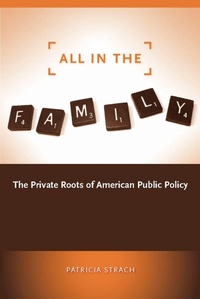
All in the Family
The Private Roots of American Public Policy
Published on 13. June 2007
Book
Paperback/Softback
264 pages
978-0-8047-5609-9 (ISBN)
Description
Even a casual observer of American politics might notice the importance of family in political rhetoric like the Republicans' "family values" and the Democrats' "working families," but we know surprisingly little about the role of family in American politics. We typically think of family as "private" and out of the public realm of politics or we associate family and public policy with so-called family policies, such as welfare or family leave. The goal of this book is to clarify the relationship between seemingly private family life and federal public policies. It asks two important questions: How do policymakers employ the concept of family in the policy process? And, what are the consequences of employing this concept broadly in public policy?
All in the Family is the first empirical study of family in the American policy process. It shows that, far from being "private" or only a part of "family policy," family is an important part of American policymaking even in seemingly "non-family" policies like immigration, tax, and agriculture. Policymakers rely on family to determine eligibility, distribute goods, and provide justification for their positions across a wide range of policies. Ultimately, this book shows that seemingly private life makes American public policy possible, and it suggests that the ability of policymakers to accomplish their goals is intimately tied to the strength and organization of American families. Yet, it also demonstrates that relying on a dynamic institution like family can have unintended consequences, potentially destabilizing policies over time.
All in the Family is the first empirical study of family in the American policy process. It shows that, far from being "private" or only a part of "family policy," family is an important part of American policymaking even in seemingly "non-family" policies like immigration, tax, and agriculture. Policymakers rely on family to determine eligibility, distribute goods, and provide justification for their positions across a wide range of policies. Ultimately, this book shows that seemingly private life makes American public policy possible, and it suggests that the ability of policymakers to accomplish their goals is intimately tied to the strength and organization of American families. Yet, it also demonstrates that relying on a dynamic institution like family can have unintended consequences, potentially destabilizing policies over time.
Reviews / Votes
"[Patricia Strach] does contribute to this grand narrative by exploring the intricate relationships between family and state in contemporary America and by examining how policymakers use the concept of the family in fashioning, promoting, and opposing particular programs. The careful balance between quantitative and qualitative methods, the effort to avoid an ideological vantage point, and the attempt to incorporate findings from public policy in other areas make this a valuable work." - Political Science Quarterly "Patricia Strach lucidly and persuasively contrasts the ideal of the family in public policy with the more complex and changing reality. The book will be of interest not only to political scientists but to those interested in gender and social policy, a burgeoning field of academic debate." - Cambridge Journal "Strach provides a wealth of new data that highlights the strategic use of family by policy makers as a rhetorical device in the policy process... [This] book will be valuable to researchers and graduate students who study public policy and the US Congress." - CHOICE "Strach gets beyond overheated political rhetoric and the so-called Culture Wars to examine how our conceptions of what families are and should be infuse many aspects of public policy, and to ask what happens to public policy when the structure and practice of family diverges from those expectations." - Christina Wolbrecht (University of Notre Dame) "This book brings family into the academic study of policy in a new way, with significant payoffs for both the study of how family functions as an institution connected to governance and for political science more generally." - Julie Novkov (University of Oregon)More details
Edition
New edition
Language
English
Place of publication
Palo Alto
United States
Target group
Adult education
Edition type
New edition
Product notice
Paperback (trade)
Illustrations
8 tables, 18 figures
Dimensions
Height: 226 mm
Width: 155 mm
Thickness: 14 mm
Weight
363 gr
ISBN-13
978-0-8047-5609-9 (9780804756099)
Copyright in bibliographic data and cover images is held by Nielsen Book Services Limited or by the publishers or by their respective licensors: all rights reserved.
Schweitzer Classification
Person
Patricia Strach is Assistant Professor of Political Science and Public Administration and Policy at the University at Albany, State University of New York.
Content
Contents List of Figures List of Tables Acknowledgments 1. Family and American Public Policy 2. Family in the Policy Process 3. Changing Social Practices, Changing Policy 4. Family Criteria in Immigration Policy 5. Taxing the Family 6. Rhetoric and Reality: The Family Farm 7. Conclusion Appendixes Notes Bibliography Index