

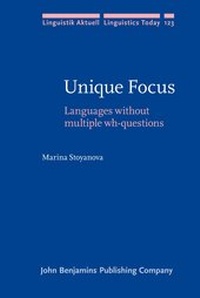
Unique Focus
Languages without multiple wh-questions
Published on 10. April 2008
Book
Hardback
184 pages
978-90-272-5506-8 (ISBN)
Description
This monograph focuses on an interesting typological property shared by four languages: the ungrammaticality of multiple wh-questions in Irish, Berber, Italian and Somali. It contains a broad discussion of data related to the grammar of wh-questions, a comparative analysis of wh-constructions in the four languages, and a theoretical account for the observed phenomenon. The analysis is based on the minimalist syntax theory as developed by Chomsky since 1995. It takes up the standard assumption that wh-phrases are typical representatives of elements bearing new information, in theoretical terms referred to as information focus. Most importantly, in the languages without multiple wh-questions the information focus is licensed in a unique syntactic position. The basic claim is that languages with unique focus are languages without multiple wh-questions. The analysis makes possible the classification of the languages without multiple wh-questions into the crosslinguistic typology of wh-constructions. Furthermore, this book is a contribution to the better understanding of information structure in natural languages, especially of focusing phenomena.
More details
Series
Language
English
Place of publication
Amsterdam
Netherlands
Target group
Professional and scholarly
Dimensions
Height: 245 mm
Width: 164 mm
Weight
500 gr
ISBN-13
978-90-272-5506-8 (9789027255068)
Copyright in bibliographic data and cover images is held by Nielsen Book Services Limited or by the publishers or by their respective licensors: all rights reserved.
Schweitzer Classification
Other editions
Additional editions
E-Book
04/2008
1st Edition
John Benjamins Publishing Company
€144.99
Available for download
Person
Content
1. Acknowledgements; 2. Abbreviations; 3. Chapter 1. Introduction; 4. Chapter 2. Previous analyses of the ungrammaticality of multiple wh-questions; 5. Chapter 3. The overview: What is possible in which language?; 6. Chapter 4. Analysis; 7. Chapter 5. Conclusion; 8. Bibliography; 9. Index