

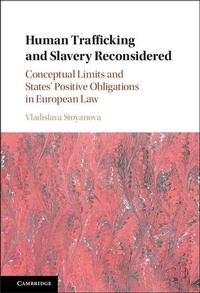
Human Trafficking and Slavery Reconsidered
Conceptual Limits and States' Positive Obligations in European Law
Published on 16. March 2017
Book
Hardback
514 pages
978-1-107-16228-0 (ISBN)
Description
By reconsidering the definitions of human trafficking, slavery, servitude and forced labour, Vladislava Stoyanova demonstrates how, in embracing the human trafficking framework, the international community has sidelined the human rights law commitments against slavery, servitude and forced labour that in many respects provide better protection for abused migrants. Stoyanova proposes two corrective steps to this development: placing a renewed emphasis on determining the definitional scope of slavery, servitude or forced labour, and gaining a clearer understanding of states' positive human rights obligations. This book compares anti-trafficking and human rights frameworks side-by-side and focuses its analysis on the Council of Europe's Trafficking Convention and Article 4 of the European Convention on Human Rights. With innovative arguments and pertinent case studies, this book is an important contribution to the field and will appeal to students, scholars and legal practitioners interested in human rights law, migration law, criminal law and EU law.
Reviews / Votes
'Vladislava Stoyonova's book is as intellectually courageous as it is meticulously researched. She effectively challenges the dominant discourse of human trafficking, showing that human rights are more effectively ensured by grappling with the modern meaning of slavery, servitude, and forced labour. This is a fine legal analysis, proving the wisdom of grounding advocacy in legal norms of indisputable authority.' James Hathaway, University of Michigan Law School 'The issue of trafficking in human beings and its relationship with slavery has risen to the top of political agendas around the world as border controls and movement of persons has become subject to increasing strict rules. This book takes the issue seriously and examines the development of anti-slavery and anti-trafficking legal frameworks and how they operate within the contours of state sovereignty claims. It is a magistral work which deserves to be read by anyone seeking to understand what trafficking and slavery mean in the 21st century.' Elspeth Guild, University of London and Radbound University Nijmegen, Netherlands 'Dr Stoyanova's book, based in part on her doctoral thesis, is a very important contribution to our understanding of the nature of states' obligations, particularly under the Council of Europe Convention on Action against Trafficking in Human Beings, to help, protect and support those who have been trafficked. Her critical analysis of these duties is superbly researched and clearly establishes her as a significant thinker and scholar in the debates on human trafficking.' Ryszard Piotrowicz, Aberystwyth University and Member of the Council of Europe Group of Experts on Action against Trafficking in Human Beings 'This provocative and timely book offers refined definitions of the three wrongs set out in Article 4 European Convention on Human Rights, slavery, servitude, forced labour, and considers states' positive obligations to ensure protection against these wrongs. Dr Stoyanova's intellectual ambition is in evidence in her meticulous analysis and argumentation, and in her novel legal arguments. She assesses prevailing interpretations of these legal terms, and where she finds them lacking, offers her own alternative interpretations. The book is broad in scope. As well as the European protections, it also integrates the international genealogy of these wrongs, and draws in other aspects of international law, including International Criminal Law, the InterAmerican Court's work on right to legal personality.' Cathryn Costello, Refugee Studies Centre, University of Oxford 'In conclusion, this book is a precious tool in aiding our understanding of the full range of obligations deriving from legal instruments dealing specifically with THB, on the one hand, and from human rights instruments more generally, on the other.' Nicolas Le Coz, International Journal of Refugee LawMore details
Language
English
Place of publication
Cambridge
United Kingdom
Target group
Professional and scholarly
Dimensions
Height: 235 mm
Width: 157 mm
Thickness: 32 mm
Weight
887 gr
ISBN-13
978-1-107-16228-0 (9781107162280)
Copyright in bibliographic data and cover images is held by Nielsen Book Services Limited or by the publishers or by their respective licensors: all rights reserved.
Schweitzer Classification
Other editions
Additional editions
Vladislava Stoyanova
Human Trafficking and Slavery Reconsidered
Conceptual Limits and States' Positive Obligations in European Law
Book
06/2018
Cambridge University Press
€60.90
Shipment within 15-20 days
Vladislava Stoyanova
Human Trafficking and Slavery Reconsidered
Conceptual Limits and States' Positive Obligations in European Law
E-Book
04/2017
Cambridge University Press
€35.49
Available for download
Vladislava Stoyanova
Human Trafficking and Slavery Reconsidered
Conceptual Limits and States' Positive Obligations in European Law
E-Book
03/2017
Cambridge University Press
€29.49
Available for download
Person
Vladislava Stoyanova is a postdoctoral fellow at the Faculty of Law, Lunds Universitet, Sweden. She is a lecturer in Migration Law and Human Rights Law and the director of the Migration Law course. She has published extensively in the field of human trafficking, slavery, migration law, refugee law and human rights law, and is an expert in Bulgarian migration and refugee law.
Content
1. Introduction; Part I. The Human Trafficking Legal Framework: 2. Origins, context and the currently valid law; 3. The definition of human trafficking in international law; 4. Positive obligations under the human trafficking legal framework; Part II. The Human Rights Law Framework: 5. The historical background; 6. Definitions with contemporary relevance; 7. The relationship between the concept of human trafficking and the concepts of slavery, servitude and forced labour; 8. Positive obligations under human rights law; 9. Conclusion.