

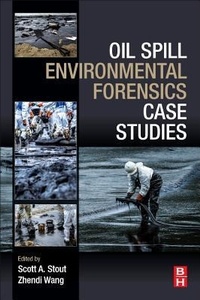
Oil Spill Environmental Forensics Case Studies
Published on 22. October 2017
Book
Paperback/Softback
860 pages
978-0-12-804434-6 (ISBN)
Description
Oil Spill Environmental Forensics Case Studies includes 34 chapters that serve to present various aspects of environmental forensics in relation to "real-world? oil spill case studies from around the globe. Authors representing academic, government, and private researcher groups from 14 countries bring a diverse and global perspective to this volume.
Oil Spill Environmental Forensics Case Studies addresses releases of natural gas/methane, automotive gasoline and other petroleum fuels, lubricants, vegetable oils, paraffin waxes, bitumen, manufactured gas plant residues, urban runoff, and, of course, crude oil, the latter ranging from light Bakken shale oil to heavy Canadian oil sands oil. New challenges surrounding forensic investigations of stray gas in the shallow subsurface, volatiles in air, dissolved chemicals in water (including passive samplers), and biological tissues associated with oil spills are included, as are the effects and long-term oil weathering, long-term monitoring in urbanized and non-urbanized environments, fate and transport, forensic historical research, new analytical and chemical data processing and interpretation methods.
Oil Spill Environmental Forensics Case Studies addresses releases of natural gas/methane, automotive gasoline and other petroleum fuels, lubricants, vegetable oils, paraffin waxes, bitumen, manufactured gas plant residues, urban runoff, and, of course, crude oil, the latter ranging from light Bakken shale oil to heavy Canadian oil sands oil. New challenges surrounding forensic investigations of stray gas in the shallow subsurface, volatiles in air, dissolved chemicals in water (including passive samplers), and biological tissues associated with oil spills are included, as are the effects and long-term oil weathering, long-term monitoring in urbanized and non-urbanized environments, fate and transport, forensic historical research, new analytical and chemical data processing and interpretation methods.
More details
Language
English
Place of publication
Woburn
United States
Publishing group
Elsevier - Health Sciences Division
Target group
Professional and scholarly
Environmental Engineers Marine Engineers, Petroleum Engineers and Environmental Scientists
Product notice
Paperback (trade)
Unsewn / adhesive bound
Dimensions
Height: 278 mm
Width: 220 mm
Thickness: 52 mm
Weight
2294 gr
ISBN-13
978-0-12-804434-6 (9780128044346)
Copyright in bibliographic data and cover images is held by Nielsen Book Services Limited or by the publishers or by their respective licensors: all rights reserved.
Schweitzer Classification
Other editions
Additional editions
Scott Stout | Zhendi Wang
Oil Spill Environmental Forensics Case Studies
E-Book
10/2017
Butterworth-Heinemann
€138.00
Available for download
Persons
Dr. Stout has more than 20 years of petroleum and coal industry experience. He specializes in chemical compositions of fuel-derived sources of contamination in terrestrial and marine environments, which includes crude oil, coal, gasoline and other substances. His research has been used for decision making by the United States Departments of Justice and Defense, and by the forest products, utility, railroad, wood treatment, maritime shipping, port operations, and oil and gas industries. Dr. Stout has authored or co-authored nearly 120 scientific papers and edited a textbook on the environmental forensics aspects of maritime oil spills. Dr. Zhendi Wang is a senior research scientist and Head of Oil Spill Research of Environment Canada, working in the oil and toxic chemical spill research field. His specialties and research interests include: development of oil spill fingerprinting and tracing technology, environmental forensics of oil spill; oil properties, fate and behavior of oil and other hazardous organics in the environment; oil burn emission and products study; oil bioremediation; identification and characterization of oil hydrocarbons; and, spill treatment studies; applications of modern analytical techniques (such as GC, GC/MS, HPLC, LC/MS, SFE and SFC, and IC) to oil spill studies and other environmental science and technology. Dr. Wang has continually and extensively led and been involved in various scientific projects, technology transfer, and national and international cooperative researches with the total funding over 3 million dollars. He has authored over 270 academic publications including 72 peer-reviewed articles and 4 invited reviews in the most respected journals in the environmental science and chemistry, and 8 books and book chapters. The productivity, excellence and achievements of Dr. Wang have established him as a national and international "leading authority on the topic?. He has won a number of national and international scientific honours and awards. Wang is also a member of America Chemical Society (ACS), the Canadian Society for Chemistry (CSC), and the International Society of Environmental Forensics.
Content
1. Critical Review of an inter-laboratory forensic dataset: Effects on data interpretation in oil spill studies
2. Fifty years of petroleum geochemistry: A valuable asset in petroleum environmental forensics
3. Fingerprinting Analysis and Source Differentiation of Petroleum-Contaminated Environmental Samples
4. Complexities in the application of isotope geochemistry to determine the origin of stray gases in the subsurface - case studies
5. Forensic aspects of airborne constituents following releases of crude oil into the environment
6. Combined Gas and Liquid Chromatography Tandem Mass Spectrometry Applications for Forensic Lubricant and Vegetable Oil Spill Identification
7. Environmental forensics study of crude oil and petroleum product spills in coastal and oilfield settings: Combined insights from conventional GC-MS, thermodesorption-GC-MS and pyrolysis-GC-MS
8. Paraffin Wax Spill Identification by GC-FID and GC-MS
9. Challenges and Mysteries in Oil Spill Fate and Transport
10. Unraveling the complexities of upland spilled fuels: Selected case studies
11. Advantages of Multi-dimensional Chemical Fingerprinting in Identifying the Source of Marine Oil Spills in Bohai Bay, China
12. Distinguishing genetically-similar diesel fuels in Taiwan using Principal Component Analysis of diagnostic ratios
13. Application of CEN Methodology in Evaluating Sources of Multiple Land-Based Fuel Spills in Alberta, Canada
14. Development and Application of Phase-Specific Methods in Oiled-Water Forensic Studies
15. Applications of the CEN Methodology in Multiple Oil Spills in Spanish Waters
16. Fingerprinting of Petroleum Hydrocarbons in Malaysia using Environmental Forensic Techniques: A 20-Year Field Data Review
17. Long-term monitoring study of beached oils around the Shetland Isles, United Kingdom
18. The Erika oil spill: 10 years monitoring program and effects of the weathering processes
19. Environmental Assessment of Spills Related to Oil Exploitation in Canada's Oil Sands Region
20. Chemical Fingerprinting Assessment of the Impact to River Sediments following the Bakken Crude Oil Train Derailment and Fire, Mount Carbon, West Virginia
21. The pixel based chemometric approach for source identification: Two case studies from the Persian Gulf
22. Use of Passive Samplers for PAH Forensics in Water from the Ottawa River, Ohio
23. Fingerprint and weathering characteristics of petroleum hydrocarbon in coastal zone after the "7-16? Dalian oil spill accident, China
24. Case study in the use of forensic history in matters involving pipeline ruptures
25. Comparison of quantitative and semi-quantitative methods in source identification following the OSPAR oil spill, in Parana, Brazil
26. Different forensic approaches for hydrocarbon source identification in an urban cluster environment: Guanabara Bay
27. Investigation of Hydrocarbon Sources and Biotechnologies Applications in Todos os Santos Bay, Brazil
28. Assessing the role of environmental conditions on the fate of oil following the Deepwater Horizon Spill
29. Using stable and radiocarbon analyses as a forensic tool to find evidence of oil in the particulates of the water column and on the seafloor following the 2010 Gulf of Mexico Oil Spill
30. Red Crabs as Sentinel Organisms of Deepwater Horizon Oil in Gulf of Mexico Deep-Sea Sediments
31. Modeling Distribution, Fate, and Concentrations of Deepwater Horizon Oil in the Gulf of Mexico in Subsurface Waters
32. Lousiana coastal marsh environments and MC252 oil biomarker chemistry
33. Novel biological exposures following the Deepwater Horizon oil spill revealed by chemical fingerprinting
34. Characterization of petroleum associated with manufactured gas plant residues and tars in sediments
2. Fifty years of petroleum geochemistry: A valuable asset in petroleum environmental forensics
3. Fingerprinting Analysis and Source Differentiation of Petroleum-Contaminated Environmental Samples
4. Complexities in the application of isotope geochemistry to determine the origin of stray gases in the subsurface - case studies
5. Forensic aspects of airborne constituents following releases of crude oil into the environment
6. Combined Gas and Liquid Chromatography Tandem Mass Spectrometry Applications for Forensic Lubricant and Vegetable Oil Spill Identification
7. Environmental forensics study of crude oil and petroleum product spills in coastal and oilfield settings: Combined insights from conventional GC-MS, thermodesorption-GC-MS and pyrolysis-GC-MS
8. Paraffin Wax Spill Identification by GC-FID and GC-MS
9. Challenges and Mysteries in Oil Spill Fate and Transport
10. Unraveling the complexities of upland spilled fuels: Selected case studies
11. Advantages of Multi-dimensional Chemical Fingerprinting in Identifying the Source of Marine Oil Spills in Bohai Bay, China
12. Distinguishing genetically-similar diesel fuels in Taiwan using Principal Component Analysis of diagnostic ratios
13. Application of CEN Methodology in Evaluating Sources of Multiple Land-Based Fuel Spills in Alberta, Canada
14. Development and Application of Phase-Specific Methods in Oiled-Water Forensic Studies
15. Applications of the CEN Methodology in Multiple Oil Spills in Spanish Waters
16. Fingerprinting of Petroleum Hydrocarbons in Malaysia using Environmental Forensic Techniques: A 20-Year Field Data Review
17. Long-term monitoring study of beached oils around the Shetland Isles, United Kingdom
18. The Erika oil spill: 10 years monitoring program and effects of the weathering processes
19. Environmental Assessment of Spills Related to Oil Exploitation in Canada's Oil Sands Region
20. Chemical Fingerprinting Assessment of the Impact to River Sediments following the Bakken Crude Oil Train Derailment and Fire, Mount Carbon, West Virginia
21. The pixel based chemometric approach for source identification: Two case studies from the Persian Gulf
22. Use of Passive Samplers for PAH Forensics in Water from the Ottawa River, Ohio
23. Fingerprint and weathering characteristics of petroleum hydrocarbon in coastal zone after the "7-16? Dalian oil spill accident, China
24. Case study in the use of forensic history in matters involving pipeline ruptures
25. Comparison of quantitative and semi-quantitative methods in source identification following the OSPAR oil spill, in Parana, Brazil
26. Different forensic approaches for hydrocarbon source identification in an urban cluster environment: Guanabara Bay
27. Investigation of Hydrocarbon Sources and Biotechnologies Applications in Todos os Santos Bay, Brazil
28. Assessing the role of environmental conditions on the fate of oil following the Deepwater Horizon Spill
29. Using stable and radiocarbon analyses as a forensic tool to find evidence of oil in the particulates of the water column and on the seafloor following the 2010 Gulf of Mexico Oil Spill
30. Red Crabs as Sentinel Organisms of Deepwater Horizon Oil in Gulf of Mexico Deep-Sea Sediments
31. Modeling Distribution, Fate, and Concentrations of Deepwater Horizon Oil in the Gulf of Mexico in Subsurface Waters
32. Lousiana coastal marsh environments and MC252 oil biomarker chemistry
33. Novel biological exposures following the Deepwater Horizon oil spill revealed by chemical fingerprinting
34. Characterization of petroleum associated with manufactured gas plant residues and tars in sediments