

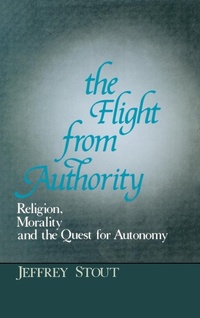
The Flight from Authority
Religion, Morality, and the Quest for Autonomy
Published on 15. July 1981
Book
Hardback
320 pages
978-0-268-00954-0 (ISBN)
Description
Jeffrey Stout argues that modern thought was born in a crisis of authority, took shape in flight from authority, and aspired to autonomy from all traditional influence. The quest for autonomy was an attempt to begin completely anew. As such it was bound to fail.
Stout traces the secularization of public discourse and its effect on the relation between theism and culture as well as the severance of morality from traditional moorings in favor of autonomy. He is unabashedly historical in his approach, defending the thesis that all thought is historically conditioned and that historical insight is essential to self-understanding.
Each section of the book takes up a major problem in contemporary philosophy - the nature of knowledge, the rationality of religious belief, the autonomy of morality- and sets that problem against the background of early modern disputes over authority. The result is simultaneously a critique of ahistorical biases, a survey of major developments in modern thought, and a normative treatment of the problems addressed.
The book culminates in the final section with an account of post-Kantian concern with the autonomy of morals. Morality attained relative independence as a form of discourse only in the modern period, but the nature of this independence is distorted when construed in foundationalist or Kantian terms. After criticizing methodological assumptions in recent moral philosophy and religious ethics, Stout sketches his own account of the emergence of autonomy for morality, stressing the need for substantial rethinking of the relationship between religion and ethics. In a concluding chapter, he places his own position in relation to the philosophical tradition descendant from Hegel.
Stout traces the secularization of public discourse and its effect on the relation between theism and culture as well as the severance of morality from traditional moorings in favor of autonomy. He is unabashedly historical in his approach, defending the thesis that all thought is historically conditioned and that historical insight is essential to self-understanding.
Each section of the book takes up a major problem in contemporary philosophy - the nature of knowledge, the rationality of religious belief, the autonomy of morality- and sets that problem against the background of early modern disputes over authority. The result is simultaneously a critique of ahistorical biases, a survey of major developments in modern thought, and a normative treatment of the problems addressed.
The book culminates in the final section with an account of post-Kantian concern with the autonomy of morals. Morality attained relative independence as a form of discourse only in the modern period, but the nature of this independence is distorted when construed in foundationalist or Kantian terms. After criticizing methodological assumptions in recent moral philosophy and religious ethics, Stout sketches his own account of the emergence of autonomy for morality, stressing the need for substantial rethinking of the relationship between religion and ethics. In a concluding chapter, he places his own position in relation to the philosophical tradition descendant from Hegel.
Reviews / Votes
"...the first extended application of Rortyian insights and methods to subjects that interest those of us in religious studies: the secularization of discourse, religious epistemology, religious ethics, inter alia." -Religious Studies ReviewMore details
Series
Language
English
Place of publication
Notre Dame IN
United States
Dimensions
Height: 235 mm
Width: 157 mm
Thickness: 23 mm
Weight
672 gr
ISBN-13
978-0-268-00954-0 (9780268009540)
Copyright in bibliographic data and cover images is held by Nielsen Book Services Limited or by the publishers or by their respective licensors: all rights reserved.
Schweitzer Classification
Persons
Jeffrey Stout is professor of religion at Princeton University. He is a member of the Department of Religion, and is associated with the departments of Philosophy and Politics, the Center for the Study of Religion, and the Center for Human Values. Stout is the author of The Flight from Authority, Ethics after Babel, Democracy and Tradition, and Blessed Are the Organized: Grassroots Democracy in America. With Robert MacSwain, he edited Grammar and Grace: Reformulations of Aquinas and Wittgenstein. His essays have appeared in such journals as Soundings: An Interdisciplinary Journal, The Monist, New Literary History, The Journal of the American Academy of Religion, and The Journal of Religious Ethics. He serves as an associate editor for the JRE.