

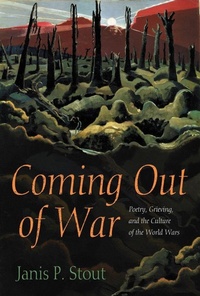
Coming Out of War
Poetry, Grieving, and the Culture of the World Wars
Will be published approx. on 30. September 2016
Book
Paperback/Softback
294 pages
978-0-8173-5862-4 (ISBN)
Description
American and British poetry, music, and visual art born of World Wars I and II.
World War I is widely considered "the Great War" and World War II, "the Good War." Janis Stout thinks of them as two parts of a whole that continues to engage historians and literary scholars searching for an understanding of both the actual war experiences and the modern culture of grief they embody. Poetry, of all the arts, Stout argues, most fully captures and conveys those cultural responses.
While probing the work of such well known war poets as Rupert Brooke, Wilfred Owen, and Randall Jarrell, Stout also highlights the impact of the wars on lesser studied, but equally compelling, sources such as the music of Charles Ives and Cole Porter, Aaron Copland and Irving Berlin. She challenges the commonplace belief that war poetry came only from the battlefield and was written only by men by examining the wartime writings of women poets such as Rose Macaulay, Marianne Moore, Elizabeth Bishop, and Gwendolyn Brooks. She also challenges the assumption that World War II did not produce poetry of distinction by studying the work of John Ciardi, Karl Shapiro, Louis Simpson, Robert Frost, and Wallace Stevens. While emphasizing aesthetic continuity between the wars, Stout stresses that the poetry that emerged from each displays a greater variety than is usually recognized.
A final chapter considers Benjamin Britten's War Requiem as a culmination and embodiment of the anti-war tradition in 20th-century poetry and music, and speculates on the reasons why, despite their abundance and eloquence, these expressions of grief and opposition to war have effected so little change.
World War I is widely considered "the Great War" and World War II, "the Good War." Janis Stout thinks of them as two parts of a whole that continues to engage historians and literary scholars searching for an understanding of both the actual war experiences and the modern culture of grief they embody. Poetry, of all the arts, Stout argues, most fully captures and conveys those cultural responses.
While probing the work of such well known war poets as Rupert Brooke, Wilfred Owen, and Randall Jarrell, Stout also highlights the impact of the wars on lesser studied, but equally compelling, sources such as the music of Charles Ives and Cole Porter, Aaron Copland and Irving Berlin. She challenges the commonplace belief that war poetry came only from the battlefield and was written only by men by examining the wartime writings of women poets such as Rose Macaulay, Marianne Moore, Elizabeth Bishop, and Gwendolyn Brooks. She also challenges the assumption that World War II did not produce poetry of distinction by studying the work of John Ciardi, Karl Shapiro, Louis Simpson, Robert Frost, and Wallace Stevens. While emphasizing aesthetic continuity between the wars, Stout stresses that the poetry that emerged from each displays a greater variety than is usually recognized.
A final chapter considers Benjamin Britten's War Requiem as a culmination and embodiment of the anti-war tradition in 20th-century poetry and music, and speculates on the reasons why, despite their abundance and eloquence, these expressions of grief and opposition to war have effected so little change.
Reviews / Votes
Patterned after Philip Beidler's The Good War's Greatest Hits (CH, Dec'98, 36-1954), this book mentions an astonishing number of works and authors but offers little in-depth commentary and analysis. Stout's thesis seems to be that a culture of grieving evolved in the 20th century due to unending wars, and that this pattern will continue, possibly unabated, throughout the 21st century. Niall Ferguson's outstanding The Pity of War (CH, Sep'99, 37-0466) is also a model for this discussion: Stout (emer., Texas A&M Univ.) mentions all the standard war poets but widens her scope to include such relatively unknown writers as Laurence Binyon, Margaret Postgate, Alice Meynell, Elizabeth Daryush, Teresa Hooley, and Mary Jo Salter. (Symptomatic is treatment of Salter's moving poem, ""Welcome to Hiroshima,"" which receives but a single sentence.) However, the author includes art and music in her discussion, mentioning political cartoons, the works of Paul Nash and Otto Dix, and music by Elgar, Ives, Cole Porter, Copland, Schoenberg, and Britten (whose War Requiem receives enough sustained attention to make one wish that Stout had mentioned fewer works and offered more in-depth analysis). The volume's shortcomings aside, the book will be invaluable to students because Stout's treatment points in many directions. Summing Up: Recommended. Lower-/upper-division undergraduate; graduate students; general readers."" - CHOICE"The most extraordinary feature of this study is its amazing scope. . . . Even for readers familiar with the terrain of 20th-century English war poetry, this book contains a treasure trove of new and interesting work. The same could be said for the exhaustive scholarship brought to bear on the discussion of the literature to excellent effect. . . . Some of its inclusions are very likely to spur new interest and new research. For example, the brief discussion of Sterling Brown's poetry should make readers curious to learn more about the African American response to the First World War."- Margot Norris, author of Writing War in the Twentieth Century
More details
Language
English
Place of publication
Alabama
United States
Target group
College/higher education
Illustrations
9 black & white illustration
Dimensions
Height: 151 mm
Width: 229 mm
Thickness: 24 mm
Weight
428 gr
ISBN-13
978-0-8173-5862-4 (9780817358624)
Copyright in bibliographic data and cover images is held by Nielsen Book Services Limited or by the publishers or by their respective licensors: all rights reserved.
Schweitzer Classification
Person
Janis P. Stout is Professor Emerita of English and Dean of Faculties Emerita at Texas A&M University, USA. She is the author or editor of several works, including Willa Cather and Material Culture, Katherine Anne Porter: A Sense of the Times, and Through the Window, Out the Door: Women's Narratives of Departure, from Austin and Cather to Tyler, Morrison, and Didion.