

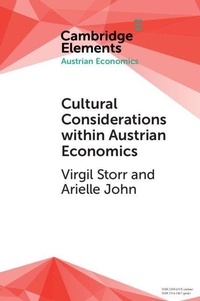
Cultural Considerations within Austrian Economics
Published on 9. July 2020
Book
Paperback/Softback
68 pages
978-1-108-70816-6 (ISBN)
Description
Increasingly, economists realize that a deeper understanding of culture can improve their insights into the most important questions in economics. The Austrian school of political economy, which has always taken economics to be a science of meaning, and therefore, a science of culture, offers a unique approach to the study of culture in economic life. We consider three important differences between these Austrian and non-Austrian approaches: the Austrian focus on culture as meaning rather than culture as norms, beliefs, or attitudes; the Austrian emphasis on culture as an interpretative lens rather than as a tool or form of capital; and the Austrian insistence that cultural analysis be a qualitative exercise rather than a quantitative one. We also examine Geertz's description of culture, Gadamer's approach to hermeneutics, and Weber's interpretative sociology, demonstrating their connections to the Austrian approach and offering examples of what Austrian cultural economics can look like.
More details
Series
Language
English
Place of publication
Cambridge
United Kingdom
Target group
Professional and scholarly
Product notice
Paperback (trade)
Illustrations
Worked examples or Exercises
Dimensions
Height: 229 mm
Width: 152 mm
Thickness: 4 mm
Weight
104 gr
ISBN-13
978-1-108-70816-6 (9781108708166)
Copyright in bibliographic data and cover images is held by Nielsen Book Services Limited or by the publishers or by their respective licensors: all rights reserved.
Schweitzer Classification
Other editions
Additional editions
Virgil Storr | Arielle John
Cultural Considerations within Austrian Economics
E-Book
07/2020
Cambridge University Press
€20.99
Available for download
Persons
Content
1. Introduction; 2. The intellectual roots of the Austrian approach to culture; 3. Non-Austrian approaches to exploring the relationship between culture and economic action; 4. Unique features of the Austrian approach to studying the relationship between culture and economic action; 5. Studying culture in the Austrian tradition; 6. Conclusion.