

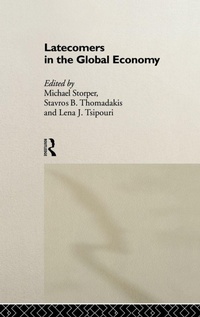
Latecomers in the Global Economy
Published on 26. February 1998
Book
Hardback
344 pages
978-0-415-14867-2 (ISBN)
Description
Drawing on the example of late-developing countries, especially from East Asia, catching up with established powers, the authors address a new formulation of industrial policy for latecoming, semi-industrialized countries.
With contributions from some of the best-known economists currently working in this area, the book will be a valuable guide for economists and international policy-makers interested in development issues.
With contributions from some of the best-known economists currently working in this area, the book will be a valuable guide for economists and international policy-makers interested in development issues.
More details
Language
English
Place of publication
London
United Kingdom
Publishing group
Taylor & Francis Ltd
Target group
College/higher education
Dimensions
Height: 240 mm
Width: 161 mm
Thickness: 23 mm
Weight
687 gr
ISBN-13
978-0-415-14867-2 (9780415148672)
Copyright in bibliographic data and cover images is held by Nielsen Book Services Limited or by the publishers or by their respective licensors: all rights reserved.
Schweitzer Classification
Other editions
Additional editions
Michael Storper | Stavros Thomadakis | Lena Tsipouri
Latecomers in the Global Economy
Book
12/2014
1st Edition
Routledge
€77.60
Shipment within 10-20 days
Michael Storper | Stavros Thomadakis | Lena Tsipouri
Latecomers in the Global Economy
E-Book
06/2005
Routledge
€69.99
Available for download
Michael Storper | Stavros Thomadakis | Lena Tsipouri
Latecomers in the Global Economy
E-Book
06/2005
Routledge
€69.99
Available for download
Persons
Michael Storper, Stavros Thomadakis, Lena Tsipouri
Content
Introduction; Part I: Theoretical foundations; 1: Industrial policy for latecomers: Products, conventions, and learning; 2: Globalization tendencies relevant for latecomers: Some conceptual issues; 3: Principles of an operational industrial policy for latecomers: Failures of analogy, strategies, and degrees of freedom; Part II: Policies, instruments and agents; 4: Coordinated industrialization: Institutional agendas for less favored countries; 5: Implications of organizational learning for horizontal technology policies: An exploratory study; 6: Industrial policy, competitive strategy, and networks of small and medium-sized firms: Theoretical issues and implications for less favored countries; 7: The regional development potential of inward investment 1; Part III: Case studies; 8: Learning, innovation, and industrial policy: Some lessons from Korea; 9: Industrial policy for catching up: The case of Taiwan; 10: Industrial policy in Ireland and the problem of late development; 11: Promoting coordination at regional level: The case of Northern Greece 1; 12: Inward investment in Central and Eastern Europe: The compatibility of objectives and the need for an industrial strategy