

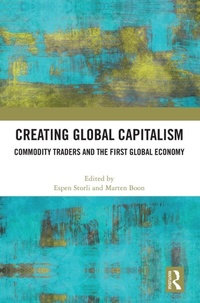
Creating Global Capitalism
Commodity Traders and the First Global Economy
1st Edition
Published on 4. October 2024
Book
Hardback
152 pages
978-1-032-85133-4 (ISBN)
Description
This book provides a unique insight into the world of commodity trading companies, often depicted as the hidden companies of the global economy and showcases how they were instrumental in bringing about the economic integration of new commodities and far-flung regions into the first global economy in the late nineteenth and early twentieth century.
The late nineteenth century witnessed an unprecedented phase of global economic integration. As organisers of global trade, trading companies specialising in commodities were instrumental in creating this first global economy. From soybeans to cultural artefacts, from seal hides to rubber, trading companies connected far-flung regions at or beyond the frontier of empires to a growing global market for these commodities. Satisfying the unsatiable appetite for commodities of industrializing economies in North America, Europe and East Asia, their nimble organisations and specialised trading skills allowed trading companies to harness imperial geopolitics, latch onto local networks and move across borders. This book brings together a collection of case studies of commodity trading companies across a range of commodities and regions between the 1870s and the 1930s. Through the lens of global value chains, the contributions showcase how these companies continuously adapted their businesses to a world that was at once economically more integrated but politically increasingly competitive in this age of high imperialism and national competition.
The chapters in this book were originally published as a special issue of Business History.
The late nineteenth century witnessed an unprecedented phase of global economic integration. As organisers of global trade, trading companies specialising in commodities were instrumental in creating this first global economy. From soybeans to cultural artefacts, from seal hides to rubber, trading companies connected far-flung regions at or beyond the frontier of empires to a growing global market for these commodities. Satisfying the unsatiable appetite for commodities of industrializing economies in North America, Europe and East Asia, their nimble organisations and specialised trading skills allowed trading companies to harness imperial geopolitics, latch onto local networks and move across borders. This book brings together a collection of case studies of commodity trading companies across a range of commodities and regions between the 1870s and the 1930s. Through the lens of global value chains, the contributions showcase how these companies continuously adapted their businesses to a world that was at once economically more integrated but politically increasingly competitive in this age of high imperialism and national competition.
The chapters in this book were originally published as a special issue of Business History.
More details
Language
English
Place of publication
London
United Kingdom
Publishing group
Taylor & Francis Ltd
Target group
College/higher education
Postgraduate, Undergraduate Advanced, and Undergraduate Core
Dimensions
Height: 250 mm
Width: 175 mm
Thickness: 14 mm
Weight
474 gr
ISBN-13
978-1-032-85133-4 (9781032851334)
Copyright in bibliographic data and cover images is held by Nielsen Book Services Limited or by the publishers or by their respective licensors: all rights reserved.
Schweitzer Classification
Other editions
Additional editions
Book
05/2026
1st Edition
Routledge
€57.50
Shipment within 10-20 days
E-Book
10/2024
1st Edition
Routledge
€212.99
Available for download
E-Book
10/2024
1st Edition
Routledge
€212.99
Available for download
Persons
Espen Storli is Professor of History at the Department of History and Modern Society at NTNU, the Norwegian University of Science and Technology. His research interests include the history of natural resource extraction, commodity trading, and cartels.
Marten Boon is Lecturer in History of International Relations at Utrecht University. He holds a PhD in economic and business history from Erasmus University. His research interest focuses on the business and transnational history of energy, with a particular focus on the oil and gas industry in the twentieth and twenty-first century.
Marten Boon is Lecturer in History of International Relations at Utrecht University. He holds a PhD in economic and business history from Erasmus University. His research interest focuses on the business and transnational history of energy, with a particular focus on the oil and gas industry in the twentieth and twenty-first century.
Content
Introduction: Creating global capitalism: An introduction to commodity trading companies and the first global economy 1. From traders to planters: The evolving role and importance of trading companies in the 19th century Anglo-Indian Indigo trade 2. Foreign merchant businesses and the integration of the Black and Azov Seas of the Russian Empire into the First global economy 3. Sourcing and shipping museum objects from East Africa to the Smithsonian, 1887-1891 4. Global trading companies in the commodity chain of rubber between 1890 and the 1920s 5. Mitsui Bussan and the Manchurian soybean trade: Geopolitics and economic strategies in China's Northeast, ca. 1870s-1920s 6. Branding and retail strategy in the condensed milk trade: Borden and Nestle in East Asia, 1870-1929 7. Natural born merchants. The Hudson Bay Company, science and Canada's final fur frontiers (1925-1931)