

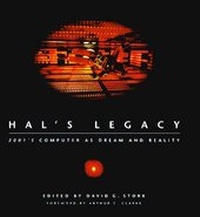
HAL's Legacy
2001's Computer as Dream and Reality
Published on 2. March 1998
Book
Paperback/Softback
384 pages
978-0-262-69211-3 (ISBN)
Description
How science fiction's most famous computer has influenced the research and design of intelligent machines.I became operational. in Urbana, Illinois, on January 12, 1997.Inspired by HAL's self-proclaimed birth date, HAL's Legacy reflects upon science fiction's most famous computer and explores the relationship between science fantasy and technological fact. The informative, nontechnical chapters written especially for this book describe many of the areas of computer science critical to the design of intelligent machines, discuss whether scientists in the 1960s were accurate about the prospects for advancement in their fields, and look at how HAL has influenced scientific research.Contributions by leading scientists look at the technologies that would be critical if we were, as Arthur Clarke and Stanley Kubrick imagined thirty years ago, to try and build HAL in 1997: supercomputers, fault-tolerance and reliability, planning, artificial intelligence, lipreading, speech recognition and synthesis, commonsense reasoning, the ability to recognize and display emotion, and human-machine interaction. A separate chapter by philosopher Daniel Dennett considers the ethical implications of intelligent machines.
More details
Series
Language
English
Place of publication
Cambridge, Mass.
United States
Publishing group
MIT Press Ltd
Target group
College/higher education
Professional and scholarly
US School Grade: College Graduate Student and over
Product notice
Paperback (trade)
Dimensions
Height: 229 mm
Width: 203 mm
Thickness: 25 mm
Weight
1089 gr
ISBN-13
978-0-262-69211-3 (9780262692113)
Copyright in bibliographic data and cover images is held by Nielsen Book Services Limited or by the publishers or by their respective licensors: all rights reserved.
Schweitzer Classification