

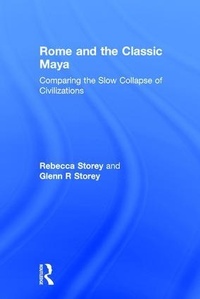
Rome and the Classic Maya
Comparing the Slow Collapse of Civilizations
1st Edition
Published on 7. February 2017
Book
Hardback
292 pages
978-1-62958-457-7 (ISBN)
Description
This volume compares two of the most famous cases of civilizational collapse, that of the Roman Empire and the Classic Maya world. First examining the concept of collapse, and how it has been utilized in the historical, archaeological and anthropological study of past complex societies, Storey and Storey draw on extensive archaeological evidence to consider the ultimate failure of the institutions, infrastructure and material culture of both of these complex cultures.
Detailing the relevant economic, political, social and environmental factors behind these notable falls, Rome and the Classic Maya contends that a phenomenon of "slow collapse" has repeatedly occurred in the course of human history: complex civilizations are shown to eventually come to an end and give way to new cultures. Through their analysis of these two ancient case studies, the authors also present intriguing parallels to the modern world and offer potential lessons for the future.
Detailing the relevant economic, political, social and environmental factors behind these notable falls, Rome and the Classic Maya contends that a phenomenon of "slow collapse" has repeatedly occurred in the course of human history: complex civilizations are shown to eventually come to an end and give way to new cultures. Through their analysis of these two ancient case studies, the authors also present intriguing parallels to the modern world and offer potential lessons for the future.
More details
Language
English
Place of publication
Walnut Creek
United States
Target group
Professional and scholarly
College/higher education
Product notice
sewn/stitched
Cloth over boards
Illustrations
14 s/w Tabellen, 77 s/w Abbildungen
14 Tables, black and white; 77 Illustrations, black and white
Dimensions
Height: 231 mm
Width: 155 mm
Thickness: 23 mm
Weight
703 gr
ISBN-13
978-1-62958-457-7 (9781629584577)
Copyright in bibliographic data and cover images is held by Nielsen Book Services Limited or by the publishers or by their respective licensors: all rights reserved.
Schweitzer Classification
Other editions
Additional editions
Rebecca Storey | Glenn R. Storey
Rome and the Classic Maya
Comparing the Slow Collapse of Civilizations
Book
01/2017
1st Edition
Left Coast Press Inc
€79.80
Shipment within 3-4 weeks
Rebecca Storey | Glenn R. Storey
Rome and the Classic Maya
Comparing the Slow Collapse of Civilizations
E-Book
01/2017
Routledge
€73.99
Available for download
Rebecca Storey | Glenn R. Storey
Rome and the Classic Maya
Comparing the Slow Collapse of Civilizations
E-Book
01/2017
Routledge
€73.99
Available for download
Persons
Rebecca Storey is Associate Professor of Anthropology at the University of Houston. Her research focuses on the bioarchaeology of Maya populations in ancient Mesoamerica.
Glenn R. Storey is Associate Professor of Classics and Anthropology at the University of Iowa. His research interests include Mediterranean archaeology, Roman demography and the economy of the Roman Empire.
Glenn R. Storey is Associate Professor of Classics and Anthropology at the University of Iowa. His research interests include Mediterranean archaeology, Roman demography and the economy of the Roman Empire.
Content
1 The Concept of Slow Collapse
2 The "Flood" of Catastrophe Books and Rethinking the Concept of Collapse
3 Introduction to the Case Studies: The Archaeological Evidence
4 The Political Economy of Collapse
5 The Political Dimension of Collapse
6 The Social Dimension of Collapse
7 The Environmental Dimension
8 The Validity of the Concept of "Slow Collapse" and Human Resilience
2 The "Flood" of Catastrophe Books and Rethinking the Concept of Collapse
3 Introduction to the Case Studies: The Archaeological Evidence
4 The Political Economy of Collapse
5 The Political Dimension of Collapse
6 The Social Dimension of Collapse
7 The Environmental Dimension
8 The Validity of the Concept of "Slow Collapse" and Human Resilience