

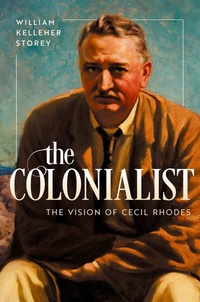
The Colonialist
The Vision of Cecil Rhodes
Published on 24. July 2025
Book
Hardback
528 pages
978-0-19-981135-9 (ISBN)
Description
This is the first comprehensive biography of Cecil Rhodes in a generation. This critical work elaborates the life and times of Rhodes, showing how his racist politics impacted mining, industry, transportation, warfare, and society, while discussing how his controversial policies fueled a lasting white-dominated colonial society and had an enduring influence on modern South Africa.
Cecil John Rhodes became one of the most influential people in the history of the British Empire. He made a fortune in South Africa by leading the world's most important diamond mining company, De Beers, as well as a gold-mining concern called Consolidated Gold Fields. While he was a busy entrepreneur, he was also a member of the Cape Colony's legislature and served as prime minister from 1890 to 1896, a key period for the development of racial discrimination. His British South Africa Company was given a charter to govern what is today Zambia and Zimbabwe. His most famous legacy is the Rhodes Trust, which funds the Rhodes Scholarships at Oxford University.
A complex figure, admired and detested in his own time, Rhodes dreamt to unite Southern Africa's colonies and republics into one state, dominated by white settlers, with labor provided by Black people who were constrained and pressured by discriminatory laws. He built his wealth on the backs of African migrant laborers, for whom he had little regard. His British South Africa Company was accused of fraud. And in 1895 and 1896, he famously encouraged a failed plot to overthrow the independent Boer republic in the Transvaal. Rhodes' coup helped to precipitate the South African War, which started in 1899 and ended in 1902, the year of Rhodes' death.
This authoritative biography focuses on the relationship between Rhodes' well-known activities in business and politics and the development of Southern Africa's infrastructure, most famously his plan for a Cape-to-Cairo railway. Rhodes envisioned a region where racism became embedded in the mining, farming, communication, and transportation industries. He pursued this vision in the face of opposition from many quarters. Understanding the extent of Rhodes' activities helps us to understand the challenges of modern Africa and the recent Rhodes Must Fall movement. A critical analysis of this contested figure, The Colonialist offers an original portrait of a crucial figure of his era.
Cecil John Rhodes became one of the most influential people in the history of the British Empire. He made a fortune in South Africa by leading the world's most important diamond mining company, De Beers, as well as a gold-mining concern called Consolidated Gold Fields. While he was a busy entrepreneur, he was also a member of the Cape Colony's legislature and served as prime minister from 1890 to 1896, a key period for the development of racial discrimination. His British South Africa Company was given a charter to govern what is today Zambia and Zimbabwe. His most famous legacy is the Rhodes Trust, which funds the Rhodes Scholarships at Oxford University.
A complex figure, admired and detested in his own time, Rhodes dreamt to unite Southern Africa's colonies and republics into one state, dominated by white settlers, with labor provided by Black people who were constrained and pressured by discriminatory laws. He built his wealth on the backs of African migrant laborers, for whom he had little regard. His British South Africa Company was accused of fraud. And in 1895 and 1896, he famously encouraged a failed plot to overthrow the independent Boer republic in the Transvaal. Rhodes' coup helped to precipitate the South African War, which started in 1899 and ended in 1902, the year of Rhodes' death.
This authoritative biography focuses on the relationship between Rhodes' well-known activities in business and politics and the development of Southern Africa's infrastructure, most famously his plan for a Cape-to-Cairo railway. Rhodes envisioned a region where racism became embedded in the mining, farming, communication, and transportation industries. He pursued this vision in the face of opposition from many quarters. Understanding the extent of Rhodes' activities helps us to understand the challenges of modern Africa and the recent Rhodes Must Fall movement. A critical analysis of this contested figure, The Colonialist offers an original portrait of a crucial figure of his era.
Reviews / Votes
A fluent and compelling work that never loses sight of the narrative arc of Rhodes's life... Kelleher Storey enriches the familiar political history of Rhodes's career with a deeply researched study of how Rhodes managed a transnational network of people and materials to build his De Beers diamond wealth and colonise central southern Africa. * Nick Pierce, Financial Times * A brave and learned book ... We need to know the history - which is so punctiliously told in this book. It has never been related before in such detail, or with such impartiality, or awareness of the rage which the very name of Rhodes inspires in African hearts. * A.N. Wilson, The Spectator * Sober, heavyweight and quietly damning...Storey argues vigorously that [Rhodes's] record must be contextualized as well as condemned...It all adds up to a rich and panoramic narrative. * Andrew Lynch, Irish Times * William Kelleher Storey has given us the most exhaustive and meticulously researched biography of one of the most consequential figures of the modern age. While the notoriously megalomanic Rhodes saw himself as a colossus standing astride Africa and the British Empire, Storey cuts him wonderfully down to size to show us a flawed historical figure who was and is so fascinating precisely because he was so human. Storey reminds us of a man who failed more than he succeeded, who owed his success more to the contingencies of life than to genius, and who was a provincial whose influence extends around the globe. We live, for better and for worse, in the world that Rhodes wrought. It behooves us to understand him. Thanks to Storey, we can say we do. * Jacob S. Dlamini, Princeton University * This deeply researched book focuses on Rhodes's colonial vision for southern Africa which was rooted in mining, railways, and scientific agriculture. A do-er rather than a thinker, Rhodes's imprint on the country has more to do with his actions in support of white colonial expansion than his thought. This is apt to be forgotten in recent debates. Storey's rigorous analysis of Rhodes's material legacy in Southern Africa represents a major contribution to the field. * Saul Dubow, Cambridge University * [The Colonialist] is a thorough and serious book, offering detailed analysis of how Rhodes persuaded London politicians and investors to back his schemes. * The Oldie * The Colonialist is a serious work of historical scholarship, written lucidly with all the sensibilities that correlate appropriately with its time... Its greatest contribution is its entwinement of Rhodes with histories of technology, specifically how technological innovations influenced social and political developments. ...Storey may be the latest in a long line of Rhodes biographers, but The Colonialist represents a new benchmark. * Times Literary Supplement * Storey performs a service by documenting just how consistently and completely Rhodes' rise disadvantaged the black Africans of his adopted country. * Erik Linstrum, History Today *More details
Language
English
Place of publication
New York
United States
Target group
Professional and scholarly
College/higher education
Illustrations
31 black and white illustrations
Dimensions
Height: 242 mm
Width: 165 mm
Thickness: 39 mm
Weight
910 gr
ISBN-13
978-0-19-981135-9 (9780199811359)
Copyright in bibliographic data and cover images is held by Nielsen Book Services Limited or by the publishers or by their respective licensors: all rights reserved.
Schweitzer Classification
Other editions
Additional editions

E-Book
07/2025
OUP eBook
€33.99
Available for download
Person
William Kelleher Storey is Professor of History and Dean of Arts and Humanities at Millsaps College. He is the author of Guns, Race, and Power in Colonial South Africa and Writing History: A Guide for Students, among other books. Storey has been recognized as statewide Professor of the Year by the Council for Advancement and Support of Education (CASE) and the Carnegie Foundation for the Advancement of Teaching.
Content
Introduction: Reconsidering Cecil Rhodes
Chapter 1: Becoming an Englishman and a Migrant
Chapter 2: Digging Diamonds
Chapter 3: Growing Pains
Chapter 4: Learning at Oxford
Chapter 5: Entering Politics
Chapter 6: Aiming North
Chapter 7: Controlling De Beers
Chapter 8: Amalgamating the Mines
Chapter 9: Connecting a Country
Chapter 10: Stealing Arcadia
Chapter 11: Perpetrating a Fraud
Chapter 12: Leading the Cape Colony
Chapter 13: Multiplying Force
Chapter 14: Consolidating Rhodesia
Chapter 15: Fighting for Arcadia
Chapter 16: Maintaining Mines
Chapter 17: Raiding the Rand
Chapter 18: Defending the Vision
Chapter 19: Recovering the Vision
Chapter 20: Falling Short
Conclusion: Perpetuating the Vision
Acknowledgments
Select Bibliography
Index
Chapter 1: Becoming an Englishman and a Migrant
Chapter 2: Digging Diamonds
Chapter 3: Growing Pains
Chapter 4: Learning at Oxford
Chapter 5: Entering Politics
Chapter 6: Aiming North
Chapter 7: Controlling De Beers
Chapter 8: Amalgamating the Mines
Chapter 9: Connecting a Country
Chapter 10: Stealing Arcadia
Chapter 11: Perpetrating a Fraud
Chapter 12: Leading the Cape Colony
Chapter 13: Multiplying Force
Chapter 14: Consolidating Rhodesia
Chapter 15: Fighting for Arcadia
Chapter 16: Maintaining Mines
Chapter 17: Raiding the Rand
Chapter 18: Defending the Vision
Chapter 19: Recovering the Vision
Chapter 20: Falling Short
Conclusion: Perpetuating the Vision
Acknowledgments
Select Bibliography
Index