

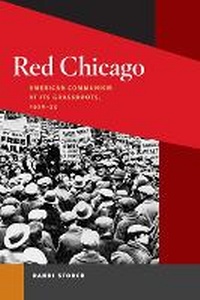
Red Chicago
American Communism at Its Grassroots, 1928-35
Published on 12. December 2008
Book
Paperback/Softback
320 pages
978-0-252-07638-1 (ISBN)
Description
Red Chicago is a social history of American Communism set within the context of Chicago's neighborhoods, industries, and radical traditions. Using local party records, oral histories, union records, party newspapers, and government documents, Randi Storch fills the gap between Leninist principles and the day-to-day activities of Chicago's rank-and-file Communists.
Uncovering rich new evidence from Moscow's former party archive, Storch argues that although the American Communist Party was an international organization strongly influenced by the Soviet Union, at the city level it was a more vibrant and flexible organization responsible to local needs and concerns. Thus, while working for a better welfare system, fairer unions, and racial equality, Chicago's Communists created a movement that at times departed from international party leaders' intentions. By focusing on the experience of Chicago's Communists, who included a large working-class, African American, and ethnic population, this study reexamines party members' actions as an integral part of the communities and industries in which they lived and worked.
Uncovering rich new evidence from Moscow's former party archive, Storch argues that although the American Communist Party was an international organization strongly influenced by the Soviet Union, at the city level it was a more vibrant and flexible organization responsible to local needs and concerns. Thus, while working for a better welfare system, fairer unions, and racial equality, Chicago's Communists created a movement that at times departed from international party leaders' intentions. By focusing on the experience of Chicago's Communists, who included a large working-class, African American, and ethnic population, this study reexamines party members' actions as an integral part of the communities and industries in which they lived and worked.
Reviews / Votes
"An engaging look at the final years of Chicago's reign as the left-wing capital of America."--Chicago Tribune "Red Chicago makes an important contribution, integrating Communist history into the broader history of the working class and challenging the recent historiography that has dismissed the local context in favor of a top-down view."--Journal of Illinois History "An interesting story of a period of labor activity in the city that eventually sparked much more worker organizing than would be found in a number of other U.S. cities. Indeed, this is the period that fostered Chicago's eventual image as 'a labor town.'"--Chicago Union Teacher "Storch's solid new book . . . [is] the beginning of a 'fourth wave' of historiography of the American Communist Party."--History: Review of New Books "[Storch's] thoroughly researched study puts a 'human face' on American Communism by contextualizing the experiences of party members."--H-Urban "Storch's new book effectively kicks off the beginning of a new wave of American Communist Party historiography. . . . Highly recommended."--Choice "Red Chicago is thoroughly researched, the prose lucid and felicitous, and its arguments clearly made. This is Storch's first book, and it marks her as a young historian of promise."--Journal of American History "A must-read and a thrilling story for anyone interested in learning the tactics and hidden history of the CP's mass organizing in the 1930s."--International Socialist Review"A first-rate study of social thought, protest and action."--American Communist History
"Red Chicago provides a wealth of new information about Chicago area Communists and breaks new ground in charting their activities at the grassroots level. In doing so, Storch speaks directly to a long-running debate about the nature of the Communist Party's connections to the American working class, coming down clearly and forcefully on the side that sees the Party as rooted in an indigenous culture of labor radicalism rather than simply a creature of the Soviet Union. . . . An impressive and well-written book."--Rick Halpern, author of Down on the Killing Floor: Black and White Workers in Chicago's Packinghouses, 1904-54
"Red Chicago is the most thorough and comprehensive case study in defense of the argument that local conditions shaped Communist policies, often anticipating changes in Party direction. What makes Storch's study particularly compelling is her ability to bring together what have often been considered to be contending interpretations: one emphasizing local initiatives and the other highlighting dependency on Moscow. This book makes a persuasive case that there needs to be a more nuanced interpretation that combines the strengths of both."--Paul Lyons, author of The People of This Generation: The Rise and Fall of the New Left in Philadelphia
More details
Series
Edition
New edition
Language
English
Place of publication
Baltimore
United States
Target group
College/higher education
Edition type
New edition
Illustrations
14 black & white photographs, 4 line drawings, 2 tables
Dimensions
Height: 235 mm
Width: 156 mm
Thickness: 25 mm
Weight
513 gr
ISBN-13
978-0-252-07638-1 (9780252076381)
Copyright in bibliographic data and cover images is held by Nielsen Book Services Limited or by the publishers or by their respective licensors: all rights reserved.
Schweitzer Classification
Other editions
Previous edition

Book
11/2007
University of Illinois Press
€35.89
Article exhausted; check for reprint
Person
Randi Storch is an associate professor of history at the State University of New York College at Cortland.
Content
Acknowledgments ix
Introduction 1
1. Sam Hammersmark's Chicagos 9
2. Revolutionary Recruitment: Numbers and Experience 31
3. "True Revolutionaries": Chicago's Party Culture in Thought and Action 64
4. Red Relief 99
5. "Abolish Capitalism": The Trade Union Unity League's Potential and Problems 130
6. "Generals Are of No Use without an Army": How and Why Communists Abandoned the TUUL 164
7. "Not That These Youths Are Geniuses": Young Communists Move from the Margins to the Mainstream 187
Epilogue 214
Notes 231
Index 289
Introduction 1
1. Sam Hammersmark's Chicagos 9
2. Revolutionary Recruitment: Numbers and Experience 31
3. "True Revolutionaries": Chicago's Party Culture in Thought and Action 64
4. Red Relief 99
5. "Abolish Capitalism": The Trade Union Unity League's Potential and Problems 130
6. "Generals Are of No Use without an Army": How and Why Communists Abandoned the TUUL 164
7. "Not That These Youths Are Geniuses": Young Communists Move from the Margins to the Mainstream 187
Epilogue 214
Notes 231
Index 289