

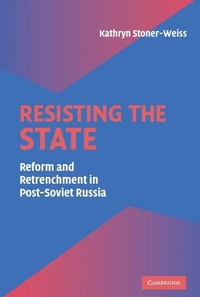
Resisting the State
Reform and Retrenchment in Post-Soviet Russia
Published on 19. June 2006
Book
Hardback
182 pages
978-0-521-82463-7 (ISBN)
Description
Why do new, democratizing states often find it so difficult to actually govern? Why do they so often fail to provide their beleaguered populations with better access to public goods and services? Using original and unusual data, this book uses post-communist Russia as a case in examining what the author calls this broader 'weak state syndrome' in many developing countries. Through interviews with over 800 Russian bureaucrats in 72 of Russia's 89 provinces, and a highly original database on patterns of regional government non-compliance to federal law and policy, the book demonstrates that resistance to Russian central authority not so much ethnically based (as others have argued) as much as generated by the will of powerful and wealthy regional political and economic actors seeking to protect assets they had acquired through Russia's troubled transition out of communism.
Reviews / Votes
'This is a serious research monograph, which anyone wanting to examine the realities of power in post-Soviet Russia, and the reasons for these, should read.' Europe-Asia Studies 'The book is a must-read for scholars of nationalism wishing to broaden their understanding of Russian federalism.' Ab ImperioMore details
Language
English
Place of publication
Cambridge
United Kingdom
Target group
Professional and scholarly
Illustrations
15 Tables, unspecified
Dimensions
Height: 235 mm
Width: 157 mm
Thickness: 15 mm
Weight
423 gr
ISBN-13
978-0-521-82463-7 (9780521824637)
Copyright in bibliographic data and cover images is held by Nielsen Book Services Limited or by the publishers or by their respective licensors: all rights reserved.
Schweitzer Classification
Other editions
Additional editions
E-Book
08/2006
1st Edition
Cambridge University Press
€66.49
Available for download
Person
Kathryn Stoner-Weiss is Associate Director and Senior Research Associate at the Center on Democracy, Development and the Rule of Law, Stanford University. Previously she taught in the Department of Politics at Princeton University for nine years before coming to Stanford. At Princeton, she was awarded the Ralph O. Glendinning Preceptorship for outstanding junior faculty. She was also a fellow at the Davis Center for Russian Studies at Harvard University and the Kennan Institute for Advanced Russian Studies at the Woodrow Wilson Center for Scholars. Professor Stoner-Weiss is the co-editor of After the Collapse of Communism: Comparative Lessons of Transition (with Michael McFaul, Cambridge University Press, 2004) and the author of Local Heroes: The Political Economy of Russian Regional Governance (1997), in addition to many articles and book chapters on contemporary Russia.
Content
1. W(h)ither the Russian State?; 2. Apparatchiki into 'Entrepreneurchiki': the sources of Russia's weak central state; 3. Governing Russia: patterns of regional resistance; 4. Inside the Russian State: assessing infrastructural power in the provinces; 5. Retrenchment over reform: obstacles to the central state in the periphery; 6. Weak party system, weak central state; 7. The comparative implications of Russia's weak state syndrome.