

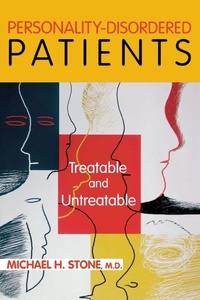
Personality-Disordered Patients
Treatable and Untreatable
Published on 22. January 2006
Book
Paperback/Softback
277 pages
978-1-58562-172-9 (ISBN)
Description
Determining the amenability of personality disorders to
psychotherapy-a patient's capacity to benefit from verbal approaches to
treatment-is important in helping clinicians determine the treatability of
cases. Michael Stone here shares the factors he has observed over long years
of practice that can help practitioners evaluate patients, stressing the
amenability of the various disorders to amelioration. By focusing on which
patients are likely to respond well to therapeutic intervention and which
will prove most resistive, his book will help therapists determine with what
kinds of patients they will most likely succeed and with which ones failure
is almost a certainty.
Stone establishes the attributes that affect
this amenability-such as the capacity for self-reflection, motivation, and
life circumstances-as guidelines for evaluating patients, then describes
borderline and other personality-disordered patients with varying levels of
amenability, from high to low. This coverage progresses from patients
belonging to the DSM "anxious cluster," along with the
depressive-masochistic character and the hysteric character, to patients who
demonstrate an intermediate level of amenability to psychotherapy. He
introduces the interrelationship between borderline personality disorder and
dissociative disorders and discusses treatability among certain patients in
Clusters "A" and "C," as well as others with narcissistic, histrionic,
depressive disorders. Final chapters address the most severe aberrations of
personality and the limitations they impose on the efficacy of therapy.
Personality-Disordered Patients is filled with practical,
clinically focused information. This guideline structured book:
* Covers all personality disorders-including ones not addressed in the
latest DSM such as sadistic, depressive, hypomanic, and
irritable-explosive
* Identifies both attributes necessary for
treatability and factors associated with low treatability
* Pays
particular attention to borderline disorders, which represent the most
discussed conditions and are among the most challenging to
psychotherapists
* Reviews personality traits whose presence, if
intense-even if unaccompanied by a definable personality disorder-creates
severe problems for psychotherapy
Numerous case studies throughout
the book provide examples that will help therapists determine which of their
own patients are most likely to benefit from their efforts and thereby
establish their own limits of effectiveness. By alerting practitioners to
when therapy is likely to fail, these guidelines can help them avoid the
professional disappointment of being unable to reach the most intractable
patients.
psychotherapy-a patient's capacity to benefit from verbal approaches to
treatment-is important in helping clinicians determine the treatability of
cases. Michael Stone here shares the factors he has observed over long years
of practice that can help practitioners evaluate patients, stressing the
amenability of the various disorders to amelioration. By focusing on which
patients are likely to respond well to therapeutic intervention and which
will prove most resistive, his book will help therapists determine with what
kinds of patients they will most likely succeed and with which ones failure
is almost a certainty.
Stone establishes the attributes that affect
this amenability-such as the capacity for self-reflection, motivation, and
life circumstances-as guidelines for evaluating patients, then describes
borderline and other personality-disordered patients with varying levels of
amenability, from high to low. This coverage progresses from patients
belonging to the DSM "anxious cluster," along with the
depressive-masochistic character and the hysteric character, to patients who
demonstrate an intermediate level of amenability to psychotherapy. He
introduces the interrelationship between borderline personality disorder and
dissociative disorders and discusses treatability among certain patients in
Clusters "A" and "C," as well as others with narcissistic, histrionic,
depressive disorders. Final chapters address the most severe aberrations of
personality and the limitations they impose on the efficacy of therapy.
Personality-Disordered Patients is filled with practical,
clinically focused information. This guideline structured book:
* Covers all personality disorders-including ones not addressed in the
latest DSM such as sadistic, depressive, hypomanic, and
irritable-explosive
* Identifies both attributes necessary for
treatability and factors associated with low treatability
* Pays
particular attention to borderline disorders, which represent the most
discussed conditions and are among the most challenging to
psychotherapists
* Reviews personality traits whose presence, if
intense-even if unaccompanied by a definable personality disorder-creates
severe problems for psychotherapy
Numerous case studies throughout
the book provide examples that will help therapists determine which of their
own patients are most likely to benefit from their efforts and thereby
establish their own limits of effectiveness. By alerting practitioners to
when therapy is likely to fail, these guidelines can help them avoid the
professional disappointment of being unable to reach the most intractable
patients.
Reviews / Votes
In this very well-written and clinically rich text,Personality-Disordered Patients: Treatable and Untreatable, Stone
approaches the treatability of personality-disordered patients, from most
amenable to untreatable, across 11-at times, interrelated-factors or
dimensions. . . . The greatest strength of Personality-Disordered
Patients: Treatable and Untreatable lies in its vast clinical
richness and the fact that the information contained within will be useful
to mental health professionals from all schools of thought. Clinical
vignettes constitute probably more than half the text and beautifully and
poignantly illustrate the technical points being made during each phase of
the book, which is a pleasure to read. * PsycCRITIQUES * [Personality-Disordered Patients] is enjoyable,
readable, and informative. We are invited in for a glimpse of Michael
Stone's many therapeutic encounters and learn from his broad range of
experience. His organizing the book along the lines of amenability to
treatment is useful, and his tables of traits and characteristics can help
clinicians evaluate prognosis and course, and can provide comfort to
therapists who are having difficulty understanding what is going on their
therapists with personality-disordered- patients. * The Journal of Nervous and Mental Disease * Personality-Disordered Patients is a terrific book
for clinicians. It is well written with multiple clinical vignettes. I would
highly recommend this book to all clinicians who work with challenging
patients. * Journal of Clinical Psychiatry *
More details
Language
English
Place of publication
VA
United States
Target group
Professional and scholarly
US School Grade: College Graduate Student and over
Product notice
Paperback (trade)
Illustrations
Not illustrated
Dimensions
Height: 229 mm
Width: 157 mm
Thickness: 20 mm
Weight
461 gr
ISBN-13
978-1-58562-172-9 (9781585621729)
Copyright in bibliographic data and cover images is held by Nielsen Book Services Limited or by the publishers or by their respective licensors: all rights reserved.
Schweitzer Classification
Other editions
Additional editions
E-Book
05/2007
1st Edition
American Psychiatric Association Publishing
€57.99
Available for download
Person
Michael H. Stone, M.D., is Professor of Clinical
Psychiatry at Columbia College of Physicians and Surgeons.
Psychiatry at Columbia College of Physicians and Surgeons.
Content
CONTENTS
PREFACE
Chapter 1. AMENABILITY TO
TREATMENT IN THE REALM OF PERSONALITY DISORDER
Chapter 2. PERSONALITY
DISORDERS MOST AMENABLE TO PSYCHOTHERAPY: BORDERLINE PERSONALITY DISORDER
Chapter 3. PERSONALITY DISORDERS MOST AMENABLE TO PSYCHOTHERAPY: THE
ANXIOUS CLUSTER AND RELATED DISORDERS
Chapter 4. PERSONALITY DISORDERS
OF INTERMEDIATE AMENABILITY TO PSYCHOTHERAPY: BORDERLINE PERSONALITY
DISORDER
Chapter 5. PERSONALITY DISORDERS OF INTERMEDIATE AMENABILITY TO
PSYCHOTHERAPY: OTHER PERSONALITY DISORDERS
Chapter 6. PERSONALITY
DISORDERS OF LOW AMENABILITY TO PSYCHOTHERAPY: BORDERLINE PERSONALITY
DISORDER
Chapter 7. PERSONALITY DISORDERS OF LOW AMENABILITY TO
PSYCHOTHERAPY: OTHER PERSONALITY DISORDERS
Chapter 8. PERSONALITY TRAITS
AT THE EDGE OF TREATABILITY
Chapter 9. UNTREATABLE PERSONALITY
DISORDERS
AFTERWORD
INDEX
PREFACE
Chapter 1. AMENABILITY TO
TREATMENT IN THE REALM OF PERSONALITY DISORDER
Chapter 2. PERSONALITY
DISORDERS MOST AMENABLE TO PSYCHOTHERAPY: BORDERLINE PERSONALITY DISORDER
Chapter 3. PERSONALITY DISORDERS MOST AMENABLE TO PSYCHOTHERAPY: THE
ANXIOUS CLUSTER AND RELATED DISORDERS
Chapter 4. PERSONALITY DISORDERS
OF INTERMEDIATE AMENABILITY TO PSYCHOTHERAPY: BORDERLINE PERSONALITY
DISORDER
Chapter 5. PERSONALITY DISORDERS OF INTERMEDIATE AMENABILITY TO
PSYCHOTHERAPY: OTHER PERSONALITY DISORDERS
Chapter 6. PERSONALITY
DISORDERS OF LOW AMENABILITY TO PSYCHOTHERAPY: BORDERLINE PERSONALITY
DISORDER
Chapter 7. PERSONALITY DISORDERS OF LOW AMENABILITY TO
PSYCHOTHERAPY: OTHER PERSONALITY DISORDERS
Chapter 8. PERSONALITY TRAITS
AT THE EDGE OF TREATABILITY
Chapter 9. UNTREATABLE PERSONALITY
DISORDERS
AFTERWORD
INDEX