

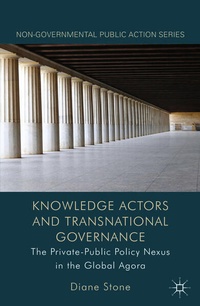
Knowledge Actors and Transnational Governance
The Private-Public Policy Nexus in the Global Agora
Published on 1. January 2013
Book
Paperback/Softback
XVI, 222 pages
978-1-349-43797-9 (ISBN)
Description
Diane Stone addresses the network alliances or partnerships of international organisations with knowledge organisations and networks. Moving beyond more common studies of industrial public-private partnerships, she addresses how, and why, international organisations and global policy actors need to incorporate ideas, expertise and scientific opinion into their 'global programmes'. Rather than assuming that the encouragement for 'evidence-informed policy' in global and regional institutions of governance is an indisputable public good, she queries the influence of expert actors in the growing number of part-private or semi-public policy networks.
More details
Series
Edition
1st ed. 2013
Language
English
Place of publication
London
United Kingdom
Target group
Professional and scholarly
Illustrations
XVI, 222 p.
Dimensions
Height: 216 mm
Width: 140 mm
Thickness: 14 mm
Weight
308 gr
ISBN-13
978-1-349-43797-9 (9781349437979)
DOI
10.1057/9781137022912
Schweitzer Classification
Other editions
Additional editions
D. Stone
Knowledge Actors and Transnational Governance
The Private-Public Policy Nexus in the Global Agora
Book
08/2013
Palgrave Macmillan
€53.49
Shipment within 10-20 days
D. Stone
Knowledge Actors and Transnational Governance
The Private-Public Policy Nexus in the Global Agora
E-Book
08/2013
1st Edition
Palgrave Macmillan
€53.49
Available for download
Person
Diane Stone is Professor of Politics and International Relations at the University of Warwick, UK, and the University of Western Australia. She was founding Professor of the Public Policy at Central European University, Hungary where she remains a visiting professor. Her professional and research interests are in the area of public policy, globalisation and governance.
Content
Introduction 1. The Global Agora 2. Knowledge Networks / Policy Networks 3. Think Tank Thinking 4. RAPID Knowledge 5. Translating Foundation Ideas 6. Informal Diplomacy of ASEAN-ISIS 7. Bankrolling Knowledge Networks Conclusion: The Rise of Knowledge Networks and the Turn of Think Tanks