

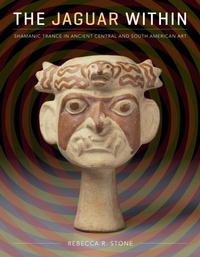
The Jaguar Within
Shamanic Trance in Ancient Central and South American Art
Published on 9. April 2024
Book
Paperback/Softback
244 pages
978-1-4773-2921-4 (ISBN)
Description
An important new way of viewing the prehistoric art of the Americas, The Jaguar Within demonstrates that understanding a work of art's connection with shamanic trance can lead to an appreciation of it as an extremely creative solution to the inherent challenge of giving material form to nonmaterial realities and states of being.
Shamanism-the practice of entering a trance state to experience visions of a reality beyond the ordinary and to gain esoteric knowledge-has been an important part of life for indigenous societies throughout the Americas from prehistoric times until the present. Much has been written about shamanism in both scholarly and popular literature, but few authors have linked it to another significant visual realm-art. In this pioneering study, Rebecca R. Stone considers how deep familiarity with, and profound respect for, the extra-ordinary visionary experiences of shamanism profoundly affected the artistic output of indigenous cultures in Central and South America before the European invasions of the sixteenth century.
Using ethnographic accounts of shamanic trance experiences, Stone defines a core set of trance vision characteristics, including enhanced senses; ego dissolution; bodily distortions; flying, spinning, and undulating sensations; synaesthesia; and physical transformation from the human self into animal and other states of being. Stone then traces these visionary characteristics in ancient artworks from Costa Rica and Peru. She makes a convincing case that these works, especially those of the Moche, depict shamans in a trance state or else convey the perceptual experience of visions by creating deliberately chaotic and distorted conglomerations of partial, inverted, and incoherent images.
Shamanism-the practice of entering a trance state to experience visions of a reality beyond the ordinary and to gain esoteric knowledge-has been an important part of life for indigenous societies throughout the Americas from prehistoric times until the present. Much has been written about shamanism in both scholarly and popular literature, but few authors have linked it to another significant visual realm-art. In this pioneering study, Rebecca R. Stone considers how deep familiarity with, and profound respect for, the extra-ordinary visionary experiences of shamanism profoundly affected the artistic output of indigenous cultures in Central and South America before the European invasions of the sixteenth century.
Using ethnographic accounts of shamanic trance experiences, Stone defines a core set of trance vision characteristics, including enhanced senses; ego dissolution; bodily distortions; flying, spinning, and undulating sensations; synaesthesia; and physical transformation from the human self into animal and other states of being. Stone then traces these visionary characteristics in ancient artworks from Costa Rica and Peru. She makes a convincing case that these works, especially those of the Moche, depict shamans in a trance state or else convey the perceptual experience of visions by creating deliberately chaotic and distorted conglomerations of partial, inverted, and incoherent images.
Reviews / Votes
A tour-de-force of mature scholarship, elegant writing, and well-illustrated text. This album-sized art book takes the reader on a comparative adventure of deep penetration into shamanic practices and conceptions of the Andes and Costa Rica, via pottery and dramatic visionary imagery. . . She also extends her research skills to anthropological fieldwork, hinting that she has befriended healers and shamans over many years of confidence building. . . From Mesoamerican Chavin Vision Serpents with feline elements, to Peruvian Moche visionary scenes with feline-snake depictions, Stone skillfully reveals commonalities and variations of shamanic imaginations. (Religion)More details
Language
English
Place of publication
Austin, TX
United States
Target group
College/higher education
Illustrations
137 b&w photos, 15 line drawings
Dimensions
Height: 279 mm
Width: 216 mm
Thickness: 33 mm
Weight
454 gr
ISBN-13
978-1-4773-2921-4 (9781477329214)
Copyright in bibliographic data and cover images is held by Nielsen Book Services Limited or by the publishers or by their respective licensors: all rights reserved.
Schweitzer Classification
Person
Rebecca R. Stone was a Masse-Martin/NEH Distinguished Teaching Professor in the Humanities (2010-2014), a professor in the Art History Department, and Faculty Curator of Art of the Ancient Americas in the Michael C. Carlos Museum at Emory University. She has published one other book, Art of the Andes from ChavIn to Inca, as well as one online catalogue and two museum catalogues.
Content
Acknowledgments
Introduction
Chapter 1. General Recurrent Themes in the Phenomenology of Visions
Chapter 2. The Common Perceptual Phenomena and Stages of the Visionary Experience
Chapter 3. Visions and Shamanizing: The Intermediary Role, Anomalousness, Control, and Balance
Chapter 4. Embodying the Shaman in Trance: Embracing Creative Ambiguity
Chapter 5. Shamanic Embodiment in Ancient Costa Rican Art I: At the Human End and the Balance Point of the Flux Continuum
Chapter 6. Shamanic Embodiment in Ancient Costa Rican Art II: Toward the Animal End and Beyond the Flux Continuum
Chapter 7. Shamanic Embodiment in Ancient Central Andean Art I: Toward the Human End and the Balance Point of the Flux Continuum
Chapter 8. Shamanic Embodiment in Ancient Central Andean Art II: Toward the Animal End and Beyond the Flux Continuum
Conclusion
Notes
Works Cited
Index
Introduction
Chapter 1. General Recurrent Themes in the Phenomenology of Visions
Chapter 2. The Common Perceptual Phenomena and Stages of the Visionary Experience
Chapter 3. Visions and Shamanizing: The Intermediary Role, Anomalousness, Control, and Balance
Chapter 4. Embodying the Shaman in Trance: Embracing Creative Ambiguity
Chapter 5. Shamanic Embodiment in Ancient Costa Rican Art I: At the Human End and the Balance Point of the Flux Continuum
Chapter 6. Shamanic Embodiment in Ancient Costa Rican Art II: Toward the Animal End and Beyond the Flux Continuum
Chapter 7. Shamanic Embodiment in Ancient Central Andean Art I: Toward the Human End and the Balance Point of the Flux Continuum
Chapter 8. Shamanic Embodiment in Ancient Central Andean Art II: Toward the Animal End and Beyond the Flux Continuum
Conclusion
Notes
Works Cited
Index