

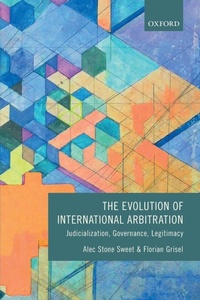
The Evolution of International Arbitration
Judicialization, Governance, Legitimacy
Published on 9. February 2017
Book
Paperback/Softback
270 pages
978-0-19-873973-9 (ISBN)
Description
The development of international arbitration as an autonomous legal order comprises one of the most remarkable stories of institution building at the global level over the past century. Today, transnational firms and states settle their most important commercial and investment disputes not in courts, but in arbitral centres, a tightly networked set of organizations that compete with one another for docket, resources, and influence.
In this book, Alec Stone Sweet and Florian Grisel show that international arbitration has undergone a self-sustaining process of institutional evolution that has steadily enhanced arbitral authority. This judicialization process was sustained by the explosion of trade and investment, which generated a steady stream of high stakes disputes, and the efforts of elite arbitrators and the major centres to construct arbitration as a viable substitute for litigation in domestic courts. For their part, state officials (as legislators and treaty makers), and national judges (as enforcers of arbitral awards), have not just adapted to the expansion of arbitration; they have heavily invested in it, extending the arbitral order's reach and effectiveness. Arbitration's very success has, nonetheless, raised serious questions about its legitimacy as a mode of transnational governance.
The book provides a clear causal theory of judicialization, original data collection and analysis, and a broad, relatively non-technical overview of the evolution of the arbitral order. Each chapter compares international commercial and investor-state arbitration, across clearly specified measures of judicialization and governance. Topics include: the evolution of procedures; the development of precedent and the demand for appeal; balancing in the public interest; legitimacy debates and proposals for systemic reform. This book is a timely assessment of how arbitration has risen to become a key component of international economic law and why its future is far from settled.
In this book, Alec Stone Sweet and Florian Grisel show that international arbitration has undergone a self-sustaining process of institutional evolution that has steadily enhanced arbitral authority. This judicialization process was sustained by the explosion of trade and investment, which generated a steady stream of high stakes disputes, and the efforts of elite arbitrators and the major centres to construct arbitration as a viable substitute for litigation in domestic courts. For their part, state officials (as legislators and treaty makers), and national judges (as enforcers of arbitral awards), have not just adapted to the expansion of arbitration; they have heavily invested in it, extending the arbitral order's reach and effectiveness. Arbitration's very success has, nonetheless, raised serious questions about its legitimacy as a mode of transnational governance.
The book provides a clear causal theory of judicialization, original data collection and analysis, and a broad, relatively non-technical overview of the evolution of the arbitral order. Each chapter compares international commercial and investor-state arbitration, across clearly specified measures of judicialization and governance. Topics include: the evolution of procedures; the development of precedent and the demand for appeal; balancing in the public interest; legitimacy debates and proposals for systemic reform. This book is a timely assessment of how arbitration has risen to become a key component of international economic law and why its future is far from settled.
Reviews / Votes
The innovative theory of judicialization set forth in the book, and the thorough data collection used to illustrate and complement the analysis, are valuable contributions to the study of international arbitration. This book will provide scholars, practitioners, law students and neophytes with a tremendous compilation of materials and analytic research to better apprehend not only the evolution of international arbitration, but also to understand arbitration as an autonomous legal order as we know it today. * Camille Martini, Journal of International Economic Law 2017 *More details
Language
English
Place of publication
Oxford
United Kingdom
Target group
Professional and scholarly
Dimensions
Height: 234 mm
Width: 156 mm
Thickness: 15 mm
Weight
415 gr
ISBN-13
978-0-19-873973-9 (9780198739739)
Copyright in bibliographic data and cover images is held by Nielsen Book Services Limited or by the publishers or by their respective licensors: all rights reserved.
Schweitzer Classification
Other editions
Additional editions
Alec Stone Sweet | Florian Grisel
The Evolution of International Arbitration
Judicialization, Governance, Legitimacy
E-Book
02/2017
1st Edition
OUP eBook
€24.99
Available for download
Alec Stone Sweet | Florian Grisel
The Evolution of International Arbitration
Judicialization, Governance, Legitimacy
Book
02/2017
Oxford University Press
€165.20
Shipment within 15-20 days
Alec Stone Sweet | Florian Grisel
The Evolution of International Arbitration
Judicialization, Governance, Legitimacy
E-Book
02/2017
1st Edition
OUP eBook
€24.99
Available for download
Persons
Professor Alec Stone Sweet is Saw Swee Hock Centennial Professor of Law, National University of Singapore, and Senior Fellow, Orville H. Schell Center for International Human Rights, Yale Law School. He is the author of The Birth of Judicial Politics in France, Governing with Judges: Constitutional Politics in Europe, On Law, Politics, and Judicialization, and The Judicial Construction of Europe, and the co-editor of European Integration and Supranational Governance,The Institutionalization of Europe, and A Europe of Rights: The Impact of the European Convention on Human Rights on National Legal Systems, all published by Oxford University Press.
Dr Florian Grisel is a Research Fellow at the Centre national de la recherche scientifique and a Senior Lecturer in Transnational Law at King's College London. He is a graduate of Sciences po Paris, Universite Paris 1 Pantheon-Sorbonne, Columbia University and Yale Law School. He has also gained extensive practice in international arbitration as an attorney based in Geneva and Paris.
Dr Florian Grisel is a Research Fellow at the Centre national de la recherche scientifique and a Senior Lecturer in Transnational Law at King's College London. He is a graduate of Sciences po Paris, Universite Paris 1 Pantheon-Sorbonne, Columbia University and Yale Law School. He has also gained extensive practice in international arbitration as an attorney based in Geneva and Paris.
Content
1: Judicialization and Arbitral Governance
2: The Evolution of the Arbitral Order
3: Procedures and Hierarchy
4: Precedent and Appeal
5: Balancing and the Public Interest
6: Legitimacy and Reform
2: The Evolution of the Arbitral Order
3: Procedures and Hierarchy
4: Precedent and Appeal
5: Balancing and the Public Interest
6: Legitimacy and Reform