

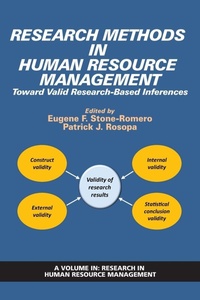
Research Methods in Human Resource Management
Toward Valid Research-Based Inferences
Published on 20. April 2020
Book
Paperback/Softback
242 pages
978-1-64802-088-9 (ISBN)
Description
Empirical research in HRM has focused on such issues as recruiting, testing, selection, training, motivation, compensation, and employee well-being. A review of the literature on these and other topics suggests that less than optimal methods have often been used in many HRM studies. Among the methods-related problems are using (a) measures or manipulations that have little or no construct validity, (b) samples of units (e.g., participants, organizations) that bear little or no correspondence to target populations, (c) research designs that have little or no potential for supporting valid causal inferences, (d) samples that are too small to provide for adequate statistical power, and (e) data analytic strategies that are inappropriate for the issues addressed by a study. As a result, our understanding of various HRM phenomena has suffered and improved methods may serve to enhance both the science and practice of HRM.
In view of the above, the purpose of this volume of Research in Human Resource Management is to provide basic and applied researchers with resources that will enable them to improve the internal validity, external validity, construct validity, and statistical conclusion validity of research in HRM and the related fields of industrial and organizational psychology, and organizational behavior. Sound research in these fields should serve to improve both science and practice. With respect to science, support for a theory hinges on the validity of research used to support it. In addition, the results of valid research are essential for the development and implementation of HRM policies and practices.
In the interest of promoting valid research-based inferences in HRM research, the chapters in this volume identify a wide range of methods-related problems and offer recommendations for dealing with them. Chapters in it address such HRM research-related topics as neglected research issues, causal inferences in research, heteroscedasticity in research, range restriction in research, interrater agreement indices, and construct validity issues in measures of such constructs as job performance, organizational politics, and safety climate.
In view of the above, the purpose of this volume of Research in Human Resource Management is to provide basic and applied researchers with resources that will enable them to improve the internal validity, external validity, construct validity, and statistical conclusion validity of research in HRM and the related fields of industrial and organizational psychology, and organizational behavior. Sound research in these fields should serve to improve both science and practice. With respect to science, support for a theory hinges on the validity of research used to support it. In addition, the results of valid research are essential for the development and implementation of HRM policies and practices.
In the interest of promoting valid research-based inferences in HRM research, the chapters in this volume identify a wide range of methods-related problems and offer recommendations for dealing with them. Chapters in it address such HRM research-related topics as neglected research issues, causal inferences in research, heteroscedasticity in research, range restriction in research, interrater agreement indices, and construct validity issues in measures of such constructs as job performance, organizational politics, and safety climate.
More details
Series
Language
English
Place of publication
United States
Publishing group
Emerald Publishing Inc
Target group
Professional and scholarly
Dimensions
Height: 234 mm
Width: 156 mm
Thickness: 14 mm
Weight
374 gr
ISBN-13
978-1-64802-088-9 (9781648020889)
Copyright in bibliographic data and cover images is held by Nielsen Book Services Limited or by the publishers or by their respective licensors: all rights reserved.
Schweitzer Classification
Other editions
Additional editions
Eugene F. Stone-Romero
Research Methods in Human Resource Management
Toward Valid Research-Based Inferences
E-Book
01/2020
1st Edition
Information Age Publishing
from
€62.33
Available for download
Persons
Eugene F. Stone-Romero, University of New Mexico
Patrick J. Rosopa, Clemson University
Patrick J. Rosopa, Clemson University
Content
Chapter 1. Perspectives on the Validity of Inferences from Research in Human Resource Management; Eugene F. Stone-Romero and Patrick J. Rosopa.
Chapter 2. Advances in Research Methods: What Have We Neglected? Neal Schmitt.
Chapter 3. Research Design and Causal Inferences in Human Resource Management Research; Eugene F. Stone-Romero.
Chapter 4. Heteroscedasticity in Organizational Research; Amber N. Schroeder, Patrick J. Rosopa, Julia H. Whitaker, Ian N. Fairbanks, and Phoebe Xoxakos.
Chapter 5. Kappa and Alpha and Pi, Oh My: Beyond Traditional Interrater Reliability Using Gwet's AC1 Statistic; Julie I. Hancock, James M. Vardaman, and David G. Allen.
Chapter 6. Evaluating Job Performance Measures: Criteria for Criteria; Angelo S. DeNisi and Kevin R. Murphy.
Chapter 7. Research Methods in Organizational Politics: Issues, Challenges, and Opportunities; Liam P. Maher, Zachary A. Russell, Samantha L. Jordan, Gerald R. Ferris, and Wayne A. Hochwarter.
Chapter 8. Range Restriction in Employment Interviews: An Influence Too Big to Ignore; Allen I. Huffcutt.
Chapter 9. We've Got (Safety) Issues: Current Methods and Potential Future Directions in Safety Climate Research; Lois E. Tetrick, Robert R. Sinclair, Gargi Sawhney, and Tiancheng (Allen) Chen.
Biographies.
Chapter 2. Advances in Research Methods: What Have We Neglected? Neal Schmitt.
Chapter 3. Research Design and Causal Inferences in Human Resource Management Research; Eugene F. Stone-Romero.
Chapter 4. Heteroscedasticity in Organizational Research; Amber N. Schroeder, Patrick J. Rosopa, Julia H. Whitaker, Ian N. Fairbanks, and Phoebe Xoxakos.
Chapter 5. Kappa and Alpha and Pi, Oh My: Beyond Traditional Interrater Reliability Using Gwet's AC1 Statistic; Julie I. Hancock, James M. Vardaman, and David G. Allen.
Chapter 6. Evaluating Job Performance Measures: Criteria for Criteria; Angelo S. DeNisi and Kevin R. Murphy.
Chapter 7. Research Methods in Organizational Politics: Issues, Challenges, and Opportunities; Liam P. Maher, Zachary A. Russell, Samantha L. Jordan, Gerald R. Ferris, and Wayne A. Hochwarter.
Chapter 8. Range Restriction in Employment Interviews: An Influence Too Big to Ignore; Allen I. Huffcutt.
Chapter 9. We've Got (Safety) Issues: Current Methods and Potential Future Directions in Safety Climate Research; Lois E. Tetrick, Robert R. Sinclair, Gargi Sawhney, and Tiancheng (Allen) Chen.
Biographies.