

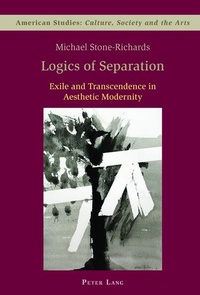
Logics of Separation
Exile and Transcendence in Aesthetic Modernity
Published on 28. July 2011
Book
Paperback/Softback
432 pages
978-3-03911-008-7 (ISBN)
Description
This book is made up of a set of innovative close readings and meditations on the significance of the modes and logics of separation in the thinking of aesthetic modernity. Separation is defined in Hegelian and psychoanalytic terms as psychic processes in the formation of identity that necessarily entail self-division and estrangement in the emergence of subjectivity and social identity. This phenomenon, called subjection, has been at the core of psychoanalytic readings since the work of Melanie Klein.
The works under consideration in the volume include material by W.E.B. Du Bois, Frantz Fanon, C.L.R. James, Ralph Ellison, Theresa Hak Kyung Cha, and Paul Celan, as well as the sorrow songs/Negro Spirituals. In each case the moment of passivity and modes of separation are approached as sites of inescapable conflict. The varying psychic, ethical, and political tensions underwriting this experience are examined in detail for each case study.
More details
Series
Edition
New edition
Language
English
Place of publication
Oxford
United Kingdom
Publishing group
Peter Lang Group AG, International Academic Publishers
Edition type
New edition
Illustrations
num. ill.
Dimensions
Height: 225 mm
Width: 150 mm
Thickness: 25 mm
Weight
630 gr
ISBN-13
978-3-03911-008-7 (9783039110087)
DOI
10.3726/978-3-0353-0155-7
Schweitzer Classification
Other editions
Additional editions
E-Book
08/2011
1st Edition
Peter Lang Verlag
€108.69
Available for download
Person
Michael Stone-Richards teaches in the Department of Liberal Arts, College for Creative Studies, Detroit, as professor in comparative literature and critical theory. He has published widely in French and English on critical theory, philosophy, and the intellectual history of the avant-garde and has translated the work of the psychoanalyst Pierre Fédida. His current research encompasses the work of Simone Weil, Frantz Fanon, Jean Wahl, Guy Debord and the French Baroque, Pierre Fédida, and Jean-Bertrand Pontalis.
Content
Contents: Race, Marxism and Colonial Experience: Du Bois, Fanon and James - Violence, temporality, subjection and cultural formation: Bildung and Hegelian Dialectic in Fanon - Painful time: a post-phenomenological reading of affective movement in the sorrow songs - The opening scene of Theresa Hak Kyung Cha's Dictee: She mimicks the speaking: Diseuse - Worker, aesthete, terrorist: the claims of justice in Henry James' The Princess Casamassima - Moments musicaux: Composition and landscape in the subject of Stevens and Prynne.