

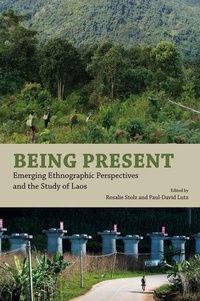
Being Present
Emerging Ethnographic Perspectives and the Study of Laos
Will be published approx. on 15. December 2025
Book
Paperback/Softback
288 pages
978-981-325-303-2 (ISBN)
Description
As Laos navigates development and globalization, Being Present examines the shifting role of ethnography in capturing the country's changing realities.
Ethnography has long called on researchers to immerse themselves in the worlds they study-but what does it mean to "be present" in the field today? Being Present investigates this question through innovative research on Laos, a country rapidly changing at the crossroads of Southeast Asia and China. This volume brings together a new generation of scholars to explore Chinese-built railways, shifting farmlands, urban mourning rituals, and changing aspirations in Laos.
Covering infrastructure, health, trade, and spirituality, these studies challenge assumptions about ethnography. They show how immersion and reflexivity remain essential in a connected world. Being Present offers a fresh look at contemporary Laos and a timely reflection on ethnographic practice.
Ethnography has long called on researchers to immerse themselves in the worlds they study-but what does it mean to "be present" in the field today? Being Present investigates this question through innovative research on Laos, a country rapidly changing at the crossroads of Southeast Asia and China. This volume brings together a new generation of scholars to explore Chinese-built railways, shifting farmlands, urban mourning rituals, and changing aspirations in Laos.
Covering infrastructure, health, trade, and spirituality, these studies challenge assumptions about ethnography. They show how immersion and reflexivity remain essential in a connected world. Being Present offers a fresh look at contemporary Laos and a timely reflection on ethnographic practice.
More details
Language
English
Place of publication
Singapore
Singapore
Target group
Professional and scholarly
Illustrations
20 color photos, 1 map
Dimensions
Height: 153 mm
Width: 229 mm
Thickness: 26 mm
Weight
380 gr
ISBN-13
978-981-325-303-2 (9789813253032)
Copyright in bibliographic data and cover images is held by Nielsen Book Services Limited or by the publishers or by their respective licensors: all rights reserved.
Schweitzer Classification
Persons
Rosalie Stolz is a postdoctoral researcher at the Global South Studies Center, University of Cologne, Germany. She conducts research among Khmu-speaking uplanders of northwestern Laos with a focus on the prevalent transformations of houses. She is also the author of Living Kinship, Fearing Spirits. Paul-David Lutz is an anthropologist and (former) rural development advisor with a longstanding focus on Laos. Currently, he is a postdoctoral researcher at the Laboratoire d'Anthropologie des Mondes Contemporains, Universite libre de Bruxelles, Belgium. His ongoing research focuses on animism in the context of agrarian transition among ethnic Khmu.
Content
FOREWORD by Liana Chua
INTRODUCTION by Paul-David Lutz and Rosalie Stolz
PART 1: ETHICS, IMMERSION AND AFFECT
CHAPTER 1 Fieldwork, literally - 'indolence', immersion and perceptions of poverty in upland Laos by Paul-David Lutz
CHAPTER 2 Ethical evaluation-and its absence-at a wake in Luang Prabang by Charles P. Zuckerman
CHAPTER 3 Embarrassment and social belonging: Pathways of participant feeling in northern Laos by Rosalie Stolz
PART 2 EXPERIENCING INFRASTRUCTURE
CHAPTER 4 The politics of dammed rivers and their futures: insights from the Nam Ou basin in northern Laos by Sumiya Bilegsaikhan Taij
CHAPTER 5 Refrigeration after relocation: What refrigerators can (not) do to improve lives in a resettled community in northwestern Laos by Floramante S. J. Ponce
CHAPTER 6 Cycling as method, train as transect: Exploring infrastructural friction and flow through mobile ethnography on the Laos-China Corridor by Jessica DiCarlo
CHAPTER 7 Closer together, but still apart: reflections on the Laos-China Railway and the (re)making of neighbour relations by Phill Wilcox
PART 3: SPIRITS, EFFICACY AND THE STATE
CHAPTER 8 Potency and phitsanu medicinal efficacy in the southern lowlands by Elizabeth M. Elliott
CHAPTER 9 'Do just enough for riid': the contemporary understanding of health and the reduction of rituals in Yrou communities by Thipphaphone Xayavong
CHAPTER 10 When new shamans enter the stage: traditional customs and ecstatic healing among the Akha by Giulio Ongaro
AFTERWORD by Sophie Chao
INTRODUCTION by Paul-David Lutz and Rosalie Stolz
PART 1: ETHICS, IMMERSION AND AFFECT
CHAPTER 1 Fieldwork, literally - 'indolence', immersion and perceptions of poverty in upland Laos by Paul-David Lutz
CHAPTER 2 Ethical evaluation-and its absence-at a wake in Luang Prabang by Charles P. Zuckerman
CHAPTER 3 Embarrassment and social belonging: Pathways of participant feeling in northern Laos by Rosalie Stolz
PART 2 EXPERIENCING INFRASTRUCTURE
CHAPTER 4 The politics of dammed rivers and their futures: insights from the Nam Ou basin in northern Laos by Sumiya Bilegsaikhan Taij
CHAPTER 5 Refrigeration after relocation: What refrigerators can (not) do to improve lives in a resettled community in northwestern Laos by Floramante S. J. Ponce
CHAPTER 6 Cycling as method, train as transect: Exploring infrastructural friction and flow through mobile ethnography on the Laos-China Corridor by Jessica DiCarlo
CHAPTER 7 Closer together, but still apart: reflections on the Laos-China Railway and the (re)making of neighbour relations by Phill Wilcox
PART 3: SPIRITS, EFFICACY AND THE STATE
CHAPTER 8 Potency and phitsanu medicinal efficacy in the southern lowlands by Elizabeth M. Elliott
CHAPTER 9 'Do just enough for riid': the contemporary understanding of health and the reduction of rituals in Yrou communities by Thipphaphone Xayavong
CHAPTER 10 When new shamans enter the stage: traditional customs and ecstatic healing among the Akha by Giulio Ongaro
AFTERWORD by Sophie Chao