

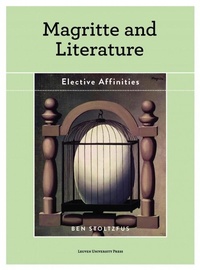
Magritte and Literature
Elective Affinities
1st Edition
Will be published approx. on 13. January 2014
Book
Paperback/Softback
296 pages
978-90-5867-960-4 (ISBN)
Description
Magritte's interarts dialog with literature
The Belgian surrealist artist Rene Magritte (1898-1967) is well known for his thought-provoking and witty images that challenge the observer's preconditioned perceptions of reality.
Magritte and Literature examines some of the artist's major paintings whose titles were influenced by and related to works of literature. Baudelaire's The Flowers of Evil, Goethe's Elective Affinities, and Poe's The Domain of Arnheim are representative examples of Magritte's interarts dialog with literary figures. Despite these convergences the titles subvert the images in his paintings. It is the two images together, the image in the painting and the image in the title, that expresses the aesthetics of Surrealism -- sparked by the juxtaposition of unrelated objects. Magritte's challenge to representation compares with metafiction's challenge to classic realism, Les Chants de Maldoror for example, and the intersecting space between art and writing, sometimes referred to as the iconotext, manifests itself whenever Magritte borrows a literary title for a painting. His strategy is to paint visible thought, and this reverse ekphrasis, the opposite of a rhetorical description of a painting, undermines the written text. When he succeeds, the effect is poetry.
This publication is GPRC-labeled (Guaranteed Peer-Reviewed Content).
The Belgian surrealist artist Rene Magritte (1898-1967) is well known for his thought-provoking and witty images that challenge the observer's preconditioned perceptions of reality.
Magritte and Literature examines some of the artist's major paintings whose titles were influenced by and related to works of literature. Baudelaire's The Flowers of Evil, Goethe's Elective Affinities, and Poe's The Domain of Arnheim are representative examples of Magritte's interarts dialog with literary figures. Despite these convergences the titles subvert the images in his paintings. It is the two images together, the image in the painting and the image in the title, that expresses the aesthetics of Surrealism -- sparked by the juxtaposition of unrelated objects. Magritte's challenge to representation compares with metafiction's challenge to classic realism, Les Chants de Maldoror for example, and the intersecting space between art and writing, sometimes referred to as the iconotext, manifests itself whenever Magritte borrows a literary title for a painting. His strategy is to paint visible thought, and this reverse ekphrasis, the opposite of a rhetorical description of a painting, undermines the written text. When he succeeds, the effect is poetry.
This publication is GPRC-labeled (Guaranteed Peer-Reviewed Content).
Reviews / Votes
The relationships uncovered with Lautreamont, Jules Verne, and even Hegel and Goethe is amazing. It's a really fascinating book. - Marjorie Perloff, Professor Emerita from Stanford University, a member of the American Academy of Arts and Sciences It is a masterpiece that not only just full justice to Magritte as a great artist but also reveals his intellectual powers. - Professor Emeritus Judd Hubert, University of California, Irvine What a fantastic book! A real treasure--it brings to it all of the author's inimitable skill with language, poetry, and visual aesthetics [...] handsomely printed and so well illustrated - Professor MacCannell, University of California, IrvineMore details
Edition
01
Language
English
Place of publication
Leuven
Belgium
Target group
College/higher education
US School Grade: College Graduate Student and over
Product notice
Paperback (trade)
Illustrations
40 Illustrations, color
Dimensions
Height: 232 mm
Width: 170 mm
Thickness: 15 mm
Weight
680 gr
ISBN-13
978-90-5867-960-4 (9789058679604)
Copyright in bibliographic data and cover images is held by Nielsen Book Services Limited or by the publishers or by their respective licensors: all rights reserved.
Schweitzer Classification
Person
Ben Stoltzfus, Edward A. Dickson Distinguished Professor Emeritus of Comparative Literature at the University of California, Riverside, is an internationally recognized scholar of Chenneviere, Gide, Robbe-Grillet, Hemingway, Lacan, Magritte, and Jasper Johns.
Content
Contents List of illustrations Foreword Acknowledgments Abbreviations Introduction
1 Magritte's Painterly Language: Reading, Writing, and Art-Magic 2 Toward Surrealism: Baudelaire and Poe 3 Lautreamont and Les Chants de Maldoror 4 Magritte and Jules Verne: Voyages extraordinaires to the Center of Art 5 Laclos and Les Liaisons dangereuses: Woman, Mirrors, and Robbe-Grillet 6 Cladel and The Tomb of the Wrestlers: Roses, Daggers, and Love in Interarts Discourse 7 The Glass Key-an Interarts Dialogue: Magritte and Dashiell Hammett 8 Dialectical Affinities: Hegel, Sade, and Goethe 9 Time Transfixed: Bergson, Proust, Einstein, and the Fourth Dimension 10 Magritte and Sheherazade: The Enchanted Domain
Conclusion Bibliography Index Gallery with color plates
1 Magritte's Painterly Language: Reading, Writing, and Art-Magic 2 Toward Surrealism: Baudelaire and Poe 3 Lautreamont and Les Chants de Maldoror 4 Magritte and Jules Verne: Voyages extraordinaires to the Center of Art 5 Laclos and Les Liaisons dangereuses: Woman, Mirrors, and Robbe-Grillet 6 Cladel and The Tomb of the Wrestlers: Roses, Daggers, and Love in Interarts Discourse 7 The Glass Key-an Interarts Dialogue: Magritte and Dashiell Hammett 8 Dialectical Affinities: Hegel, Sade, and Goethe 9 Time Transfixed: Bergson, Proust, Einstein, and the Fourth Dimension 10 Magritte and Sheherazade: The Enchanted Domain
Conclusion Bibliography Index Gallery with color plates