

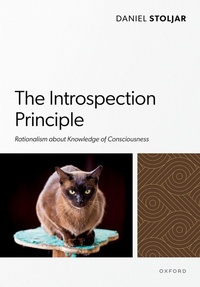
The Introspection Principle
Rationalism about Knowledge of Consciousness
Will be published approx. on 21. July 2026
Book
Hardback
256 pages
978-0-19-886564-3 (ISBN)
Description
What is introspection and how is it different from other sources of knowledge such as memory, perception and inference? The Introspection Principle offers a novel philosophical picture of introspection on which rational subjects are disposed to form beliefs about their own conscious states much as they are disposed to believe the obvious consequences of their beliefs, to form beliefs in response to the way they perceive the world around them, and to act in accordance with their beliefs; to introspect on this picture just is to form beliefs about conscious states in this way.
Daniel Stoljar sets out this rationalist account in detail, formulating it in terms of a proposed principle of rationality, the introspection principle. He explores several ways to interpret the principle, examines the notion of consciousness on which it relies, discusses its relation to other and better-known principles of rationality, and shows how an approach to introspection based on the principle improves on influential alternatives, such as inner sense, acquaintance, inferentialist and constitutivist theories.
Stoljar applies the rationalist account to thirteen major problems of introspection drawn from a wide analysis of the literatures in philosophy of mind, epistemology, and cognitive science. These include issues of evidence, transparency, diaphanousness, necessity, privileged access, luminosity, negative introspection, externalism, reasoning, revelation and the self. The Introspection Principle is a systematic presentation of a new approach to introspection that greatly illuminates our understanding of consciousness, rationality, and self-knowledge.
Daniel Stoljar sets out this rationalist account in detail, formulating it in terms of a proposed principle of rationality, the introspection principle. He explores several ways to interpret the principle, examines the notion of consciousness on which it relies, discusses its relation to other and better-known principles of rationality, and shows how an approach to introspection based on the principle improves on influential alternatives, such as inner sense, acquaintance, inferentialist and constitutivist theories.
Stoljar applies the rationalist account to thirteen major problems of introspection drawn from a wide analysis of the literatures in philosophy of mind, epistemology, and cognitive science. These include issues of evidence, transparency, diaphanousness, necessity, privileged access, luminosity, negative introspection, externalism, reasoning, revelation and the self. The Introspection Principle is a systematic presentation of a new approach to introspection that greatly illuminates our understanding of consciousness, rationality, and self-knowledge.
More details
Person
Daniel Stoljar is Professor of Philosophy at the Australian National University in Canberra, a fellow of the Australian Academy of the Humanities, and a former President of the Australasian Association of Philosophy. He is the author of many articles on philosophical issues about consciousness, mind, language, epistemology, and the nature of philosophy itself, as well as the books Ignorance and Imagination: The Epistemic Origin of the Problem of Consciousness (OUP, 2006), Physicalism (Routledge, 2010), Philosophical Progress: In Defence of a Reasonable Optimism (OUP, 2017) and What is Consciousness? (Routledge, 2023, co-authored with Amy Kind).
Content
- 1: Introspection
- 2: Consciousness
- 3: Rationalism
- 4: Perception
- 5: Evidence
- 6: Transparency
- 7: Diaphanousness
- 8: Acquaintance
- 9: Truth
- 10: Necessity
- 11: Privilege
- 12: Luminosity
- 13: Negation
- 14: Externalism
- 15: Inference
- 16: Revelation
- 17: Existence
- Conclusion