

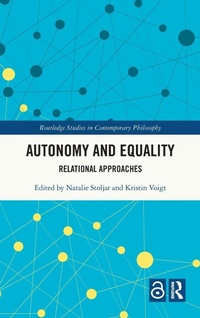
Autonomy and Equality
Relational Approaches
1st Edition
Published on 30. September 2021
Book
Hardback
258 pages
978-0-367-41689-8 (ISBN)
Description
This book draws connections and explores important questions at the intersection of the debates about relational autonomy and relational equality. Although these two research areas share several common assumptions and concerns, their connections have not been systematically explored.
The essays in this volume address theoretical questions at the intersection of relational theories of autonomy and equality and also consider how these theoretical considerations play out in real-world contexts. Several chapters explore possible conceptual links between relational autonomy and equality by considering the role of values-such as agency, non-domination, and self-respect-to which both relational autonomy theorists and relational egalitarians are committed. Others reflect on how debates about autonomy and equality can clarify our thinking about oppression based on race and gender, and how such oppression affects interpersonal relationships.
Autonomy and Equality: Relational Approaches is the first book to specifically address the relationship between these two research areas. It will be of interest to scholars and graduate students working in social and political philosophy, moral philosophy, and feminist philosophy.
Chapter 8 of this book is freely available as a downloadable Open Access PDF at http://www.taylorfrancis.com under a Creative Commons Attribution-Non Commercial-No Derivatives (CC-BY-NC-ND) 4.0 license.
The essays in this volume address theoretical questions at the intersection of relational theories of autonomy and equality and also consider how these theoretical considerations play out in real-world contexts. Several chapters explore possible conceptual links between relational autonomy and equality by considering the role of values-such as agency, non-domination, and self-respect-to which both relational autonomy theorists and relational egalitarians are committed. Others reflect on how debates about autonomy and equality can clarify our thinking about oppression based on race and gender, and how such oppression affects interpersonal relationships.
Autonomy and Equality: Relational Approaches is the first book to specifically address the relationship between these two research areas. It will be of interest to scholars and graduate students working in social and political philosophy, moral philosophy, and feminist philosophy.
Chapter 8 of this book is freely available as a downloadable Open Access PDF at http://www.taylorfrancis.com under a Creative Commons Attribution-Non Commercial-No Derivatives (CC-BY-NC-ND) 4.0 license.
Reviews / Votes
"Autonomy and Equality: Relational Approaches brings together 10 new essays by prominent philosophers on the hitherto unexamined yet patent interconnection of relational autonomy and political equality. The volume breaks new ground and constitutes an invaluable contribution to social and political philosophy." -- Marina Oshana, Professor Emerita, University of California, Davis, USA.More details
Series
Language
English
Place of publication
London
United Kingdom
Publishing group
Taylor & Francis Ltd
Target group
College/higher education
Dimensions
Height: 235 mm
Width: 157 mm
Thickness: 19 mm
Weight
529 gr
ISBN-13
978-0-367-41689-8 (9780367416898)
Copyright in bibliographic data and cover images is held by Nielsen Book Services Limited or by the publishers or by their respective licensors: all rights reserved.
Schweitzer Classification
Other editions
Additional editions
Book
09/2023
1st Edition
Routledge
€65.80
Shipment within 10-20 days
E-Book
09/2021
1st Edition
Routledge
€52.49
Available for download
E-Book
09/2021
1st Edition
Routledge
€52.49
Available for download
Persons
Natalie Stoljar is Professor of Philosophy at McGill University, jointly appointed in the Institute for Health and Social Policy. She is co-editor, with Catriona Mackenzie, of Relational Autonomy: Feminist Perspectives on Autonomy, Agency, and the Social Self (2000).
Kristin Voigt is an Associate Professor at McGill University, jointly appointed in the Institute for Health and Social Policy and the Department of Philosophy.
Kristin Voigt is an Associate Professor at McGill University, jointly appointed in the Institute for Health and Social Policy and the Department of Philosophy.
Content
1. Introduction: A relational turn in political philosophy
Natalie Stoljar and Kristin Voigt
2. Relational Equality and the Debate Between Externalist and Internalist Theories of Relational Autonomy
Catriona Mackenzie
3. Could Friends of Relational Autonomy be Relational Sufficientarians Rather than Relational Egalitarians?
Kasper Lippert-Rasmussen
4. The Wrongs of Relational Inequalities
Eliot Litalien
5. Relational Autonomy, Equality, and Self-Respect
Christian Schemmel
6. Autonomy, Relational Egalitarianism, and Indignation
Rebekah Johnston
7. Regarding Oneself as an Equal
Natalie Stoljar and Kristin Voigt
8. How Being Better Off Is Bad for You: Implications for Distribution, Relational Equality and an Egalitarian Ethos
Carina Fourie
9. Microaggressions: A Relational Analysis of Harm
Nabina Liebow
10. Musical Performance as a Route to Relational Autonomy and Social Equality
Jonathan Wolff
Natalie Stoljar and Kristin Voigt
2. Relational Equality and the Debate Between Externalist and Internalist Theories of Relational Autonomy
Catriona Mackenzie
3. Could Friends of Relational Autonomy be Relational Sufficientarians Rather than Relational Egalitarians?
Kasper Lippert-Rasmussen
4. The Wrongs of Relational Inequalities
Eliot Litalien
5. Relational Autonomy, Equality, and Self-Respect
Christian Schemmel
6. Autonomy, Relational Egalitarianism, and Indignation
Rebekah Johnston
7. Regarding Oneself as an Equal
Natalie Stoljar and Kristin Voigt
8. How Being Better Off Is Bad for You: Implications for Distribution, Relational Equality and an Egalitarian Ethos
Carina Fourie
9. Microaggressions: A Relational Analysis of Harm
Nabina Liebow
10. Musical Performance as a Route to Relational Autonomy and Social Equality
Jonathan Wolff