

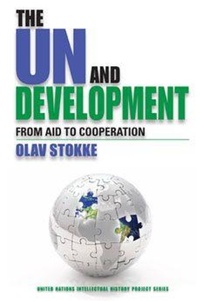
The UN and Development
From Aid to Cooperation
Published on 6. July 2009
Book
Paperback/Softback
752 pages
978-0-253-22081-3 (ISBN)
Description
The UN and Development provides the first comprehensive overview of the development policies and activities of the United Nations system from the late 1940s to the present. With an explicit focus on the history of the ideas that have been generated, institutionalized, and implemented by UN organizations, this book examines changing trends in development paradigms from the concept of technical assistance to underdeveloped countries, as they were called in the late 1940s, to development cooperation in the 21st century. Olav Stokke traces this fascinating story and demonstrates the UN's essential role and its future challenges in aiding the least developed countries and the globe's billion poorest inhabitants.
Reviews / Votes
"Stokke (Norwegian Institute of International Affairs) has written the 11th volume in the United Nations Intellectual History Project. Taking a largely narrative and chronological approach to a vast and complex subject, the author ultimately concludes that the UN's most important contribution to development 'has been to generate and successfully promote globally a holistic development concept, almost consistently keeping the social and human dimensions of development at the core.' He argues that this focus is correct, and that in this respect the UN has been right more often than some other development agencies such as the World Bank's International Bank for Reconstruction and Development. He makes sound points along the way, noting that UN programs have always been lightly funded and operate in a decentralized or horizontally organized system, with much diversity of thought and many political disagreements. There are 62 pages of appendixes filled with data and 114 pages of reference notes. [The author] . . . provides a sound reference work. Summing Up: Recommended. Graduate and research collections. -Choice"-D. P. Forsythe, University of Nebraska, Feb. 2010"...a sound reference work...Recommended. -ChoiceFeb. 2010"-D. P. Forsythe, University of Nebraska
"A fascinating and deeply researched study. . . . Olav Stokke has done a remarkable job of weaving together this complex story."-From the foreword by Louis Emmerij, Richard Jolly, and Thomas G. Weiss
More details
Series
Language
English
Place of publication
Bloomington, IN
United States
Product notice
Paperback (trade)
Illustrations
25 b&w illus.
Dimensions
Height: 234 mm
Width: 158 mm
Thickness: 46 mm
Weight
1058 gr
ISBN-13
978-0-253-22081-3 (9780253220813)
Copyright in bibliographic data and cover images is held by Nielsen Book Services Limited or by the publishers or by their respective licensors: all rights reserved.
Schweitzer Classification
Other editions
Previous edition

Book
06/2009
Indiana University Press
€81.71
Article exhausted; check for reprint
Person
Olav Stokke is Senior Researcher at the Norwegian Institute of International Affairs and former editor of the Nordic journal Forum for Development Studies. His books include Perspectives on European Development Co-operation, with Paul Hoebink; Food Aid and Human Security, with Edward Clay; and Policy Coherence in Development Co-operation, with Jacques Forster.
Content
List of Boxes and Tables
Series Editors' ForewordLouis Emmerij, Richard Jolly, and Thomas G. Weiss
Preface and Acknowledgments
List of Abbreviations
Introduction
Part 1. The Emergence of International Development Assistance
1. The Institutional Heritage and Pre-Aid Traditions and Ideas
2. The Expanded Programme of Technical Assistance
3. The UN Fund for Economic Development
4. First Steps Down the Road: What Can the Footprints Tell?
Part 2. The Formative Years
5. The First Development Decade: An Instrument of Persuasion?
6. The Second Development Decade
7. The United Nations Development Programme, 1966-1981
8. The World Food Programme, 1961-1981: Surplus Food for Development and Relief
9. The 1960s and 1970s: Perspectives on Development
Part 3. The Lost Decade and a New Beginning
10. Visions and Priorities for the 1990s: The United Nations Strategy for the Fourth Development Decade
11. The Revival of the Social and Human Dimensions of Development
12. Evolving Priorities, Patterns, and Trends, 1982-2005
13. Food Aid: From Development to Humanitarian Relief
14. The Long Road toward the Millennium Development Goals
15. The Contribution of the UN System to International Development Cooperation
Appendix: A Bird's-Eye View of ODA to Developing Countries and Multilateral Institutions
Notes
Index
About the Author
About the Project
Series Editors' ForewordLouis Emmerij, Richard Jolly, and Thomas G. Weiss
Preface and Acknowledgments
List of Abbreviations
Introduction
Part 1. The Emergence of International Development Assistance
1. The Institutional Heritage and Pre-Aid Traditions and Ideas
2. The Expanded Programme of Technical Assistance
3. The UN Fund for Economic Development
4. First Steps Down the Road: What Can the Footprints Tell?
Part 2. The Formative Years
5. The First Development Decade: An Instrument of Persuasion?
6. The Second Development Decade
7. The United Nations Development Programme, 1966-1981
8. The World Food Programme, 1961-1981: Surplus Food for Development and Relief
9. The 1960s and 1970s: Perspectives on Development
Part 3. The Lost Decade and a New Beginning
10. Visions and Priorities for the 1990s: The United Nations Strategy for the Fourth Development Decade
11. The Revival of the Social and Human Dimensions of Development
12. Evolving Priorities, Patterns, and Trends, 1982-2005
13. Food Aid: From Development to Humanitarian Relief
14. The Long Road toward the Millennium Development Goals
15. The Contribution of the UN System to International Development Cooperation
Appendix: A Bird's-Eye View of ODA to Developing Countries and Multilateral Institutions
Notes
Index
About the Author
About the Project