

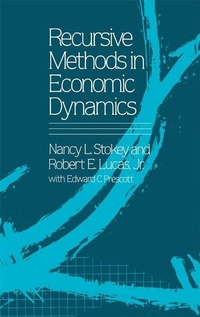
Recursive Methods in Economic Dynamics
Published on 10. October 1989
Book
Hardback
608 pages
978-0-674-75096-8 (ISBN)
Description
Three eminent economists provide in this book a rigorous, self-contained treatment of modern economic dynamics. Nancy L. Stokey, Robert E. Lucas, Jr., and Edward C. Prescott develop the basic methods of recursive analysis and emphasize the many areas where they can usefully be applied.
After presenting an overview of the recursive approach, the authors develop economic applications for deterministic dynamic programming and the stability theory of first-order difference equations. They then treat stochastic dynamic programming and the convergence theory of discrete-time Markov processes, illustrating each with additional economic applications. They also derive a strong law of large numbers for Markov processes. Finally, they present the two fundamental theorems of welfare economics and show how to apply the methods developed earlier to general equilibrium systems.
The authors go on to apply their methods to many areas of economics. Models of firm and industry investment, household consumption behavior, long-run growth, capital accumulation, job search, job matching, inventory behavior, asset pricing, and money demand are among those they use to show how predictions can be made about individual and social behavior. Researchers and graduate students in many areas of economics, both theoretical and applied, will find this book essential.
After presenting an overview of the recursive approach, the authors develop economic applications for deterministic dynamic programming and the stability theory of first-order difference equations. They then treat stochastic dynamic programming and the convergence theory of discrete-time Markov processes, illustrating each with additional economic applications. They also derive a strong law of large numbers for Markov processes. Finally, they present the two fundamental theorems of welfare economics and show how to apply the methods developed earlier to general equilibrium systems.
The authors go on to apply their methods to many areas of economics. Models of firm and industry investment, household consumption behavior, long-run growth, capital accumulation, job search, job matching, inventory behavior, asset pricing, and money demand are among those they use to show how predictions can be made about individual and social behavior. Researchers and graduate students in many areas of economics, both theoretical and applied, will find this book essential.
Reviews / Votes
The book is a tour de force. The authors present a unified approach to the techniques and applications of recursive economic theory. The presentations of discrete-time dynamic programming and of Markov processes are authoritative. There is a wide-ranging series of examples drawn from all branches of the discipline, but with special emphasis on macroeconomics. In the short run, the book will be a vital reference in any advanced course in macroeconomic theory. In the long run, it may help to remove the traditional boundaries between microeconomic theory and macroeconomic theory. -- Andrew Caplin, Columbia University This book is a wonderful collection of results on the techniques of dynamic programming with great applications to economics written by giants in the field. -- Sanford J. Grossman, University of Pennsylvania A magnificent work that is bound to have immense influence on the ways economists think about dynamic systems for many years to come. My own guess is that this book will eventually acquire the stature, say, of Hicks's Value and Capital or Samuelson's Foundations. -- Thomas J. Sargent, The Hoover InstitutionMore details
Language
English
Place of publication
Cambridge, Mass
United States
Target group
College/higher education
Professional and scholarly
Illustrations
27 line illustrations
Dimensions
Height: 243 mm
Width: 165 mm
Thickness: 48 mm
Weight
976 gr
ISBN-13
978-0-674-75096-8 (9780674750968)
Copyright in bibliographic data and cover images is held by Nielsen Book Services Limited or by the publishers or by their respective licensors: all rights reserved.
Schweitzer Classification
Other editions
Additional editions
Nancy L. Stokey
Recursive Methods in Economic Dynamics
E-Book
10/1989
1st Edition
Harvard University Press
€94.79
Available for download
Nancy L. Stokey
Recursive Methods in Economic Dynamics
E-Book
10/1989
1st Edition
Harvard University Press
€101.09
Available for download
Persons
Nancy L. Stokey is Frederick Henry Prince Distinguished Service Professor of Economics at the University of Chicago. Robert E. Lucas, Jr., is John Dewey Distinguished Service Professor of Economics at the University of Chicago. In 1995, he was awarded the Nobel Prize in Economics. Edward C. Prescott is Regents' Professor and Professor of Economics at Arizona State University and Senior Monetary Advisor to the Federal Reserve Bank of Minneapolis.
Content
I. THE RECURSIVE APPROACH 1. Introduction 2. An Overview 2.1 A Deterministic Model of Optimal Growth 2.2 A Stochastic Model of Optimal Growth 2.3 Competitive Equilibrium Growth 2.4 Conclusions and Plans II. DETERMINISTIC MODELS 3. Mathematical Preliminaries 3.1 Metric Spaces and Normed Vector Spaces 3.2 The Contraction Mapping Theorem 3.3 The Theorem of the Maximum 4. Dynamic Programming under Certainty 4.1 The Principle of Optimality 4.2 Bounded Returns 4.3 Constant Returns to Scale 4.4 Unbounded Returns 4.5 Euler Equations 5. Applications of Dynamic Programming under Certainty 5.1 The One-Sector Model of Optimal Growth 5.2 A "Cake-Eating" Problem 5.3 Optimal Growth with Linear Utility 5.4 Growth with Technical Progress 5.5 A Tree-Cutting Problem 5.6 Learning by Doing 5.7 Human Capital Accumulation 5.8 Growth with Human Capital 5.9 Investment with Convex Costs 5.10 Investment with Constant Returns 5.11 Recursive Preferences 5.12 Theory of the Consumer with Recursive Preferences 5.13 A Pareto Problem with Recursive Preferences 5.14 An (s, S) Inventory Problem 5.15 The Inventory Problem in Continuous Time 5.16 A Seller with Unknown Demand 5.17 A Consumption-Savings Problem 6. Deterministic Dynamics 6.1 One-Dimensional Examples 6.2 Global Stability: Liapounov Functions 6.3 Linear Systems and Linear Approximations 6.4 Euler Equations 6.5 Applications III. STOCHASTIC MODELS 7. Measure Theory and Integration 7.1 Measurable Spaces 7.2 Measures 7.3 Measurable Functions 7.4 Integration 7.5 Product Spaces 7.6 The Monotone Class Lemma