

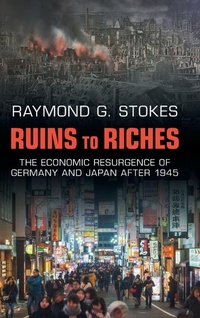
Ruins to Riches
The Economic Resurgence of Germany and Japan after 1945
Published on 9. May 2024
Book
Hardback
345 pages
978-1-316-51452-8 (ISBN)
Description
In 1945, Germany and Japan lay prostrate after total war and resounding defeat. By 1960, they had the second and fifth largest economies in the world respectively. This global leadership has been maintained ever since. How did these 'economic miracles' come to pass, and why were these two nations particularly adept at achieving them? Ray Stokes is the first to unpack these questions from comparative and international perspectives, emphasising both the individuals and companies behind this exceptional performance and the broader global political and economic contexts. He highlights the potent mixtures in both countries of judicious state action, effective industrial organisation, benign labour relations, and technological innovation, which they adapted constantly - sometimes painfully - to take full advantage of rapidly growing post-war international trade and globalisation. Together, they explain the spectacular resurgence of Deutschland AG and Japan Incorporated to global economic and technological leadership, which they have sustained to the present.
Reviews / Votes
'Stokes provides a highly accessible and nuanced comparative history of the evolution of German and Japanese capitalism after World War II, highlighting the key if ambiguous role of the United States in their success.' Geoffrey Jones, author of Deeply Responsible Business. A Global History of Values-Driven Leadership 'Ray Stokes presents a marvelous synthetic history of the remarkable (and as he shows, somewhat surprising) post World War II recovery and growth of the German and Japanese economies. The book is an excellent resource for anyone wanting to understand the remarkable and enduring success of both of these highly successful political economies.' Gary Herrigel, author of Manufacturing Constructions: Creative Action and Industrial Recomposition in the US, Germany and Japan 'Ray Stokes is one of the foremost international experts on the history of German industrialization and now he has turned his historical acumen to Japan as well. The result is extraordinarily good, filled with fresh insights and fascinating details. We have needed a work like this for a long time, and Stokes has provided it with masterful style and verve.' Mark Metzler, author of Capital as Will and Imagination: Schumpeter's Guide to the Postwar Japanese Miracle 'Writing with clarity and force, Ray Stokes tells one of the most important economic stories in modern history. The economic recovery of Japan and Germany after World War II, when in a few decades they transformed from defeated nations with devastated infrastructures into economic powerhouses with the second and third largest economies in the world, remains a stunning development. This is an important book both to understand the past and think towards the future, and Stokes should be commended for writing it.' Phillips O'Brien, author of How the War Was Won: Air-Sea Power and Allied Victory in World War II 'This is a well-researched and well-structured book that makes a valuable contribution to the field of comparative economic history. It will be of great interest to economic and business historians seeking a better understanding of the similarities and differences among the economic models and histories of Germany, Japan, and the United States. Its clear structure and coverage of many essential issues also make it an excellent read for advanced undergraduate and graduate students in economic and business history.' Jonathan Krautter, H-Soz-KultMore details
Language
English
Place of publication
Cambridge
United Kingdom
Illustrations
Worked examples or Exercises
Dimensions
Height: 235 mm
Width: 157 mm
Thickness: 25 mm
Weight
713 gr
ISBN-13
978-1-316-51452-8 (9781316514528)
Copyright in bibliographic data and cover images is held by Nielsen Book Services Limited or by the publishers or by their respective licensors: all rights reserved.
Schweitzer Classification
Other editions
Additional editions
Book
approx. 06/2026
Cambridge University Press
€31.50
Not yet published
E-Book
05/2024
Cambridge University Press
€36.99
Available for download
Person
Raymond Stokes is Professor of Business History and Director of the Centre for Business History in Scotland at the University of Glasgow. His extensive publications on business, environmental, and technological history include co-authoring The Business of Waste (CUP, 2013) and Building on Air (CUP, 2016).
Content
Introduction; Part I. No Mere Incantation: Rising from the Ashes of Defeat, 1945 to the early 1950s; 1. From Foe to Friend: The Allied Military Occupation of Germany and Japan; 2. Networking the Miracle Makers: (Re-)Constructing Cooperative Capitalism; Part II. Making Miracles, 1950-1973; 3. Manufacturing Miracles I: Forging Alternative Fordisms; 4. Manufacturing Miracles II: From Humble Craftsmen to World Beaters; 5. Consuming Miracles; 6. Exporting Wonders; Part III. Sustaining Miracles, 1973-1989; 7. The Wages of Construction; 8. The Hauntings of the Past; 9. Fragile Strength: Coping with Currency and Oil Crises; Part IV. Navigating Waves of Globalization, 1990 to the present; 10. Managing in Major Markets: Making and Selling in the United States and China; 11. Coping with the Close of the Cold War; 12. The Shock of the New Century: Three Crises (and a Near Miss); Conclusion: Deutschland AG and Japan Inc. - Lessons and Limits.