

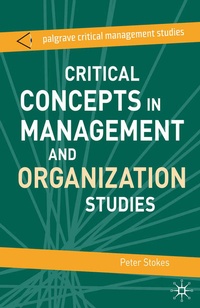
Critical Concepts in Management and Organization Studies
Key Terms and Concepts
Published on 24. May 2011
Book
Paperback/Softback
208 pages
978-0-230-01974-4 (ISBN)
Description
Critical Concepts in Management and Organization Studies provides an accessible introduction to the key themes of critical management studies. An ideal companion for students studying critical management and organizations, it breaks down the complex language, concepts and philosophical underpinnings defining critical management studies.
Reviews / Votes
'Much of the most important - even the most useful - contribution to Management Studies in recent years has come from critical theorists. However, there is a problem with their language. Because they have had something new to say, they have often resorted to new words or phrases, or new uses of existing words and phrases, to make their point. A tradition of playful use of language has exacerbated this problem for those new to the field. This book will give newcomers an insight into the language of critical management studies, as well as suggesting how to follow up on concepts. It will be equally useful to those of us who have been around for a time but have never cracked some of our colleagues' codes.' - David Sims, City University, UKMore details
Series
Edition
2011
Language
English
Place of publication
London
United Kingdom
Publishing group
Bloomsbury Publishing PLC
Target group
College/higher education
Dimensions
Height: 216 mm
Width: 140 mm
Thickness: 11 mm
Weight
269 gr
ISBN-13
978-0-230-01974-4 (9780230019744)
DOI
10.1007/978-0-230-34556-0
Schweitzer Classification
Other editions
Additional editions
E-Book
05/2011
1st Edition
Bloomsbury Academic
€44.49
Available for download
Person
PETER STOKES is Professor of Sustainable Management, Marketing and Tourism at Chester Business School, University of Chester, UK. His research interests are broadly situated in the areas of management and organization theory and interconnect with fields as diverse as, by way of example, marketing, training and development/tourism, doctoral study, genocide and militarization.
Content
Introduction: How to Use this Book.- Entries from A to Z.- References.- Index.