

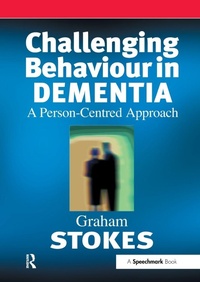
Challenging Behaviour in Dementia
A Person-Centred Approach
1st Edition
Published on 14. July 2000
Book
Paperback/Softback
272 pages
978-0-86388-397-2 (ISBN)
Description
Understanding socially disruptive behavior in dementia is never easy. Most explanations offer neither solace nor solutions for families and carers, and treatment is often characterized by policies of control and containment. The result of Graham Stokes' 15 years of clinical work with people who are challenging, this book: disputes the traditional medical model of dementia and asserts that if we reach behind the barrier of cognitive devastation and decipher the cryptic messages, it can be shown that much behavior is not meaningless but meaningful. It contrasts the medical interpretation that sees anti-social behavior as mere symptoms of disease with a person-centered interpretation that resonates change and resolution. It offers a radical and innovative interpretation of challenging behavior consistent with the new culture of dementia care, focusing on needs to be met rather than problems to be managed.
Reviews / Votes
"A detailed, extremely practical book ... This book's value is in its thorough treatment of this often complex area of clinical work ... undoubtedly a valuable source of information." - RCSLT Bulletin"This practical, spiral-bound book is a popular and useful text ... recommended to neuroscience nurses ... should be in every nursing library." - British Journal of Neuroscience Nursing
"Comprehensive and easy to use text...this is a well presented, easy to read, comprehensive text; a must for any clinician working in the field." - International Journal of Geriatric Psychiatry
"This manual draws on research to highlight the feeding and swallowing difficulties that may accompany dementia...needs assessment is guided by a discussion of a wide range of sensory, psychomotor, neurological and emotional factors." - Exceptional Child Educational Resources
"She has produced a detailed, extremely practical book...This book's value is in its thorough treatment of this often complex area of clinical work." - Bulletin
"The Layout is clear and concise; it provides good value for money and is defiantly a practical reference." - Speech & Language Therapy on Practice
"The book provides a balanced mix of theory and practice. All professionals will find the assessment forms and case studies useful. There is an excellent section on the ethics of tube feeding in severe dementia...The book advocates a team approach, which is reflected by the fact that all health professionals will find it a useful addition to their libraries." - Therapy Weekly
More details
Series
Language
English
Place of publication
London
United Kingdom
Publishing group
Taylor & Francis Ltd
Target group
Professional and scholarly
Professional Practice & Development
Dimensions
Height: 246 mm
Width: 174 mm
Thickness: 15 mm
Weight
494 gr
ISBN-13
978-0-86388-397-2 (9780863883972)
Copyright in bibliographic data and cover images is held by Nielsen Book Services Limited or by the publishers or by their respective licensors: all rights reserved.
Schweitzer Classification
Other editions
Additional editions
E-Book
07/2017
Routledge
€49.99
Available for download
E-Book
07/2017
Routledge
€49.99
Available for download
Person
GRAHAM STOKES is a Consultant Clinical Psychologist, Premier Health NHS Trust, Staffordshire, and Director of Mental Health, BUPA Care Services. He is a specialist in neurodegenerative disease and dementia, and has been instrumental in the development of person-centred approaches to assessment and care, with particular reference to challenging behaviour.
Content
1: Dementia: No Longer a 'Silent Epidemic'; 2: Assessment of Behaviour in Dementia; 3: The 'Medical Disease' Model of Dementia; 4: A Person with Dementia; 5: The Environmental Context of Dementia; 6: The Needs of People with Dementia; 7: Taxonomies of Possible Explanations; 8: Behavioural, Ecobehavioural and Functional Analysis; 9: Resolution Therapy; 10: Resolution: Needs to be Met, not Problems to be Managed; 11: Working with Unmet Need; 12: The Challenge of Confusion