

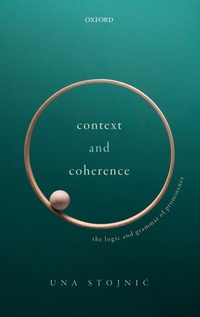
Context and Coherence
The Logic and Grammar of Prominence
Published on 25. February 2021
Book
Hardback
240 pages
978-0-19-886546-9 (ISBN)
Description
Natural languages are riddled with context-sensitivity. One and the same string of words can express many different meanings on occasion of use, and yet we understand one another effortlessly, on the fly. How do we do so? What fixes the meaning of context-sensitive expressions, and how are we able to recover the meaning so effortlessly?
This book offers a novel response: we can do so because we draw on a broad array of subtle linguistic conventions that determine the interpretation of context-sensitive items. Contrary to the dominant tradition, which maintains that the meaning of context-sensitive language is underspecified by grammar and that interpretation relies on non-linguistic cues and speakers' intentions, this book argues that meaning is determined entirely by discourse conventions, rules of language that have largely been missed and the effects of which have been mistaken for extra-linguistic effects of an utterance situation on meaning. The linguistic account of context developed here sheds a new light on the nature of linguistic content and the interaction between content and context. At the same time, it provides a novel model of context that should constrain and help evaluate debates across many subfields of philosophy where appeal to context has been common, often leading to surprising conclusions such as epistemology, ethics, value theory, metaphysics, metaethics, and logic.
This book offers a novel response: we can do so because we draw on a broad array of subtle linguistic conventions that determine the interpretation of context-sensitive items. Contrary to the dominant tradition, which maintains that the meaning of context-sensitive language is underspecified by grammar and that interpretation relies on non-linguistic cues and speakers' intentions, this book argues that meaning is determined entirely by discourse conventions, rules of language that have largely been missed and the effects of which have been mistaken for extra-linguistic effects of an utterance situation on meaning. The linguistic account of context developed here sheds a new light on the nature of linguistic content and the interaction between content and context. At the same time, it provides a novel model of context that should constrain and help evaluate debates across many subfields of philosophy where appeal to context has been common, often leading to surprising conclusions such as epistemology, ethics, value theory, metaphysics, metaethics, and logic.
Reviews / Votes
Context and Coherence exhibits the virtues of good writing in philosophy. Pragmaticians in particular will learn a great deal of formal semantics and will be pressed to ponder deep issues in philosophy of language and philosophical logic. They'll also learn, more concretely, lots of new lessons about how some kinds of pronoun resolution happen and relatedly, about unnoticed conventions governing discourse prominence. * Robert Stainton, University of Western Ontario, Journal of Pragmatics *More details
Language
English
Place of publication
Oxford
United Kingdom
Target group
Professional and scholarly
Dimensions
Height: 240 mm
Width: 161 mm
Thickness: 17 mm
Weight
514 gr
ISBN-13
978-0-19-886546-9 (9780198865469)
Copyright in bibliographic data and cover images is held by Nielsen Book Services Limited or by the publishers or by their respective licensors: all rights reserved.
Schweitzer Classification
Other editions
Additional editions
E-Book
02/2021
1st Edition
OUP eBook
€50.49
Available for download
E-Book
02/2021
1st Edition
OUP eBook
€50.49
Available for download
Person
Una Stojnic is an assistant professor of philosophy in the Department of Philosophy, Princeton University. Prior to joining Princeton, she was an assistant professor in the Department of Philosophy at Columbia University, a Bersoff assistant professor and faculty fellow in Philosophy at NYU, and a research fellow in philosophy in the School of Philosophy at ANU. She earned her PhD in Philosophy and a Certificate in Cognitive Science from Rutgers University in 2016.
Content
1: Introduction
Part I: So, What is Context and How Does it Work?
2: The Model of a True Demonstrative: Extra-linguistic Effects on Situated Meaning
3: An Alleged Ambiguity and the Dynamics of Context Change
4: Pointing Things Out: Prominence and the Attentional State of a Discourse
5: Context and Discourse Conventions
6: Interlude: Context and Common Ground
Part II: Contextualizing Content
7: Content in Context
8: The Challenge: Non-propositionalism
9: Dynamic Propositionalism
Part III: The Logic of Prominence
10: Content, Context and Logic
11: Prominence Semantics for Modality
Part IV: Conclusions and Directions
12: The Grammar of Prominence
Part V: Appendices
Appendix A: Formal Definitions for the Attention-Coherence Approach to Pronoun Resolution
Appendix B: A Formal Language for Modality with Coherence
Part I: So, What is Context and How Does it Work?
2: The Model of a True Demonstrative: Extra-linguistic Effects on Situated Meaning
3: An Alleged Ambiguity and the Dynamics of Context Change
4: Pointing Things Out: Prominence and the Attentional State of a Discourse
5: Context and Discourse Conventions
6: Interlude: Context and Common Ground
Part II: Contextualizing Content
7: Content in Context
8: The Challenge: Non-propositionalism
9: Dynamic Propositionalism
Part III: The Logic of Prominence
10: Content, Context and Logic
11: Prominence Semantics for Modality
Part IV: Conclusions and Directions
12: The Grammar of Prominence
Part V: Appendices
Appendix A: Formal Definitions for the Attention-Coherence Approach to Pronoun Resolution
Appendix B: A Formal Language for Modality with Coherence