

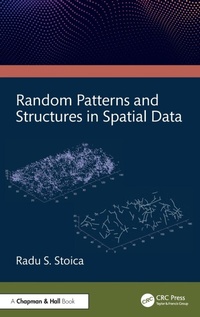
Random Patterns and Structures in Spatial Data
1st Edition
Published on 1. April 2025
Book
Hardback
281 pages
978-1-032-45936-3 (ISBN)
Description
The book presents a general mathematical framework able to detect and to characterise, from a morphological and statistical perspective, patterns hidden in spatial data. The mathematical tools employed are Gibbs Markov processes, mainly marked point procesess with interaction, which permits us to reduce the complexity of the pattern. It presents the framework, step by step, in three major parts: modeling, simulation, and inference. Each of these parts contains a theoretical development followed by applications and examples.
Features
Presents mathematical foundations for tackling pattern detection and characterisation in spatial data using marked Gibbs point processes with interactions
Includes application examples from cosmology, environmental sciences, geology, and social networks
Presents theoretical and practical details for the presented algorithms in order to be correctly and efficiently used
Provides access to C++ and R code to encourage the reader to experiment and to develop new ideas
Includes references and pointers to mathematical and applied literature to encourage further study
Random Patterns and Structures in Spatial Data is primarily aimed at researchers in mathematics, statistics, and the above-mentioned application domains. It is accessible for advanced undergraduate and graduate students and thus could be used to teach a course. It will be of interest to any scientific researcher interested in formulating a mathematical answer to the always challenging question: what is the pattern hidden in the data?
Features
Presents mathematical foundations for tackling pattern detection and characterisation in spatial data using marked Gibbs point processes with interactions
Includes application examples from cosmology, environmental sciences, geology, and social networks
Presents theoretical and practical details for the presented algorithms in order to be correctly and efficiently used
Provides access to C++ and R code to encourage the reader to experiment and to develop new ideas
Includes references and pointers to mathematical and applied literature to encourage further study
Random Patterns and Structures in Spatial Data is primarily aimed at researchers in mathematics, statistics, and the above-mentioned application domains. It is accessible for advanced undergraduate and graduate students and thus could be used to teach a course. It will be of interest to any scientific researcher interested in formulating a mathematical answer to the always challenging question: what is the pattern hidden in the data?
More details
Language
English
Place of publication
United Kingdom
Publishing group
Taylor & Francis Ltd
Target group
College/higher education
Academic, Professional Reference, and Professional Training
Illustrations
60 s/w Abbildungen, 60 s/w Zeichnungen
60 Line drawings, black and white; 60 Illustrations, black and white
Dimensions
Height: 240 mm
Width: 161 mm
Thickness: 21 mm
Weight
611 gr
ISBN-13
978-1-032-45936-3 (9781032459363)
Copyright in bibliographic data and cover images is held by Nielsen Book Services Limited or by the publishers or by their respective licensors: all rights reserved.
Schweitzer Classification
Other editions
Additional editions
Radu Stoica
Random Patterns and Structures in Spatial Data
E-Book
04/2025
Chapman and Hall
€73.99
Available for download
Radu Stoica
Random Patterns and Structures in Spatial Data
E-Book
04/2025
Chapman and Hall
€73.99
Available for download
Person
Radu S. Stoica is a full professor in mathematics at the University of Lorraine, France. His research activity connects stochastic geometry, spatial statistics, and Bayesian inference for probabilistic modeling and statistical description of random structures and patterns. The results of his work consist of tailored to the data methodologies based on Gibbs Markov models, Monte Carlo algorithms, and inference procedures, which can characterise and detect structures and patterns either hidden or directly observed in the data. The tackled application domains are astronomy, geosciences, image analysis, and network sciences. Prior to his current position, Dr. Stoica was an associate professor at University of Lille, France. He also worked as a researcher for INRAe Avignon, France, University Jaume I, Spain, and CWI Amsterdam, The Netherlands.
Content
1. Introduction. 2. Marked point processes. 3. Applications. 4. Markov chains: notions, properties and simulation algorithms 5. Applications. 6. Mathematical tools for statistical pattern detection and characterisation. 7. Applications.