

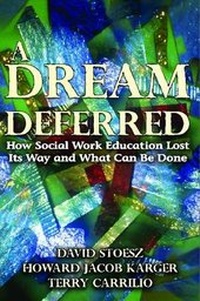
A Dream Deferred
How Social Work Education Lost Its Way and What Can be Done
Published on 30. April 2011
Book
Hardback
284 pages
978-1-4128-1422-5 (ISBN)
Description
From its inception in the late nineteenth century, social work has struggled with carrying out the complex, sometimes contradictory, functions associated with reducing suffering, enhancing social order, and social reform. Since then, social programs like the implementation of welfare and the expansion of the service economy - which should have augured well for American social work - instead lead to a continued loss of credibility with the public and within the academy. "A Dream Deferred" chronicles this decline of social work, attributing it to the poor quality of professional education during the past half-century. The incongruence between social work's promise and its performance warrants a critical review of professional education. For the past half-century, the fortunes of social work have been controlled by the Council of Social Work Education, which oversees accreditation of the nation's schools of social work. Stoesz, Karger and Carrilio argue that the lack of scholarship of the Board of Directors compromises this accreditation policy. Similarly, the quality of professional literature suffers from the weak scholarship of editors and referees.
The caliber of deans and directors of social work educational programs is low and Graduate students are ill-prepared to commence studies in social work. Further complicating this debate - the substitution of ideology for academic rigor makes social work vulnerable to its critics. The authors state that, since CSWE is unlikely to reform social work education, schools of social work should be free to obtain accreditation independently, and they propose criteria for independent accreditation. "A Dream Deferred" builds on the past, presents a bracing critique of the present, and proposes recommendations for a better future which cannot be ignored or dismissed.
From its inception in the late nineteenth century, social work has struggled with carrying out the complex, sometimes contradictory, functions associated with reducing suffering, enhancing social order, and social reform. Since then, social programs like the implementation of welfare and the expansion of the service economy - which should have augured well for American social work - instead lead to a continued loss of credibility with the public and within the academy. "A Dream Deferred" chronicles this decline of social work, attributing it to the poor quality of professional education during the past half-century. The incongruence between social work's promise and its performance warrants a critical review of professional education. For the past half-century, the fortunes of social work have been controlled by the Council of Social Work Education, which oversees accreditation of the nation's schools of social work. Stoesz, Karger and Carrilio argue that the lack of scholarship of the Board of Directors compromises this accreditation policy. Similarly, the quality of professional literature suffers from the weak scholarship of editors and referees.
The caliber of deans and directors of social work educational programs is low and Graduate students are ill-prepared to commence studies in social work. Further complicating this debate - the substitution of ideology for academic rigor makes social work vulnerable to its critics. The authors state that, since CSWE is unlikely to reform social work education, schools of social work should be free to obtain accreditation independently, and they propose criteria for independent accreditation. "A Dream Deferred" builds on the past, presents a bracing critique of the present, and proposes recommendations for a better future which cannot be ignored or dismissed.
The caliber of deans and directors of social work educational programs is low and Graduate students are ill-prepared to commence studies in social work. Further complicating this debate - the substitution of ideology for academic rigor makes social work vulnerable to its critics. The authors state that, since CSWE is unlikely to reform social work education, schools of social work should be free to obtain accreditation independently, and they propose criteria for independent accreditation. "A Dream Deferred" builds on the past, presents a bracing critique of the present, and proposes recommendations for a better future which cannot be ignored or dismissed.
From its inception in the late nineteenth century, social work has struggled with carrying out the complex, sometimes contradictory, functions associated with reducing suffering, enhancing social order, and social reform. Since then, social programs like the implementation of welfare and the expansion of the service economy - which should have augured well for American social work - instead lead to a continued loss of credibility with the public and within the academy. "A Dream Deferred" chronicles this decline of social work, attributing it to the poor quality of professional education during the past half-century. The incongruence between social work's promise and its performance warrants a critical review of professional education. For the past half-century, the fortunes of social work have been controlled by the Council of Social Work Education, which oversees accreditation of the nation's schools of social work. Stoesz, Karger and Carrilio argue that the lack of scholarship of the Board of Directors compromises this accreditation policy. Similarly, the quality of professional literature suffers from the weak scholarship of editors and referees.
The caliber of deans and directors of social work educational programs is low and Graduate students are ill-prepared to commence studies in social work. Further complicating this debate - the substitution of ideology for academic rigor makes social work vulnerable to its critics. The authors state that, since CSWE is unlikely to reform social work education, schools of social work should be free to obtain accreditation independently, and they propose criteria for independent accreditation. "A Dream Deferred" builds on the past, presents a bracing critique of the present, and proposes recommendations for a better future which cannot be ignored or dismissed.
More details
Language
English
Place of publication
Somerset
United Kingdom
Publishing group
Taylor & Francis Inc
Target group
College/higher education
Professional and scholarly
ISBN-13
978-1-4128-1422-5 (9781412814225)
Copyright in bibliographic data and cover images is held by Nielsen Book Services Limited or by the publishers or by their respective licensors: all rights reserved.
Schweitzer Classification
Persons
David Stoesz is professor of social work at Virginia Commonwealth University. His research interests include child welfare and financial services for low-income families. He is the author of Quixote's Ghost: The Right, the Liberati, and the Future of Social Policy. Howard Jacob Karger is head of the School of Social Work & Human Services at the University of Queensland. He is the author of numerous books, including Shortchanged: Life and Debt in the Fringe Economy and American Social Welfare Policy (Sixth Edition). Terry Carrilio is assistant professor emeritus of social work at San Diego State University. She is the author of Home-Visiting Strategies: A Case-Management Guide for Caregivers.
David Stoesz is professor of social work at Virginia Commonwealth University. His research interests include child welfare and financial services for low-income families. He is the author of Quixote's Ghost: The Right, the Liberati, and the Future of Social Policy. Howard Jacob Karger is head of the School of Social Work & Human Services at the University of Queensland. He is the author of numerous books, including Shortchanged: Life and Debt in the Fringe Economy and American Social Welfare Policy (Sixth Edition). Terry Carrilio is assistant professor emeritus of social work at San Diego State University. She is the author of Home-Visiting Strategies: A Case-Management Guide for Caregivers.
David Stoesz is professor of social work at Virginia Commonwealth University. His research interests include child welfare and financial services for low-income families. He is the author of Quixote's Ghost: The Right, the Liberati, and the Future of Social Policy. Howard Jacob Karger is head of the School of Social Work & Human Services at the University of Queensland. He is the author of numerous books, including Shortchanged: Life and Debt in the Fringe Economy and American Social Welfare Policy (Sixth Edition). Terry Carrilio is assistant professor emeritus of social work at San Diego State University. She is the author of Home-Visiting Strategies: A Case-Management Guide for Caregivers.