

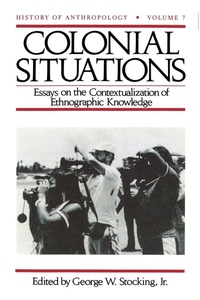
Colonial Situations
Essays on the Contextualization of Ethnographic Knowledge
Published on 15. September 1993
Book
Paperback/Softback
348 pages
978-0-299-13124-1 (ISBN)
Description
The relation of anthropology to colonialism and imperialism became a burning issue for anthropologists in the mid-1960s. As European colonies in Asia and Africa became independent nations, as the United States engaged in war in South-east Asia and in covert operations in South America, anthropologists questioned their interactions with their subjects and worried about the political consequences of government-supported research. By 1970, some spoke of anthropology as ""the child of Western imperialism"" and as ""scientific colonialism"". Ironically, as the link between anthropology and colonialism became more widely accepted within the discipline, serious interest diminished in examining the history of anthropology in colonial contexts. This volume attempts a critical historical consideration of the varying colonial situations in which (and from which) ethnographic knowledge essential to anthropology has been produced. The essays comment on ethnographic work from the middle of the 19th century to almost the end of the 20th; they cover regions from Oceania through Southeast Asia, the Andaman Islands and Southern Africa, to North and South America. The ""colonial situations"" also range from first contact through to the establishment of colonial power; from District Officer administrations through to white settler regimes; from internal colonialism to international mandates; from early pacification to wars of colonial liberation; from the expropriation of land to the defence of ecology. The motivations and responses of the anthropologists discussed are equally varied: the romantic resistance of Maclay and the complicity of Kubary in early colonialism; Malinowski's salesmanship of academic anthropology; Speck's advocacy of Indian land rights; Schneider's grappling with the ambiguities of rapport; and Turner's facilitation of Kayapo cinematic activism.
More details
Series
Language
English
Place of publication
Wisconsin
United States
Target group
College/higher education
Product notice
Paperback (trade)
Illustrations
23 illustrations, 2 maps
Dimensions
Height: 231 mm
Width: 155 mm
Thickness: 21 mm
Weight
481 gr
ISBN-13
978-0-299-13124-1 (9780299131241)
Copyright in bibliographic data and cover images is held by Nielsen Book Services Limited or by the publishers or by their respective licensors: all rights reserved.
Schweitzer Classification
Person
George W. Stocking, Jr., is the Stein-Freiler Distinguished Service Professor of Anthropology and the Committee on the Conceptual Foundations of Science at the University of Chicago. His books include The Ethnographer's Magic, also published by the University of Wisconsin Press, Race, Culture, and Evolution: Essays in the History of Anthropology, and Victorian Anthropology.