

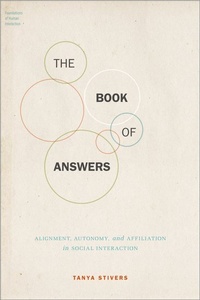
The Book of Answers
Alignment, Autonomy, and Affiliation in Social Interaction
Published on 29. August 2022
Book
Hardback
216 pages
978-0-19-756389-2 (ISBN)
Description
Imagine for a moment the only way to confirm a yes-no question was by saying Yeah. How different would this make our communication? Relying on a large corpus of naturally occurring recordings of spontaneous social interaction, this book explores all of the ways that we confirm questions in our everyday social lives.
Tanya Stivers analyzes what these different ways of responding allow us to do that is unique to each answer type. When do we answer with Yeah rather than He is, for instance; or when do we use more complicated forms of confirming? This information provides us with the basic response possibility space. From that point we can examine what the range of responses, in particular answers, tells us about what is important to us in managing social relationships through social interaction. The book explains that we can conceptualize the response possibility space as having three dimensions: alignment, autonomy, and affiliation. Speakers rely on the details of their response to position themselves at a particular point in that three-dimensional space, sometimes accepting trade-offs among the dimensions to achieve a stance that is higher in alignment and autonomy and lower in affiliation or higher in affiliation and autonomy but lower in alignment.
The Book of Answers uses real-life conversations to find hidden patterns in how we do things together such as reach decisions, tell stories, or arrive at agreement or disagreement. Delving into the science of how we talk, this book investigates what those patterns tell us about human communication and our social lives.
Tanya Stivers analyzes what these different ways of responding allow us to do that is unique to each answer type. When do we answer with Yeah rather than He is, for instance; or when do we use more complicated forms of confirming? This information provides us with the basic response possibility space. From that point we can examine what the range of responses, in particular answers, tells us about what is important to us in managing social relationships through social interaction. The book explains that we can conceptualize the response possibility space as having three dimensions: alignment, autonomy, and affiliation. Speakers rely on the details of their response to position themselves at a particular point in that three-dimensional space, sometimes accepting trade-offs among the dimensions to achieve a stance that is higher in alignment and autonomy and lower in affiliation or higher in affiliation and autonomy but lower in alignment.
The Book of Answers uses real-life conversations to find hidden patterns in how we do things together such as reach decisions, tell stories, or arrive at agreement or disagreement. Delving into the science of how we talk, this book investigates what those patterns tell us about human communication and our social lives.
Reviews / Votes
Stivers thus moves from details, to typologies, to a system of social answering which she calls the 'modular response possibility space'. This book thus provides a valuable and productive system for researchers in interaction analysis to connect the most basic interaction exchange with social and interactional relationships, a system that should be in the toolbox of every analyst. * Scott F. Kiesling, Language in Society *More details
Series
Language
English
Place of publication
New York
United States
Target group
Professional and scholarly
Dimensions
Height: 163 mm
Width: 236 mm
Thickness: 23 mm
Weight
494 gr
ISBN-13
978-0-19-756389-2 (9780197563892)
Copyright in bibliographic data and cover images is held by Nielsen Book Services Limited or by the publishers or by their respective licensors: all rights reserved.
Schweitzer Classification
Other editions
Additional editions
E-Book
04/2022
OUP eBook
€56.99
Available for download
E-Book
04/2022
OUP eBook
€56.99
Available for download
Person
Tanya Stivers is a Professor of Sociology at UCLA. She is the Director of the Center for Language, Interaction, and Culture and the President of the International Society for Conversation Analysis. She has studied social interaction in clinical encounters with a focus on the way that patient interaction with physicians shapes diagnostic and treatment outcomes. Her research on everyday conversation has explored a range of aspects of response design including timing of responses, who responds, and the design of the response. She is the author of Prescribing Under Pressure: Physician-Parent Conversations and Antibiotics and the co-editor of Person Reference in Interaction: Linguistic, Cultural, and Social Perspectives and The Morality of Knowledge in Conversation.
Content
Preface
Acknowledgments
Chapter 1: Introduction
Chapter 2: Questions
Chapter 3: Responses
Chapter 4: Interjections
Chapter 5: Repetitions
Chapter 6: Transformations
Chapter 7: The Modular Response Possibility Space
Index
Acknowledgments
Chapter 1: Introduction
Chapter 2: Questions
Chapter 3: Responses
Chapter 4: Interjections
Chapter 5: Repetitions
Chapter 6: Transformations
Chapter 7: The Modular Response Possibility Space
Index