

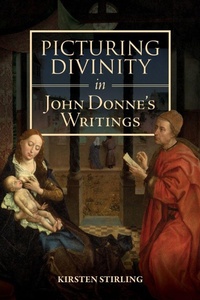
Picturing Divinity in John Donne's Writings
Published on 5. March 2024
Book
Paperback/Softback
192 pages
978-1-84384-707-6 (ISBN)
Description
A new approach to the visual arts in the work of John Donne
The five known portraits of John Donne and the many artworks bequeathed in his will bear witness to his interest in painting. His interest in art is also evident in his writings, with poems and sermons including many references to pictures and engravings, painters and sculptors. However, Donne never used his familiarity with painterly techniques to produce a simple ekphrasis or description in his writings. This book offers a new approach to Donne's rich and nuanced presentation of the visual arts in his writing, arguing that even his explicit allusions to pictures are less concrete than they may first appear.
Although Donne was familiar with contemporary treatises on art, many of his most compelling references to paintings and painterly techniques come from his reading of theology, including works by Nicholas of Cusa and Martin Luther.These previously unidentified sources for Donne's painterly imagery help us to understand how the plastic arts become his tool to reveal the limits of representation, and thus to point beyond the material realm towards the unrepresentable and unknowable divine.
This study provides new insights on some of his best-known poems, both secular and religious, and extends our appreciation of John Donne as an artist constantly exploring the limits of his own practice as a poet - and preacher - as he confronts the relationship between the human and the divine.
On publication this book is available as an Open Access eBook under the Creative Commons license: CC BY-NC.
The five known portraits of John Donne and the many artworks bequeathed in his will bear witness to his interest in painting. His interest in art is also evident in his writings, with poems and sermons including many references to pictures and engravings, painters and sculptors. However, Donne never used his familiarity with painterly techniques to produce a simple ekphrasis or description in his writings. This book offers a new approach to Donne's rich and nuanced presentation of the visual arts in his writing, arguing that even his explicit allusions to pictures are less concrete than they may first appear.
Although Donne was familiar with contemporary treatises on art, many of his most compelling references to paintings and painterly techniques come from his reading of theology, including works by Nicholas of Cusa and Martin Luther.These previously unidentified sources for Donne's painterly imagery help us to understand how the plastic arts become his tool to reveal the limits of representation, and thus to point beyond the material realm towards the unrepresentable and unknowable divine.
This study provides new insights on some of his best-known poems, both secular and religious, and extends our appreciation of John Donne as an artist constantly exploring the limits of his own practice as a poet - and preacher - as he confronts the relationship between the human and the divine.
On publication this book is available as an Open Access eBook under the Creative Commons license: CC BY-NC.
Reviews / Votes
It is always refreshing when a scholar invested in theology is also comfortable with uncertainty, fluidity, and unknowing. Both Stirling's broader arguments and her specific readings repeatedly resist certainty, definitiveness, or consistency; Picturing Divinity claims untidiness and unknowing as important lyric and doctrinal territory. Stirling's literary analyses are also often nuanced, subtle, and open-ended, and this is just as true of her readings of the sermons as it is of the holy sonnets or secular poems... Stirling raises important issues about how we should think about the figure, the artwork, the icon, and the image in a writer like Donne in a moment of English culture like his. Her work models important questions about how to study influences, allusions, and intertextuality in early modern writers: John Donne and beyond. * RENAISSANCE QUARTERLY *More details
Series
Language
English
Place of publication
Cambridge
United Kingdom
Publishing group
Boydell & Brewer Ltd
Target group
Professional and scholarly
Product notice
Paperback (trade)
Illustrations
6 colour illus.
Dimensions
Height: 234 mm
Width: 156 mm
Thickness: 11 mm
Weight
304 gr
ISBN-13
978-1-84384-707-6 (9781843847076)
Copyright in bibliographic data and cover images is held by Nielsen Book Services Limited or by the publishers or by their respective licensors: all rights reserved.
Schweitzer Classification
Person
Kirsten Stirling is Associate Professor of English Literature at the University of Lausanne, Switzerland. A former president of the John Donne Society, she has written extensively on a range of topics, including early modern poetry, Scottish Literature, and J. M. Barrie's Peter Pan.
Content
Introduction: Verbal and Visual Art
Making and breaking images
Donne's knowledge of art
Dr. Donne's art gallery
Iconoclasm and anxiety in Donne's poetry
1. Shadows
Portraits of Donne
"His Picture"
The picture in the heart
Likeness
2. Art and the Apophatic
The "well-made and well-placed picture"
The sculptor and the statue
The red glasse
The "curious masterpeece" and the Imago Dei
3. Annunciation: Representing the Unrepresentable
"In little roome": the circumscription of the divine
The Incarnate Word
Swerving away from ekphrasis
"A circle... whose first and last concurre"
4. Crucifixion
Negative theology and "The Crosse"
The Deus Absconditus and the Cross in Donne's Good Friday Poem
The "Picture of Christ crucified"
5. Judgement
Resurrection. Imperfect.
The face of God in the Holy Sonnets
Imagined corners
Vision and Revision
Ut pictura poesis
Conclusion
Making and breaking images
Donne's knowledge of art
Dr. Donne's art gallery
Iconoclasm and anxiety in Donne's poetry
1. Shadows
Portraits of Donne
"His Picture"
The picture in the heart
Likeness
2. Art and the Apophatic
The "well-made and well-placed picture"
The sculptor and the statue
The red glasse
The "curious masterpeece" and the Imago Dei
3. Annunciation: Representing the Unrepresentable
"In little roome": the circumscription of the divine
The Incarnate Word
Swerving away from ekphrasis
"A circle... whose first and last concurre"
4. Crucifixion
Negative theology and "The Crosse"
The Deus Absconditus and the Cross in Donne's Good Friday Poem
The "Picture of Christ crucified"
5. Judgement
Resurrection. Imperfect.
The face of God in the Holy Sonnets
Imagined corners
Vision and Revision
Ut pictura poesis
Conclusion