

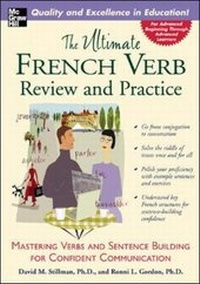
The Ultimate French Verb Review and Practice
Published on 16. April 2006
Book
Paperback/Softback
320 pages
978-0-07-141672-6 (ISBN)
Description
Learn verb skills and communicate confidently in a new language
Building on the authors' bestselling The Ultimate Review and Practice series, this book is your best bet to mastering the often tricky verb forms and key sentence structures of the French language. The Ultimate French Verb Review and Practice offers a step-by-step program for experienced beginners through advanced learners to understand how different verb forms work and use that knowledge to build increasingly sophisticated sentences in French. No other book on the market combines guidance and practice in verb formation and usage with tips on the 18 most commonly used sentence models.
Building on the authors' bestselling The Ultimate Review and Practice series, this book is your best bet to mastering the often tricky verb forms and key sentence structures of the French language. The Ultimate French Verb Review and Practice offers a step-by-step program for experienced beginners through advanced learners to understand how different verb forms work and use that knowledge to build increasingly sophisticated sentences in French. No other book on the market combines guidance and practice in verb formation and usage with tips on the 18 most commonly used sentence models.
More details
Series
Language
English
Place of publication
United States
Publishing group
McGraw-Hill Education - Europe
Dimensions
Height: 254 mm
Width: 178 mm
Thickness: 15 mm
Weight
433 gr
ISBN-13
978-0-07-141672-6 (9780071416726)
Copyright in bibliographic data and cover images is held by Nielsen Book Services Limited or by the publishers or by their respective licensors: all rights reserved.
Schweitzer Classification
Other editions
New editions
David Stillman | Ronni Gordon
The Ultimate French Verb Review and Practice
Book
10/2012
2nd Edition
McGraw-Hill Contemporary
€28.50
Shipment within 15-20 days
Persons
McGraw-Hill authors represent the leading experts in their fields and are dedicated to improving the lives, careers, and interests of readers worldwide
McGraw-Hill authors represent the leading experts in their fields and are dedicated to improving the lives, careers, and interests of readers worldwide
McGraw-Hill authors represent the leading experts in their fields and are dedicated to improving the lives, careers, and interests of readers worldwide
Content
Introduction
1. The Present Tense of Regular Verbs
Building Sentences
Subject + verb, subject + verb + direct object
(transitive and intransitive verbs)
Disjunctive pronouns + subject + verb,
disjunctive pronoun + subject + verb + direct object
2. Irregular Verbs (Part I)
Building Sentences
Negative Sentences
3. Irregular Verbs (Part II)
Building Sentences
Verb + infinitive construction
Questions: yes/no questions
4. The Imperative
Building Sentences
Sentences with indirect objects
Sentences with direct object pronouns
Sentences with indirect object pronouns
Object pronouns with the imperative
5. The Passe Compose
Building Sentences
Questions: information questions, question words
Placement of adverbs in the passe
The Passive voice
6. The Imperfect; The Imperfect vs. the Passe Compose
Building Sentences
Sentences with the pronouns y and en
7. Reflexive Verbs
Building Sentences
Sentences with double object pronouns
8. The Future and the Conditional
Building Sentences
Conditional sentence: possible conditions, contrary -to-present-fact conditions
Clef sentences: highlighting an element of a sentence
9. Compound Tense: The Pluerfect; The Future Perfect;
The Conditional Perfect
Building Sentences
Conditional sentences: contrary- to- past-fact conditions
Clef sentences: highlighting the direct object of the sentence
10. The Subjunctive (Part I): The Present Subjunctive Building Sentences
Clef sentencehighlightinging the direct object and other elements of the sentence
11. The Subjunctive (Part II)
The Subjunctive in Adjective Clauses; The Past Subjunctive
The Subjunctive in Adverb Clauses
Building Sentences
Compound and complex sentence
12. The Present Participle and the Infinitive
Building Sentences
Preposition + infinitive phrases as verbal complements
Laisser + infinitive
The causative (faire + infinitive)
Etc.
1. The Present Tense of Regular Verbs
Building Sentences
Subject + verb, subject + verb + direct object
(transitive and intransitive verbs)
Disjunctive pronouns + subject + verb,
disjunctive pronoun + subject + verb + direct object
2. Irregular Verbs (Part I)
Building Sentences
Negative Sentences
3. Irregular Verbs (Part II)
Building Sentences
Verb + infinitive construction
Questions: yes/no questions
4. The Imperative
Building Sentences
Sentences with indirect objects
Sentences with direct object pronouns
Sentences with indirect object pronouns
Object pronouns with the imperative
5. The Passe Compose
Building Sentences
Questions: information questions, question words
Placement of adverbs in the passe
The Passive voice
6. The Imperfect; The Imperfect vs. the Passe Compose
Building Sentences
Sentences with the pronouns y and en
7. Reflexive Verbs
Building Sentences
Sentences with double object pronouns
8. The Future and the Conditional
Building Sentences
Conditional sentence: possible conditions, contrary -to-present-fact conditions
Clef sentences: highlighting an element of a sentence
9. Compound Tense: The Pluerfect; The Future Perfect;
The Conditional Perfect
Building Sentences
Conditional sentences: contrary- to- past-fact conditions
Clef sentences: highlighting the direct object of the sentence
10. The Subjunctive (Part I): The Present Subjunctive Building Sentences
Clef sentencehighlightinging the direct object and other elements of the sentence
11. The Subjunctive (Part II)
The Subjunctive in Adjective Clauses; The Past Subjunctive
The Subjunctive in Adverb Clauses
Building Sentences
Compound and complex sentence
12. The Present Participle and the Infinitive
Building Sentences
Preposition + infinitive phrases as verbal complements
Laisser + infinitive
The causative (faire + infinitive)
Etc.