

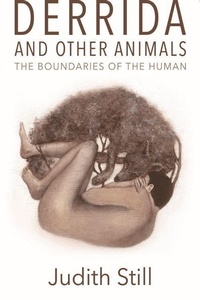
Derrida and Other Animals
The Boundaries of the Human
Published on 13. July 2015
Book
Hardback
416 pages
978-0-7486-8097-9 (ISBN)
Description
What is man? Judith Still examines Derrida's contribution to this long-standing philosophical and political debate, which has typically evoked a significant division between human beings and other animals. Derrida pays close attention to how animals are used to explore humanity in a range of writings, including fables and fiction. This leads to ethical questions about how humans treat animals: sacrificing animals (say, in factory farms) while extending love to pets. And it leads to political questions about how we dehumanise 'outsiders', from historical matters such as colonialism and slavery to contemporary issues such as State Terror in response to 'rogue states'.
Reviews / Votes
In this fascinating and important study, Judith Still is 'on the track' of Derrida's writings on the human/animal question. She proceeds a pas de loup, presenting, critiquing and amplifying his texts with issues of gender (social and grammatical), the borderline with 'less human humans', cannibalism, naming, weaving and much more. * Professor Naomi Segal, Birkbeck, University of London *More details
Language
English
Place of publication
Edinburgh
United Kingdom
Target group
College/higher education
Product notice
sewn/stitched
Cloth over boards
Dimensions
Height: 239 mm
Width: 163 mm
Thickness: 30 mm
Weight
816 gr
ISBN-13
978-0-7486-8097-9 (9780748680979)
Copyright in bibliographic data and cover images is held by Nielsen Book Services Limited or by the publishers or by their respective licensors: all rights reserved.
Schweitzer Classification
Other editions
Additional editions
E-Book
07/2015
1st Edition
Edinburgh University Press
€0.00
Available for download
Person
Judith Still is Professor of French and Critical Theory and Head of the School of Cultures, Languages and Area Studies at the University of Nottingham. She is the author of Justice and Differences in the Works of Rousseau (CUP, 1993), Feminine Economies: Thinking against the Market in the Enlightenment and the Late Twentieth Century (MUP, 1997), Derrida and Hospitality (EUP, 2010, Gapper Prize winner 2011) and Enlightenment Hospitality (Voltaire Foundation, 2011).
Content
1. IntroductionThe Frontier or Abyss - and Animals as Good to ThinkThe Derrida Texts in Question and the Problem of Defining TermsSocio-political ContextsThe Philosophical Tradition: Aristotle to LevinasThe Modern Critical and Literary ContextSavages, Slaves and Women
2. Man is a Wolf to ManIntroduction: The Beast and the Sovereign and Lycological IntertextsLa Fontaine and the Fable of Might and RightRousseau and Hobbes: Wolves in the State of NatureWolves in the EncyclopedieFrom Hunger to Taste, and the Eating of FleshConcluding Comments
3. The Love of the WolfA Certain TraditionRenee Vivien and 'The Lady with the She-Wolf'Cixous and Other LovingLittle Red Riding Hood
4. The SavageBackground: the Ethnographic and Philosophic Encounter with the New World from La Fontaine OnwardsWhat is the Difference between 'Man' and 'Animal' (Savage)?Solitude, Social Characteristics and the Human Community: the Community of Cannibals?Derrida and 'Eating Well'
5. The SlaveSovereignty: Masters Defining SlavesThe Animal-thingThe Pretend Family of SlaveryThe Community and Terror: Letters from an American Farmer
6. Women and Other Animals: Working MetamorphosesFables: Duffy's 'Mrs Aesop'Work and Technology: Women as AnimalsMetamorphoses Porcine Metamorphosis: From Ulysses's Companions to DarrieussecqLove and Money in Marie Ndiaye's LadivineConclusion around Eating and Writing
7. Wanting ConclusionBlindness, Textual and HistoricalSelf-positing Man and EnlightenmentThe State and TerrorReturning to AnimalsWomen and EmotionStupid Conclusions and Gesturing to the Future.
Bibliography Index
2. Man is a Wolf to ManIntroduction: The Beast and the Sovereign and Lycological IntertextsLa Fontaine and the Fable of Might and RightRousseau and Hobbes: Wolves in the State of NatureWolves in the EncyclopedieFrom Hunger to Taste, and the Eating of FleshConcluding Comments
3. The Love of the WolfA Certain TraditionRenee Vivien and 'The Lady with the She-Wolf'Cixous and Other LovingLittle Red Riding Hood
4. The SavageBackground: the Ethnographic and Philosophic Encounter with the New World from La Fontaine OnwardsWhat is the Difference between 'Man' and 'Animal' (Savage)?Solitude, Social Characteristics and the Human Community: the Community of Cannibals?Derrida and 'Eating Well'
5. The SlaveSovereignty: Masters Defining SlavesThe Animal-thingThe Pretend Family of SlaveryThe Community and Terror: Letters from an American Farmer
6. Women and Other Animals: Working MetamorphosesFables: Duffy's 'Mrs Aesop'Work and Technology: Women as AnimalsMetamorphoses Porcine Metamorphosis: From Ulysses's Companions to DarrieussecqLove and Money in Marie Ndiaye's LadivineConclusion around Eating and Writing
7. Wanting ConclusionBlindness, Textual and HistoricalSelf-positing Man and EnlightenmentThe State and TerrorReturning to AnimalsWomen and EmotionStupid Conclusions and Gesturing to the Future.
Bibliography Index