

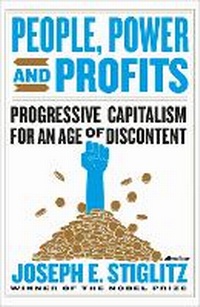
People, Power, and Profits
Progressive Capitalism for an Age of Discontent
Published on 23. April 2019
Book
Hardback
400 pages
978-0-241-39923-1 (ISBN)
Description
From Nobel Prize-winning economist and bestselling author Joseph Stiglitz, this account of the dangers of free market fundamentalism reveals what has gone so wrong, but also shows us a way out.
We all have the sense that our economy tilts toward big business, but as Joseph E. Stiglitz explains in People, Power and Profits, a few corporations have come to dominate entire sectors, contributing to skyrocketing inequality and slow growth. This is how the financial industry has managed to write its own regulations, tech companies have accumulated reams of personal data with little oversight, and government has negotiated trade deals that fail to represent the best interests of workers. Too many have made their wealth through exploitation of others rather than through wealth creation. If something isn't done, new technologies may make matters worse, increasing inequality and unemployment.
Stiglitz identifies the true sources of wealth and increases in standards of living, based on learning, advances in science and technology, and the rule of law. He shows that the assault on the judiciary, universities, and the media undermines the very institutions that have long been the foundation of economic prosperity and democracy.
Helpless though we may feel today, we are far from powerless. In fact, the economic solutions are often quite clear. We need to exploit the benefits of markets while taming their excesses, making sure that markets work for people and not the other way around. If enough rally behind this agenda for change, we can create a progressive capitalism that will recreate a shared prosperity. Stiglitz shows how a decent middle-class life can once again be attainable by all.
We all have the sense that our economy tilts toward big business, but as Joseph E. Stiglitz explains in People, Power and Profits, a few corporations have come to dominate entire sectors, contributing to skyrocketing inequality and slow growth. This is how the financial industry has managed to write its own regulations, tech companies have accumulated reams of personal data with little oversight, and government has negotiated trade deals that fail to represent the best interests of workers. Too many have made their wealth through exploitation of others rather than through wealth creation. If something isn't done, new technologies may make matters worse, increasing inequality and unemployment.
Stiglitz identifies the true sources of wealth and increases in standards of living, based on learning, advances in science and technology, and the rule of law. He shows that the assault on the judiciary, universities, and the media undermines the very institutions that have long been the foundation of economic prosperity and democracy.
Helpless though we may feel today, we are far from powerless. In fact, the economic solutions are often quite clear. We need to exploit the benefits of markets while taming their excesses, making sure that markets work for people and not the other way around. If enough rally behind this agenda for change, we can create a progressive capitalism that will recreate a shared prosperity. Stiglitz shows how a decent middle-class life can once again be attainable by all.
More details
Language
English
Place of publication
London
United Kingdom
Publishing group
Penguin Books Ltd
Target group
College/higher education
Professional and scholarly
Dimensions
Height: 240 mm
Width: 162 mm
Thickness: 36 mm
Weight
629 gr
ISBN-13
978-0-241-39923-1 (9780241399231)
Copyright in bibliographic data and cover images is held by Nielsen Book Services Limited or by the publishers or by their respective licensors: all rights reserved.
Schweitzer Classification
Other editions
Additional editions
E-Book
04/2019
1st Edition
Penguin Books Ltd
€9.49
Available for download
Person
Joseph E. Stiglitz was Chairman of the President's Council of Economic Advisers 1995-7 and Chief Economist at the World Bank 1997-2000. He won the Nobel Prize for Economics in 2001 and is the bestselling author of Globalization and Its Discontents, The Roaring Nineties, Making Globalization Work, Freefall, The Price of Inequality, The Great Divide and The Euro, all published by Penguin.