

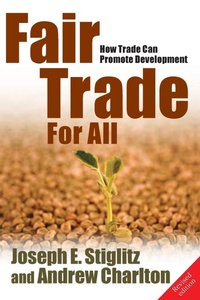
Fair Trade For All
How Trade Can Promote Development
Published on 26. July 2007
Book
Paperback/Softback
340 pages
978-0-19-921998-8 (ISBN)
Description
How can the poorer countries of the world be helped to help themselves through freer, fairer trade? In this challenging and controversial book Nobel prize-winning economist Joseph E. Stiglitz and his co-author Andrew Charlton address one of the key issues facing world leaders today. They put forward a radical and realistic new model for managing trading relationships between the richest and the poorest countries. Their approach is designed to open up markets in the interests of all and not just the most powerful economies, to ensure that trade promotes development, and to minimise the costs of adjustments. Beginning with a brief history of the World Trade Organisation and its agreements, the authors explore the issues and events which led to the failure of Cancun and the obstacles that face the successful completion of the Doha Round of negotiations. Finally they spell out the reforms and principles upon which a successful agreement must be based. Accessibly written and packed full of empirical evidence and analysis, this book is a must read for anyone interested in world trade and development.
Reviews / Votes
'A worthwhile read for anyone interested in trade and development.' * Diplomat *More details
Series
Language
English
Place of publication
Oxford
United Kingdom
Illustrations
23 figures and 32 tables
Dimensions
Height: 234 mm
Width: 156 mm
Thickness: 19 mm
Weight
518 gr
ISBN-13
978-0-19-921998-8 (9780199219988)
Copyright in bibliographic data and cover images is held by Nielsen Book Services Limited or by the publishers or by their respective licensors: all rights reserved.
Schweitzer Classification
Other editions
Additional editions
Book
12/2005
Oxford University Press
€58.60
Shipment within 15-20 days
Persons
Joseph E. Stiglitz was awarded the Nobel Prize in economics in 2001 and is University Professor at Columbia University where he founded the Initiative for Policy Dialogue in 2000. He was Chair of President Bill Clinton's Council of Economic Advisors from 1995-97 and Chief Economist and Senior Vice-President of the World Bank from 1997-2000.His best known recent publications include 'Making Globalization Work' (2006), 'Globalization and its Discontents' (2002) and 'The Roaring Nineties' (2003).
Andrew Charlton is a Research Officer at the London School of Economics. He has taught at Oxford University and been a consultant for the Initiative for Policy Dialogue, The United Nations Development Program and the OECD Development Centre.
Andrew Charlton is a Research Officer at the London School of Economics. He has taught at Oxford University and been a consultant for the Initiative for Policy Dialogue, The United Nations Development Program and the OECD Development Centre.
Content
Foreword ; Glossary ; 1. Introduction: The Story So Far ; 2. Trade Can Be Good for Development ; 3. The Need for a Development Round ; 4. What Has Doha Achieved? ; 5. Founding Principles: The Basis for a Fair Agreement ; 6. Special Treatment for Developing Countries ; 7. Priorities for a Development Round ; 8. How to Open Up Markets ; 9. Priorities Behind The Border ; 10. What Should Not Be On the Agenda? ; 11. Joining the Trading System ; 12. Institutional Reforms ; 13. Trade Liberalization and the Costs of Adjustment ; Appendix 1: Empirical Review of Market Access Issues ; Appendix 2: Empirical Review of the Singapore Issues