

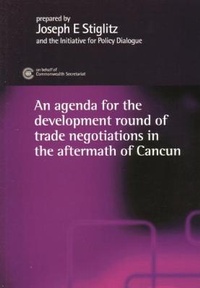
An Agenda for the Development Round of Trade Negotiations in the Aftermath of Cancun
Published on 1. October 2004
Book
Paperback/Softback
126 pages
978-0-85092-801-3 (ISBN)
Description
"It is an Advanced Industrial Country Round of what they think can pass as a Development Round. But we should not let them get away with it" Professor Joseph Stiglitz, Nobel Laureate. Awarded the 2001 Nobel Prize in Economics. This Commonwealth report presents the pro-development priorities that it recommends should form the core of the Doha Round agreements and sets out the key steps required for a true development round agenda. In the aftermath of the failure of Cancun, there is a need to reassess the direction of global trade negotiations. It argues that the Doha Round agenda was set by the special interests of advanced industrial countries to serve their own needs. The report takes a step back from the disputes and presents an alternative way forward for the Doha Round of trade negotiations, approaching the issues with a fresh eye. Professor Stiglitz calls for the fundamental reform of the agenda and negotiating process which they see as a requirement if the Doha Round is to deliver on its promise to bring widespread benefits to developing countries. This report is by Nobel Laureate Joseph Stiglitz, Columbia University and Andrew Charlton, Oxford University.
More details
Language
English
Place of publication
London
United Kingdom
Target group
Professional and scholarly
Illustrations
Illustrations
Dimensions
Height: 240 mm
Width: 165 mm
ISBN-13
978-0-85092-801-3 (9780850928013)
Copyright in bibliographic data and cover images is held by Nielsen Book Services Limited or by the publishers or by their respective licensors: all rights reserved.
Schweitzer Classification
Persons
Joseph Stiglitz was awarded the Nobel Prize in economics in 2001 and is a University Professor at Columbia University. He was Chief Economist and Senior Vice-President of the World Bank from 1997-2000 and Chair of President Bill Clinton's Council of Economic Advisors from 1995-97.
Content
Executive Summary 1. Introduction 2. The Need for a Development Round 2.1 Redressing Past Imbalances 2.2 Unfinished Business 2.3 New Area of Importance 3. Doha's Development So Far 4. Principles of a Development Round 4.1 Any Agreement Should Be Assessed in Terms of its Impact on Development 4.2 Any Agreement Should Be Fair 4.3 Any Agreement Should Be Fairly Arrived At 4.4 The Policy Space Should Be Interpreted Conservatively 4.5 Some Implications 5. Priorities for a Development Round 5.1 The Context 5.2 Market Access Priorities 5.3 Priorities in Non-market Access Issues 5.4 What Should Not Be on the Agenda 6. Special Issues 6.1 Special and Differential Treatment and the Development Box 6.2 Intellectual Property Issues 6.3 Competition Issues 6.4 Regional and Bilateral Trade Agreements and South-South Trade 7. Institutional Reforms 7.1 Procedures 7.2 Structures and Representation 8. A Practical Agenda Appendices 1. Empirical Review of Market Access Proposals 2. Regulatory Harmonisation: The Singapore Issues References