

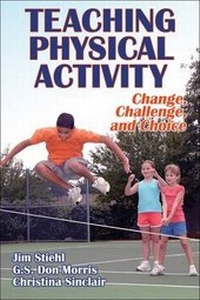
Teaching Physical Activity
Change, Challenge, and Choice
Published on 4. January 2008
Book
Paperback/Softback
232 pages
978-0-7360-5921-3 (ISBN)
Description
This book will help you get participants enthused about physical activity by giving them ownership. Teaching Physical Activity: Change, Challenge, and Choice guides you in designing activities and games through which you can meet your objectives while engaging all the participants in your class or group.
You engage all participants by creating healthy learning climates where everyone feels safe, capable, successful, motivated, and connected to others, and where they have a sense of ownership in the activities. And that's exactly what Teaching Physical Activity: Change, Challenge, and Choice helps you do. That ownership comes from the choices that participants make: First, participants choose from challenges that you offer them, which allow them some self-directed behavior. Second, at a more advanced level, participants can choose among options they generate themselves, imparting a greater sense of autonomy-and with it, a willingness to participate in a more personal and appropriate manner.
These choices result in changes-changes to games and activities and changes in the ways participants view being physically active. Kids will no longer fear being embarrassed in front of their peers; instead, they will welcome the challenges of a safe and fun learning environment and become more fully engaged. These ideas of choice and change are key ingredients in this book.
Other key ingredients include
-foundational material on teaching activities and games,
-45 ready-to-use games and activities to get you started right away, and
-numerous tips, ideas, and strategies to help you fully understand and implement this approach.
Part I lays a foundation for changing activities in ways that afford proper challenges to participants. It focuses on ways to maximize participation by relating participants' needs to the program goals, and it explores strategies for introducing change, challenge, and choice into your program. It also guides you in the type of communication necessary for successful implementation, and it details the steps involved in sharing decision making with participants. Part II includes 45 activities that feature change, challenge, and choice strategies you can apply with your participants. The activities span a variety of physical activity pursuits, such as dance, adventure, and sports.
Written by the leaders of the "changing kids' games" movement, Teaching Physical Activity: Change, Challenge, and Choice will help you engage all the participants under your charge, regardless of their levels of skill, fitness, and motivation. Your participants will benefit now, and the experience will pave the way for a lifetime of healthy physical activity.
You engage all participants by creating healthy learning climates where everyone feels safe, capable, successful, motivated, and connected to others, and where they have a sense of ownership in the activities. And that's exactly what Teaching Physical Activity: Change, Challenge, and Choice helps you do. That ownership comes from the choices that participants make: First, participants choose from challenges that you offer them, which allow them some self-directed behavior. Second, at a more advanced level, participants can choose among options they generate themselves, imparting a greater sense of autonomy-and with it, a willingness to participate in a more personal and appropriate manner.
These choices result in changes-changes to games and activities and changes in the ways participants view being physically active. Kids will no longer fear being embarrassed in front of their peers; instead, they will welcome the challenges of a safe and fun learning environment and become more fully engaged. These ideas of choice and change are key ingredients in this book.
Other key ingredients include
-foundational material on teaching activities and games,
-45 ready-to-use games and activities to get you started right away, and
-numerous tips, ideas, and strategies to help you fully understand and implement this approach.
Part I lays a foundation for changing activities in ways that afford proper challenges to participants. It focuses on ways to maximize participation by relating participants' needs to the program goals, and it explores strategies for introducing change, challenge, and choice into your program. It also guides you in the type of communication necessary for successful implementation, and it details the steps involved in sharing decision making with participants. Part II includes 45 activities that feature change, challenge, and choice strategies you can apply with your participants. The activities span a variety of physical activity pursuits, such as dance, adventure, and sports.
Written by the leaders of the "changing kids' games" movement, Teaching Physical Activity: Change, Challenge, and Choice will help you engage all the participants under your charge, regardless of their levels of skill, fitness, and motivation. Your participants will benefit now, and the experience will pave the way for a lifetime of healthy physical activity.
More details
Edition
New edition
Language
English
Place of publication
Champaign, IL
United States
Publishing group
Human Kinetics Publishers
Target group
Professional and scholarly
Primary & secondary/elementary & high school
Interest Age: From 18 to 99 years
Edition type
New edition
Product notice
Paperback (trade)
Illustrations
6
Dimensions
Height: 229 mm
Width: 152 mm
Weight
386 gr
ISBN-13
978-0-7360-5921-3 (9780736059213)
Copyright in bibliographic data and cover images is held by Nielsen Book Services Limited or by the publishers or by their respective licensors: all rights reserved.
Schweitzer Classification
Persons
Jim Stiehl, PhD, is a professor in the School of Sport and Exercise Science at the University of Northern Colorado. He has more than 30 years of experience working with kids and teachers and has experienced the successes and pitfalls of change, challenge, and choice with a variety of youngsters. Dr. Stiehl was Faculty Member of the Year in the College of Health and Human Sciences at the University of Northern Colorado in 2005, and he received the Scholar Award from the Central District of the American Alliance for Health, Physical Education, Recreation and Dance (AAHPERD) in 1993. He also was a co-recipient of a Research Writing Award from AAHPERD in 1991, and he is past chair of AAHPERD's council on outdoor education. During his professional career, Dr. Stiehl has taught physical education as well as elementary and special education classes. His favorite leisure activities are mountaineering, backpacking, rock climbing, and cycling.
G.S. Don Morris, PhD, is a professor at California State Polytechnic University at Pomona. Part of his past assignments included serving as coordinator of curriculum, instruction, and teacher education in kinesiology. Dr. Morris spent over 25 years teaching in local elementary schools, and he remains involved in ongoing research and intervention programs to enhance children's comprehensive health status. He also designed and created a model elementary PE curriculum used in many California school districts. He was a Fulbright scholar and a Marshall researcher. Currently he is associated with Wingate Institute and Zinman College in Israel and divides his time between Cal Poly Pomona and Zinman College. In his leisure time, he enjoys snow skiing, participating in all water activities, and spending time in the Sierra Nevada Mountains.
Christina Sinclair, PhD, is an associate professor in the School of Sport and Exercise Science at the University of Northern Colorado. She has worked as a teacher, coach, and teacher educator for 15 years, including firsthand experience in implementing programs of change, challenge, and choice among children in a variety of settings. A member of AAHPERD, she has presented at conferences and workshops on various topics. She enjoys playing tennis, camping in Colorado, going to the beach in Texas, and taking long walks and skiing in her leisure time.
G.S. Don Morris, PhD, is a professor at California State Polytechnic University at Pomona. Part of his past assignments included serving as coordinator of curriculum, instruction, and teacher education in kinesiology. Dr. Morris spent over 25 years teaching in local elementary schools, and he remains involved in ongoing research and intervention programs to enhance children's comprehensive health status. He also designed and created a model elementary PE curriculum used in many California school districts. He was a Fulbright scholar and a Marshall researcher. Currently he is associated with Wingate Institute and Zinman College in Israel and divides his time between Cal Poly Pomona and Zinman College. In his leisure time, he enjoys snow skiing, participating in all water activities, and spending time in the Sierra Nevada Mountains.
Christina Sinclair, PhD, is an associate professor in the School of Sport and Exercise Science at the University of Northern Colorado. She has worked as a teacher, coach, and teacher educator for 15 years, including firsthand experience in implementing programs of change, challenge, and choice among children in a variety of settings. A member of AAHPERD, she has presented at conferences and workshops on various topics. She enjoys playing tennis, camping in Colorado, going to the beach in Texas, and taking long walks and skiing in her leisure time.
Content
Preface
Acknowledgments
Part I: Basics of Change, Challenge, and Choice
Chapter 1: Maximizing Participation: The Three Cs
Beginning With Participant Needs
Relating Participants' Needs to Program Goals
Implementing Strategies to Maximize Participation
Summary
Chapter 2: Strategies to Introduce Change, Challenge, and Choice
Meeting the Needs of a Diverse Population
Strategies to Introduce Change
Strategies to Introduce Challenge
Strategies to Introduce Choice
Summary
Chapter 3: The Language of Choice
Effective Instructor Talk
Effective Discipline
Effective Participant Talk
Summary
Chapter 4: Sharing Decision Making
Phase 1: Identify the Need for Change
Phase 2: Demonstrate Some Changes
Phase 3: Grant Permission to Make Changes
Phase 4: Use the Five Categories
Phase 5: Alter the Degree of Difficulty
Phase 6: Offer Appropriate Choices
Summary
Part II: Examples of Change, Challenge, and Choice
Chapter 5: Games
Couples Races
Four-Corners Relay
Maple Hill Ball
Basketbowl
Four-Corners Volleyball
One Behind
Parts of Speech
Chapter 6: Adventure Activities
Toss-a-Name
Circle-the-Circle
Speed Rabbit
Switch, Change, Rotate
School Improvement
Iced Tea
Keypunch
Group Juggling
Traffic Jam
Chapter 7: Fitness Activities
Continuous Movement Program (CMP)
Around the Gym We Go
Swamp Tag
1, 2, 3 Dragon
Fitnessgram PACER Test
Fitness Cups
Station Folders
Muscle Universe
Health-Related Fitness Relay
Food Pyramid Challenge
Ab War
Aerobic Home Fun
Walk Across America Challenge
Chapter 8: Dance Activities
Ideas for Teaching Dance
Cooperative Boxaerobics
Time to Face the Music
Creative Four Corners
Chalk Walk
Seven Jumps
Tinikling
Chapter 9: Sport and Recreational Activities
Volleybird
Kickball Over a Net
Rugsby
Bocce
Bocce Pole
Dodgeball
Tapu-Ae
Tchoukball
Kwik Cricket
Korfball
Appendix
Bibliography
Index
About the Authors
Acknowledgments
Part I: Basics of Change, Challenge, and Choice
Chapter 1: Maximizing Participation: The Three Cs
Beginning With Participant Needs
Relating Participants' Needs to Program Goals
Implementing Strategies to Maximize Participation
Summary
Chapter 2: Strategies to Introduce Change, Challenge, and Choice
Meeting the Needs of a Diverse Population
Strategies to Introduce Change
Strategies to Introduce Challenge
Strategies to Introduce Choice
Summary
Chapter 3: The Language of Choice
Effective Instructor Talk
Effective Discipline
Effective Participant Talk
Summary
Chapter 4: Sharing Decision Making
Phase 1: Identify the Need for Change
Phase 2: Demonstrate Some Changes
Phase 3: Grant Permission to Make Changes
Phase 4: Use the Five Categories
Phase 5: Alter the Degree of Difficulty
Phase 6: Offer Appropriate Choices
Summary
Part II: Examples of Change, Challenge, and Choice
Chapter 5: Games
Couples Races
Four-Corners Relay
Maple Hill Ball
Basketbowl
Four-Corners Volleyball
One Behind
Parts of Speech
Chapter 6: Adventure Activities
Toss-a-Name
Circle-the-Circle
Speed Rabbit
Switch, Change, Rotate
School Improvement
Iced Tea
Keypunch
Group Juggling
Traffic Jam
Chapter 7: Fitness Activities
Continuous Movement Program (CMP)
Around the Gym We Go
Swamp Tag
1, 2, 3 Dragon
Fitnessgram PACER Test
Fitness Cups
Station Folders
Muscle Universe
Health-Related Fitness Relay
Food Pyramid Challenge
Ab War
Aerobic Home Fun
Walk Across America Challenge
Chapter 8: Dance Activities
Ideas for Teaching Dance
Cooperative Boxaerobics
Time to Face the Music
Creative Four Corners
Chalk Walk
Seven Jumps
Tinikling
Chapter 9: Sport and Recreational Activities
Volleybird
Kickball Over a Net
Rugsby
Bocce
Bocce Pole
Dodgeball
Tapu-Ae
Tchoukball
Kwik Cricket
Korfball
Appendix
Bibliography
Index
About the Authors