

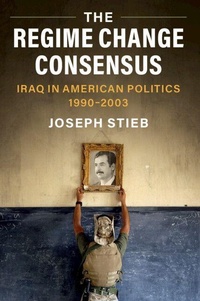
The Regime Change Consensus
Iraq in American Politics, 1990-2003
Published on 15. December 2022
Book
Paperback/Softback
282 pages
978-1-108-97838-5 (ISBN)
Description
Why did the United States invade Iraq, setting off a chain of events that profoundly changed the Middle East and the US global position? The Regime Change Consensus offers a compelling look at how the United States pivoted from a policy of containment to regime change in Iraq after September 11, 2001. Starting with the Persian Gulf War, the book traces how a coalition of political actors argued with increasing success that the totalitarian nature of Saddam Hussein's regime and the untrustworthy behavior of the international coalition behind sanctions meant that containment was a doomed policy. By the end of the 1990s, a consensus belief emerged that only regime change and democratization could fully address the Iraqi threat. Through careful examination, Joseph Stieb expands our understanding of the origins of the Iraq War while also explaining why so many politicians and policymakers rejected containment after 9/11 and embraced regime change.
Reviews / Votes
'Stieb's insightful and deeply researched new book shows how the quest to salve the lingering sore of Iraq after 1991 led to the outright bloody mess of invasion, occupation, and desperation after 2003. That scar will not soon heal. No issue more haunts American policymakers today than the question of how, if ever, to deploy force to expand the roster of democratic states, and Stieb's work is simply the best source we have for understanding how regime change came into vogue, before it fell into disrepute.' Jeffrey A. Engel, Director of the Center for Presidential History, Southern Methodist University 'What possessed policymaking elites to trigger the American march to war, and enact regime change in Iraq? The Regime Change Consensus provides a comprehensive answer to this essential question.' Michael MacDonald, Williams College 'Using archival research to deepen the portrait offered by previous accounts, Stieb traces the meandering history of US policy toward Iraq and explains why, after 9/11, the US debate over Iraq quickly coalesced around regime change. Anyone seeking to understand US policy toward Iraq in this period should add The Regime Change Consensus to their reading list.' Michael J. Mazarr, author of Leap of Faith: Hubris, Negligence, and America's Greatest Foreign Policy Tragedy 'Joseph Stieb persuasively shows that the 2003 Iraq War was not simply a misdirected response to 9/11. It occurred also because the prior US policy of containing Iraq, though largely successful, had lost credibility at home. This provocative analysis is essential reading for students and scholars of recent international history.' Salim Yaqub, author of Imperfect Strangers: Americans, Arabs, and US-Middle East Relations in the 1970s 'Joseph Stieb's sober book is a welcome addition to this growing literature.' Ray Takeyh, Survival 'This is an excellent book ... Each study is insightful and well-researched ... It should be purchased, read, assigned, and debated.' David Palkki, H-Diplo roundtable XXIII-46 '... Joseph Stieb provides an incredibly important service to the field of US foreign relations by centering his work on the prewar period, demonstrating that the invasion option had already coalesced before ... The book is therefore more of a political and intellectual history than traditional military history ... the book therefore strives to illuminate the overlooked story of the delegitimization of containment.' Michelle Paranzino, H-Diplo roundtable XXIII-46 '... No doubt, it is well-researched, effectively organized, and carefully considered ... The book is particularly valuable in the author's unearthing of another layer of relevant primary documents from presidential libraries and the National Archives. Stieb's narrative has commendable coherence, clarity, and simplicity. The book's title says it all, and for this reason, it is sure to make a major impact on the field.' Andrew Flibbert, H-Diplo roundtable XXIII-46More details
Series
Language
English
Place of publication
Cambridge
United Kingdom
Target group
Professional and scholarly
College/higher education
Product notice
Paperback (trade)
Illustrations
Worked examples or Exercises
Dimensions
Height: 229 mm
Width: 152 mm
Thickness: 17 mm
Weight
462 gr
ISBN-13
978-1-108-97838-5 (9781108978385)
Copyright in bibliographic data and cover images is held by Nielsen Book Services Limited or by the publishers or by their respective licensors: all rights reserved.
Schweitzer Classification
Other editions
Additional editions
Book
07/2021
Cambridge University Press
€67.10
Shipment within 15-20 days
Person
Joseph Stieb is Assistant Professor of National Security Affairs at the U.S. Naval War College. His articles and essays can be found in Diplomatic History, Modern American History, The International History Review, War on the Rocks, The Washington Post, Foreign Policy, and American Purpose.
Content
Introduction: 1. A Hope, Not a Policy: Containment and Regime Change During the Gulf Crisis, 1990-1991; 2. The Fallout From Victory: Containment and its Critics, 1991-1992; 3. The Long Watch: The High Years of Containment 1994-1996; 4. Saddam Must Go: Entrenching the Regime Change Consensus, 1997-2000; 5. Not Whether, But How and When: The Iraq Debate from 9/11 to the Invasion; Conclusion: Containment, Liberalism and the Regime; Bibliography; Index.